🥕 Vegetable Yield Calculator
Convert purchase weight into trimmed prep, cooked yield, servings, waste, and buffer for real kitchen planning.
Choose whether you are starting from a target serving count, a cooked weight goal, a prepared weight goal, or a purchase amount already on hand.
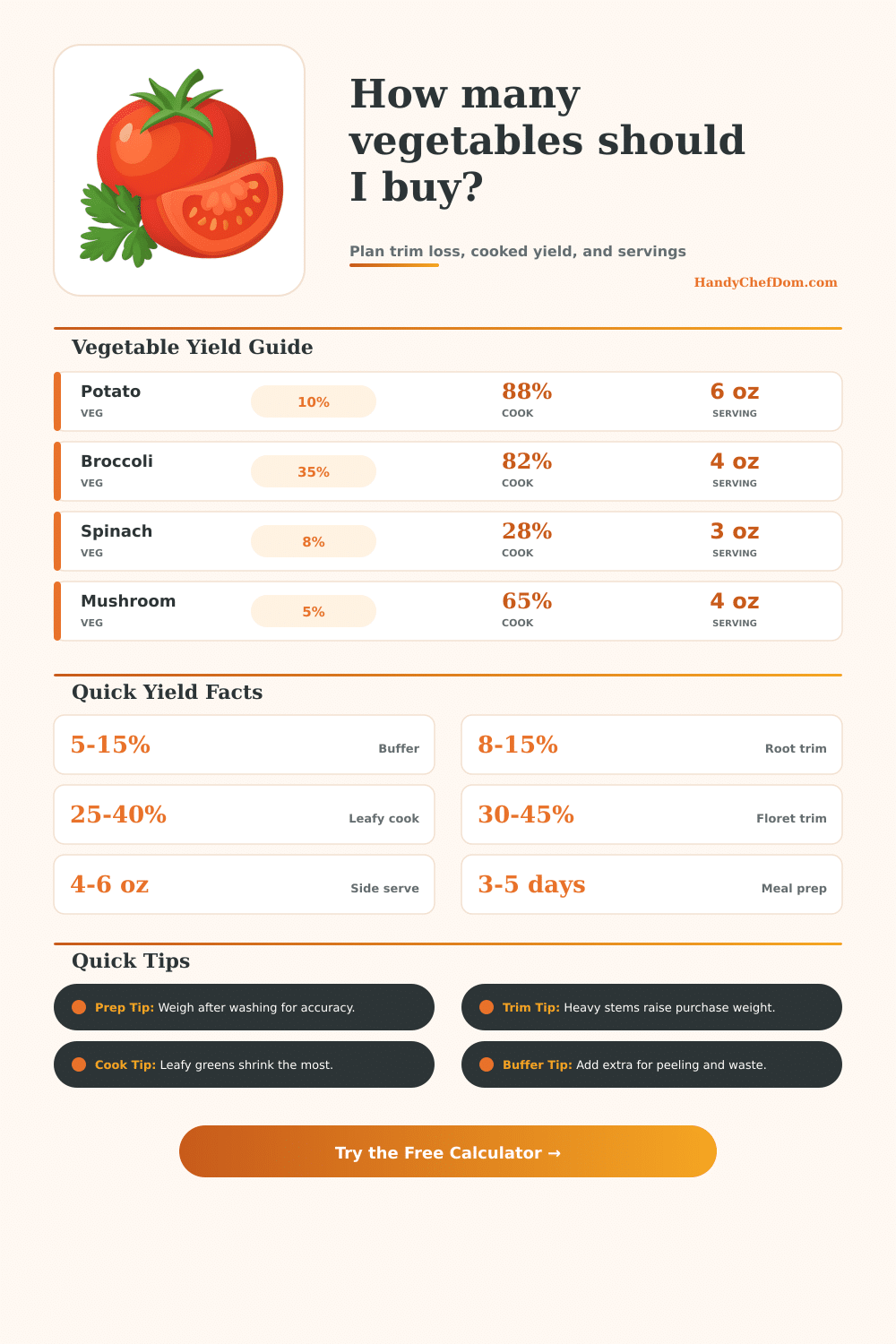
| Vegetable | Typical Trim Loss | Raw Prep Yield | Trim Notes |
|---|---|---|---|
| Potato, peeled chunks | 8% to 15% | 85% to 92% | Peels, eyes, bruises |
| Broccoli, crowns and stems | 30% to 40% | 60% to 70% | Woody stem ends |
| Cauliflower, whole head | 35% to 45% | 55% to 65% | Core and leaves |
| Carrot, peeled sticks | 10% to 18% | 82% to 90% | Peels and tops |
| Onion, peeled dice | 10% to 16% | 84% to 90% | Skin and root end |
| Bell pepper, strips | 15% to 25% | 75% to 85% | Seeds, stem, ribs |
| Vegetable | Cooked Yield | Best Use | Serving Cue |
|---|---|---|---|
| Potato | 85% to 92% | Roasted side | 5 to 7 oz |
| Broccoli | 78% to 86% | Steamed side | 3 to 5 oz |
| Spinach | 25% to 35% | Cooked greens | 2 to 4 oz |
| Mushroom | 58% to 70% | Sauteed topping | 3 to 5 oz |
| Green bean | 82% to 90% | Trimmed side | 4 to 5 oz |
| Zucchini | 62% to 75% | Grilled slices | 4 to 6 oz |
| Serving Plan | Light Side | Standard Side | Generous Side |
|---|---|---|---|
| Dinner for 4 | 1.0 lb cooked | 1.25 lb cooked | 1.5 lb cooked |
| Family of 6 | 1.5 lb cooked | 1.9 lb cooked | 2.25 lb cooked |
| Party of 12 | 3.0 lb cooked | 3.75 lb cooked | 4.5 lb cooked |
| Gathering of 25 | 6.25 lb cooked | 7.8 lb cooked | 9.4 lb cooked |
| Event for 50 | 12.5 lb cooked | 15.6 lb cooked | 18.8 lb cooked |
| Meal prep 10 | 2.5 lb cooked | 3.1 lb cooked | 3.75 lb cooked |
| Purchase Check | Low Buffer | Normal Buffer | High Buffer |
|---|---|---|---|
| Very clean produce | 3% | 5% | 8% |
| Average market produce | 5% | 10% | 15% |
| Uneven sizes | 8% | 12% | 18% |
| Bulk prep crew | 10% | 15% | 20% |
| Leafy greens | 10% | 15% | 25% |
| Large event | 8% | 12% | 18% |
A vegetable yield calculator is an tool that will assist in calculating the weight loss that occurs from preparing and cooking vegetables. The weight of vegetables when they is purchased is often more higher than the weight of the vegetables that are cooked and eaten. The weight of vegetables can decrease due to a necessity of removing parts of vegetables that are not edible, and vegetables can also lose moisture when they are cooked.
A vegetable yield calculator account for the loss of vegetables due to trimming and cooking losses, so that cooks know how much vegetables they must purchase to account for these losses. To use the vegetable yield calculator, a cook must first select the planning mode that the cook will use in the calculation. Planning modes can be selected based upon the number of servings that are to be prepared, the finished cooked weight of the vegetable, or the raw prepped weight of the vegetable that is to be prepared.
How a Vegetable Yield Calculator Works
Each of these mode will alter the calculation that the calculator performs. In addition, cooks can select the percentage of trim loss and cooked yield, which will allow for the calculation to account for the specific type of vegetables that are to be purchased. Trim loss is the weight of vegetables that is lost when preparing the vegetables.
For instance, root vegetables will lose weight if the peel are removed, and broccoli will lose weight if the stems is removed. Leafy vegetables will lose little weight when trimmed, but lose a great deal of weight when cooked. Trim loss and cooked yield are treated as separate category within the vegetable yield calculator, as trimming always occurs prior to cooking.
By choosing a high trim loss setting on the calculator, cooks will know that cooks must purchase more vegetables then the calculated amount to account for weight loss during the trimming process. Cooked yield is the weight of vegetables after they are cooked. Vegetables will lose weight during the cooking process when the vegetables release the water that they contains.
Vegetables like zucchini and mushrooms will lose a great deal of water when cooked, and thus have a low cooked yield. Vegetables like potatoes will have a more higher cooked yield than vegetables like zucchini or mushrooms. The vegetable yield calculator will calculate how much raw vegetable are required for cooks to reach the desired cooked vegetable weight, thus preventing cooks from purchasing vegetables that may not meet the needs of the cook and recipe.
In addition to the calculations within the vegetable yield calculator, cooks may also incorporate a buffer percentage to account for unexpected needs or vegetable error. For instance, if a cook is preparing vegetables for a large group, a cook may utilize a high percentage to account for the fact that some vegetables may be bruised or have other issue that prevent them from being utilized in the dish. A buffer percentage can be utilized in the vegetable yield calculator in the same way as the other parameter.
The vegetable yield calculator will calculate the total weight of vegetables that must be purchased with the buffer percentage, and will round that number to the amount of each unit size of vegetables that cooks need to purchase. Common mistake may be made by cooks that treat all vegetables as if they are the same. For instance, cooks may purchase the same weight of spinach as they would purchase for potatoes.
If cooks ignore the buffer for vegetables that may be unusable, they may not have enough vegetables for there cook. If cooks only account for the weight of cooked vegetables but do not account for the trim loss of vegetables prior to cooking, cooks will not purchase the correct amount of raw vegetables. These mistakes can be avoided by the use of the vegetable yield calculator, which provides cooks with the raw vegetables weight, the prepped weight of vegetables, and the cooked weight of vegetables.
Regular use of the vegetable yield calculator will allow cooks to more thoroughy understand how cooks prepare there vegetables. For instance, cooks can recognize that the trim loss of vegetables that they use is more higher than the default settings, or that their cooked yield is lower than the default settings due to their cooking time. These variable can be adjusted within the vegetable yield calculator to provide cooks with the best estimates for vegetable purchases.
Thus, vegetable yield calculator remove the guesswork that cooks must put into determining the amount of vegetables that is needed.