💧 Water Content in Food Calculator
Estimate water grams, dry matter, moisture percent, cooked or dehydrated yield, serving water, and target finished weight from food type, raw weight, method, and measured finish weight.
Choose a food, enter the raw edible weight, and add either a measured cooked or dehydrated weight or a target moisture. Dry matter is conserved, so the tool can estimate yield, water removed, and finished weight.
Moisture values are representative food-composition planning numbers. Exact foods vary by variety, trim, ripeness, salt, sugar, cooking endpoint, drained weight, and drying completeness.
| Food Type | Starting Moisture | Common Finished Moisture | Best Calculator Use |
|---|---|---|---|
| Apple slices | About 86% | 84% fresh or 15% to 25% dried | Fresh snack portions, dehydrated rings, and lunch box slices. |
| Banana | About 75% | 72% fresh or 12% to 20% dried | Banana chips, smoothie prep, and weighed fruit portions. |
| Tomato | About 94% | 88% roasted or 15% to 25% dried | Roasted tomatoes, drying trays, and sauce ingredient planning. |
| Mushrooms | About 92% | 82% sauteed or 8% to 12% dried | Saute pans, soup prep, and dried mushroom jars. |
| Chicken breast | About 74% | 62% to 68% cooked | Meal prep portions, roast yield, and serving water estimates. |
| Lean beef | About 71% | 58% to 66% cooked | Steaks, roast slices, ground beef yield, and jerky batches. |
| Cooked rice | About 69% | 68% to 72% cooked | Hydrated grain portions and water gain from dry rice. |
| Plain yogurt | About 88% | 76% to 82% strained | Greek-style straining, whey loss, and dairy solids concentration. |
| Method | Typical Yield | Moisture Direction | Planning Note |
|---|---|---|---|
| No cooking or drying | 100% | No intentional change | Use for fresh fruit, raw vegetables, chilled dairy, and measured snack portions. |
| Boil, simmer, or steam | 95% to 220% | Can gain water | Grains and legumes absorb water; vegetables may hold or lose depending on draining. |
| Pan cook or saute | 60% to 85% | Usually loses water | Useful for mushrooms, ground meat, fish, and small vegetable batches. |
| Roast or bake | 55% to 80% | Loses surface water | Works for potatoes, poultry, beef, tomatoes, and sheet-pan foods. |
| Strain, drain, or press | 45% to 85% | Removes free water | Best for yogurt, tofu, wet vegetables, and foods packed in liquid. |
| Dehydrator or low oven | 8% to 45% | Large water loss | Use target moisture to estimate dried fruit, herbs, mushrooms, tomatoes, and jerky. |
| Food Scenario | Raw Weight | Finished Goal | Water Change |
|---|---|---|---|
| Apple slices, fresh serving | 8 oz raw | 8 oz served | About 195 g water in the serving. |
| Tomatoes, oven dried | 2 lb raw | About 5 to 7 oz dried | Most starting water leaves the tomato flesh. |
| Chicken breast, roasted | 2 lb raw | About 1.4 to 1.6 lb cooked | Water loss concentrates protein per ounce. |
| Dry rice to cooked rice | 1 cup dry | About 3 cups cooked | Rice gains water during starch hydration. |
| Yogurt, strained | 32 oz plain yogurt | About 18 to 24 oz thick yogurt | Whey drainage removes water and lactose-rich liquid. |
| Fresh herbs, dried | 4 oz fresh | About 0.6 to 0.9 oz dried | Leaves lose most water but keep aromatic solids. |
| Target Moisture | Food Examples | Texture Cue | Calculator Meaning |
|---|---|---|---|
| 80% to 95% | Fresh fruit, yogurt, tomatoes | Juicy, soft, or spoonable | Most finished weight is still water. |
| 60% to 75% | Cooked meats, baked potato, cooked rice | Tender, hydrated, ready to serve | Water remains important but solids are concentrated. |
| 30% to 45% | Soft jerky, fruit leather, thick strained dairy | Chewy, dense, flexible | Finished weight is close to half water and half solids. |
| 15% to 25% | Dried apples, tomatoes, firm jerky | Leathery or firm | Most water is removed; nutrients are denser per ounce. |
| 8% to 12% | Dried herbs, dried mushrooms, crisp chips | Brittle, crisp, or crackly | Finished weight is mostly dry matter. |
| Under 5% | Freeze-dry style finish | Very light and crisp | Requires careful measurement; small errors matter. |
So it’s not unreasonable to weigh a tray full of apples before drying. But what about when you take them from dehydrator? Why weigh them then? You know they’ve lost water. And that they’re a lot lighter now. And knowing exactly how much water came out, and what’s still in there, make all the difference. That makes the difference between guessing and planning your pantry.
Weight isn’t everything, it’s all about moisture Most people thinks of food weight as a single number. Weight is not a singular value. It’s a combination of two values. One value is moisture. And one value is dry matter. Dry matter are made up of fat, fiber, protein, sugars, etc.
Why You Should Weigh Your Food
Enter your raw weight into the calculator. Enter your finished weight. It does the math for you. No need to guess at conversions or coefficients.
The basic idea is that you cannot cook away the solids in your food, like bananas or chicken breast. Cooking may boil off some water, or make something drain out. It will concentrate what’s left into a smaller total amount. The two pounds of raw chicken (which happens to be seventy-four percent water) contain a specific amount of protein and fat. Those are the same number of grams that remain even when the chicken shrink to one-and-a-half pounds when roasted. They’re simply closer together.
The strong effect impacts both nutrition density and portion control. For example, a dried strawberry contains much more sugar per ounce compared to it’s fresh counterpart. There is no added sugar. It is just water removal. The calculator clearly shows you that change. It identifies the weight of solids versus water. This helps you understand what is shifting.
The real reward from this mathematical exercise come in understanding yield. How many snacks will your road trip get you? You’re going to make some beef jerky. What size should you purchase that block of raw meat? Here’s one example: Two pounds of lean beef may result in less than half a pound of finished product. Ouch. Meat contains a lot of water by nature. The water has to go and it concentrates the protein along the way, but it shrinks the size down big-time.
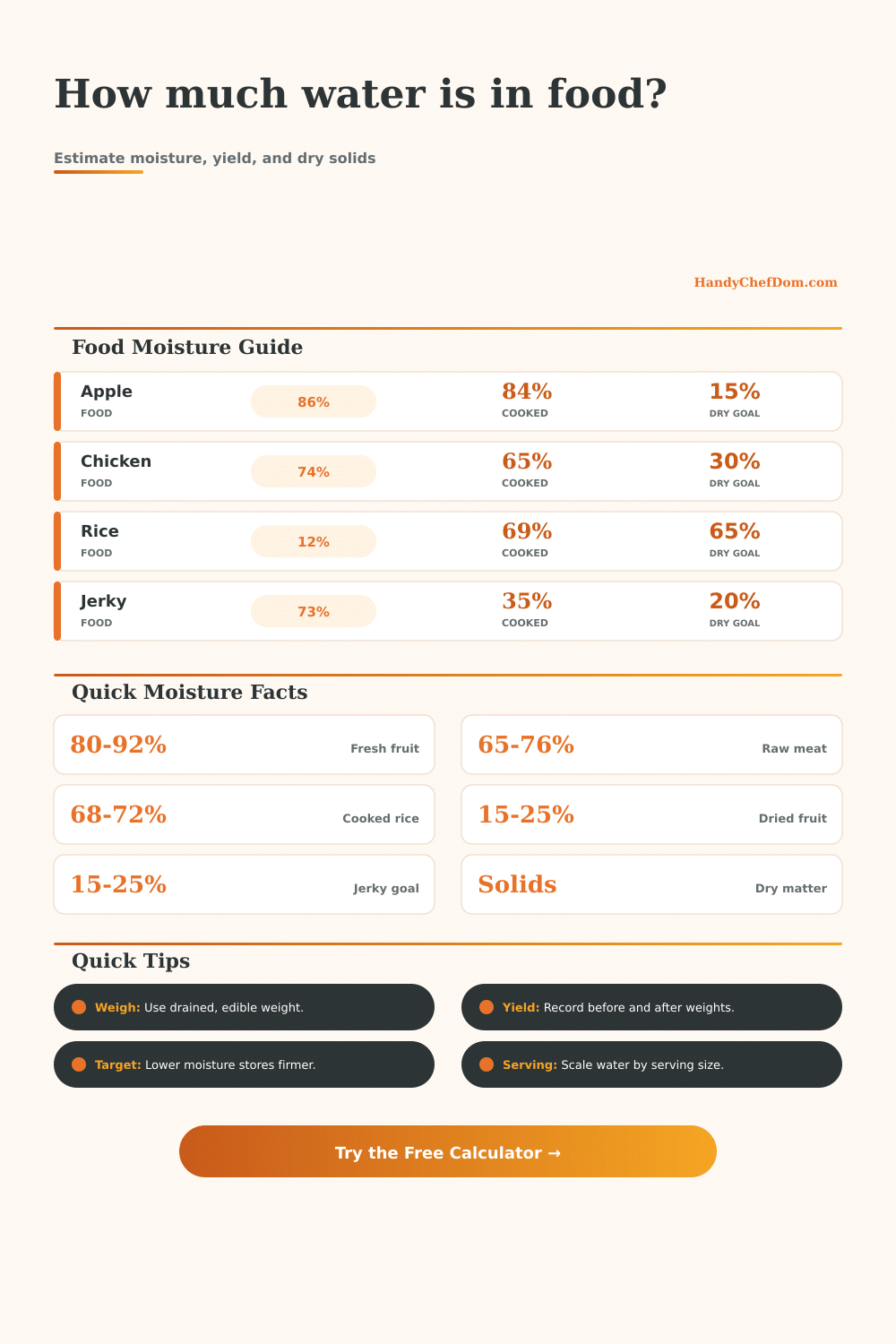
This chart, available on the page, makes it clear how most food works. Rice does not. Raw rice is mostly starch and a tiny amount of water. Cooking it takes up liquid. Its volume triples. But its moisture goes up from twelve percent to almost seventy. The amount of solids remain unchanged. Adding water instead of removing it adds weight to the overall mass.
It also depends on how you cook. If you boil a potato, it remains hydrated. But if you roast the same potato, it sheds its surface moisture. You can choose your cooking method with the tool. That shifts your expectations. It’s aware of how fast the water in sauteed mushrooms escape from inside them. Freezing and drying may preserve more structure.
One thing people often do wrong is using cups as their unit of measurement instead of weighing things. Fresh herbs are not the same as dried ones; there’s just to much water in one versus the other. One cup of dried basil is compacted leaf matter. One cup of fresh basil is mostly water and air. To compare apples with apples, you must weigh them.
In the tool, you’ll notice we have added a serving size option. This can be helpful if you’re meal prepping. For example, you may want to know how much water is in each serving. This is useful if you are cooking chicken and dividing it into portions for the week. You get a better idea of what the nutrient density actualy is. It removes the illusion of “this larger amount must be more.” It might simply be wetter. The variable is water. The constant is what’s in it: the solids.
Monitor the water lost/gained to take control. Take control of nutrition, texture and shelf life. Eliminate guesswork: why was my jerky so soft? Why is that dried fruit too hard? Adjust the target moisture and trust the scale. Weigh the raw food. Weigh the finished food. Let the water do the talking.