Cake Batter Weight Calculator
Plan exact batter weight by pan geometry, fill ratio, batter density, and production loss so every layer, loaf, sheet, and cupcake tray scales with less guesswork.
Choose a sizing mode first. Pan mode estimates batter mass from pan volume and fill level. Target mode estimates how many pans a known batter batch can fill using the same geometry and density assumptions.
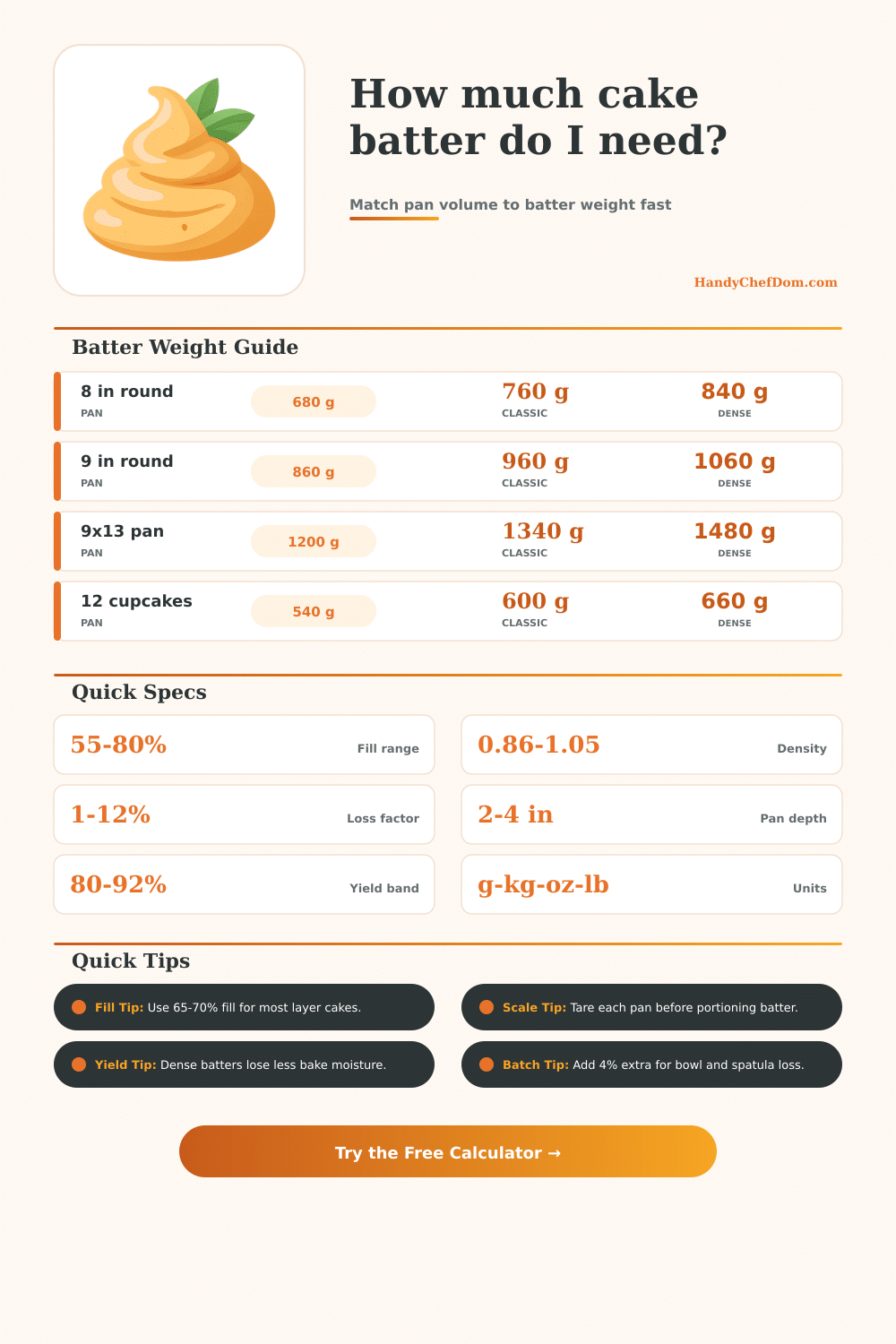
| Pan Format | Pan Volume | 67% Fill | Classic Batter |
|---|---|---|---|
| 8 in round x 2 in | 1640 ml | 1099 ml | 1090-1175 g |
| 9 in round x 2 in | 2080 ml | 1394 ml | 1380-1490 g |
| 9x13 in sheet x 2 in | 3830 ml | 2566 ml | 2540-2740 g |
| 8x4 in loaf | 1510 ml | 1012 ml | 1000-1080 g |
| 10 cup bundt | 2365 ml | 1585 ml | 1570-1700 g |
| 12 cupcakes | 850 ml | 570 ml | 560-610 g |
| Raw Batter | Baked Yield | Loss Range | Common Use |
|---|---|---|---|
| 600 g | 510-555 g | 7-15% | 12 cupcakes |
| 950 g | 815-885 g | 7-14% | One 9 in layer |
| 1400 g | 1210-1310 g | 6-14% | Two 8 in layers |
| 2000 g | 1740-1880 g | 6-13% | Bundt or loaf set |
| 2800 g | 2440-2640 g | 6-13% | 9x13 plus bonus |
| 4200 g | 3670-3950 g | 6-12% | Event batch |
| Guests | Light Cake | Classic Cake | Dense Cake |
|---|---|---|---|
| 8 | 700 g batter | 820 g batter | 940 g batter |
| 16 | 1450 g batter | 1680 g batter | 1940 g batter |
| 24 | 2200 g batter | 2550 g batter | 2950 g batter |
| 36 | 3350 g batter | 3880 g batter | 4480 g batter |
| 50 | 4650 g batter | 5400 g batter | 6240 g batter |
| 80 | 7420 g batter | 8600 g batter | 9950 g batter |
Calculating the weight of cake batter is important because the weight of cake batter determines whether the cake will bake even. If the weight of the cake batter isnt correct, the cake may dome too much during baking or the cake may sink in the middle of the cake. Many people attempt to guess the weight of the cake batter.
However, guessing the weight of cake batter often lead to baking mistakes. The calculator on this page allow you to calculate the correct weight of the cake batter by entering the shape and dimension of the cake pan that you will use to bake the cake. The calculator requires the entry of the fill percentage of the cake pan.
How to calculate the weight of cake batter
The fill percentage determines the amount of room that the cake will have to rise within the pan. Standard layer cakes require a fill percentage of two third. However, dense cakes may require a fill percentage of three quarters.
The dimensions of the cake pan are used to find the volume of the cake pan. The volume is multiplied by the density of the cake batter to find the weight of the cake batter. The density of the cake batter is a factor because different cakes has different weights for the same amount of volume.
Pound cakes tend to have a high density in comparison with other types of cakes. Chiffon cakes have a low density compared with other types of cakes. The yield factor that is incorporated into the cake batter weight calculator takes into account the amount of moisture that the cake batter will lose during the baking process.
By using the yield factor, the calculator can determine the weight of the cake after baking. The weight of the cake after baking can be used to determine the number of serving that the cake will provide. The weight of each slice of cake can be entered into the calculator to determine the total number of slices of cake that the finished cake will provide.
The planning mode for the cake batter weight calculator can be changed to change the direction of the mathematical calculation that occurs within the calculator. In one mode, you can enter the dimensions of the cake pan to calculate the weight of the cake batter that will fill the pan. The other mode of the calculator allows you to enter the weight of the cake batter batch to determine the number of pans that can be filled with that batch of batter.
This planning mode is useful for individuals that have already mixed a batch of cake batter and who wish to know how many pans can be filled with the mixed batter. The density and fill percentage of the cake will remain the same within each planning mode. When filling cake pans with batter, it is common for process loss to occur between the bowl and the cake pan.
Process loss is the amount of batter that remains on the spatula or within the piping bag. A percentage for process loss can be entered into the calculator to account for the batter that will be lost during the process of filling the cake pan. If you use piping bags to fill the cake pans, a higher percentage can be accounted for process loss.
Piping bags tend to hold some of the batter within them. If pouring the batter into the cake pans, the process loss percentage can be lower because less of the batter will remain on the spatula. Although the cake batter calculator is the main calculating tool on this page, there are also reference tables that can assist bakers in their planning.
The reference tables are not a replacement for the calculator. However, they do provide a general idea of the amount of cake batter that is required based on the size of the cake pan. For example, an eight-inch round pan will require less batter than a nine-inch round pan.
A cake that is prepared to feed fifty people will require more batter than a cake that is prepared to feed twenty four people. There are a number of variables that may affect the height of the cake that is baked in the oven and that the calculator cannot account for. For instance, the hot spots within the oven may affect the rise of the cake.
Additionally, the material of the cake pan can also affect the bake of the cake. Dark metal cake pans will heat to the cooking temperature faster than light metal cake pans. Due to the increased heating of the dark metal pans, the edges of the cake may bake faster than the center of the cake.
Pans made of glass or ceramic will retain the heat longer than metal pans. This longer retention of heat within the pan could lead to a reduction of the baking temperature of those pans. The altitude at which you are to bake the cake can also affect the rise of the cake.
At high altitudes, the air pressure within the atmosphere is lower than at sea level. Due to the lower air pressure, cakes will rise higher within the pan. This effect of high altitudes could require the reduction of the fill percentage of the pan to ensure that the cake does not rise too high within the pan.
Thus, while the calculator will provide the initial volume setting for the cake pans, adjustments to that setting must be made according to the altitude at which the baking will occur. The temperature at which you mixed the ingredients to the cake could also affect the density of the cake batter. If the ingredients were cold, such as butter or eggs, the batter will thicken.
The thicker the batter is, the higher the density. Because the density of the batter will be higher than the density that is entered into the calculator, the weight of the batter will be higher than that which is calculated. Adjustments to the density setting may have to be made if the recipe calls for the use of cold ingredients.
The portioning benchmarks provided on this page are based on the weight of one serving of cake. For birthday cakes, one serving of cake will weigh between eighty five and one hundred five grams. Coffee cakes may weigh less than cakes that are prepared for birthdays.
Cupcakes have different portioning needs than other cakes. This is due to the weight of the paper liner and the domed top of the cupcake. The calculator will calculate the weight of cake batter.
However, the baker is responsible for determining how much weight of cake should be provided to each guest. By planning for the weight of cake batter that will be used to bake a cake, bakers can avoid having to make changes to the recipe. By determining the weight of cake batter that is necessary to bake the number of cakes that are to be served, the baker can mix the cake batter once and portion it.
This ability to calculate the weight of cake batter allows for the baker to be more predictable when preparing cakes for a large group of guests. The calculator automates the mathematical calculations so that the baker can focus upon baking the cake.