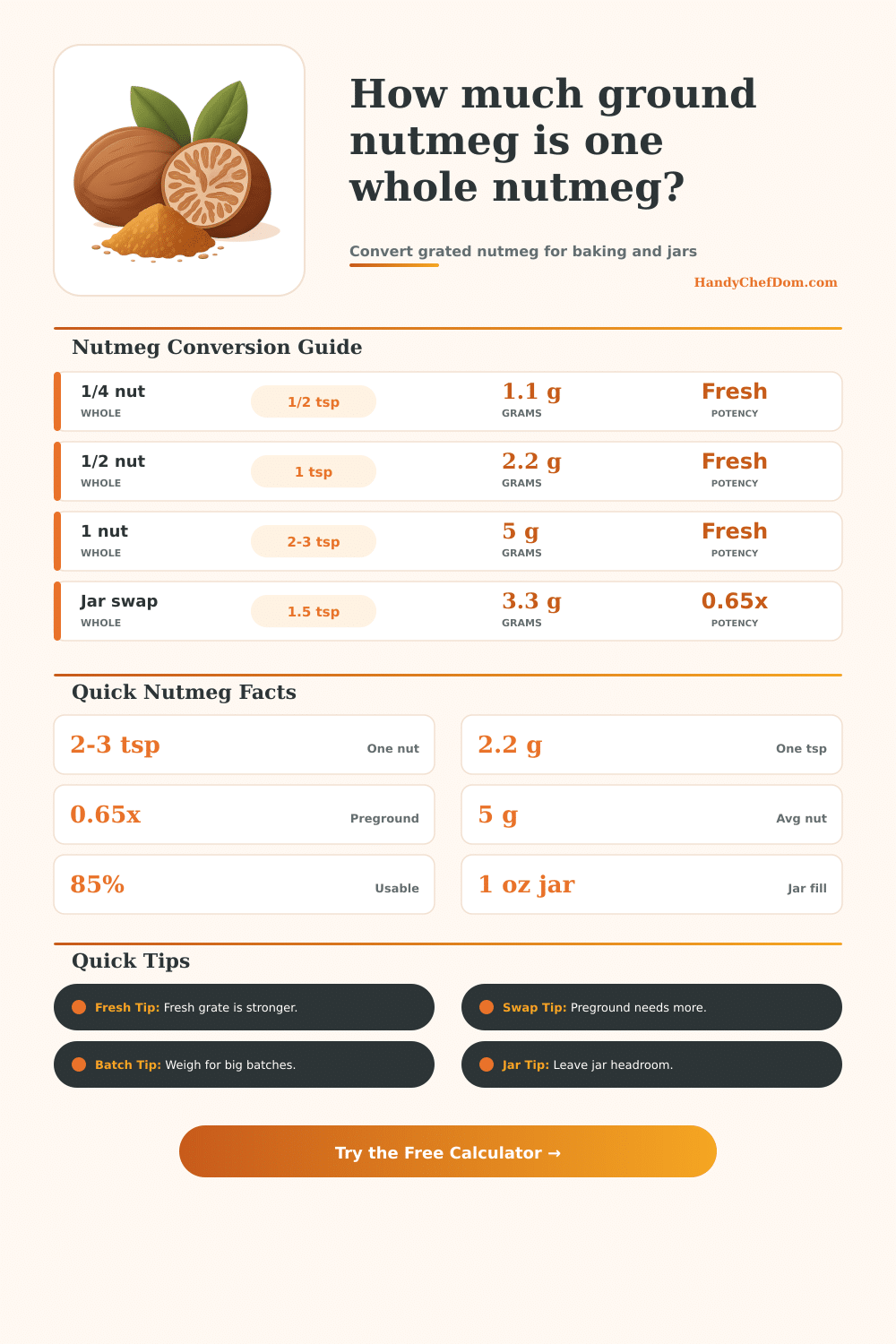
🌰 Whole Nutmeg To Ground Converter
Convert whole nutmegs, grated teaspoons, and grams while adjusting for fresh versus preground strength, baking batch size, and spice jar fill.
Use the mode selector to convert whole nutmegs to ground teaspoons, convert recipe teaspoons or grams back into whole nutmegs, or plan how many whole nutmegs are needed for a spice jar.
| Whole nutmeg | Fine ground | Approx grams | Best use |
|---|---|---|---|
| 1/8 nutmeg | 1/4 tsp | 0.5 g | Cream sauce pinch |
| 1/4 nutmeg | 1/2 tsp | 1.1 g | Small custard |
| 1/2 nutmeg | 1 to 1 1/4 tsp | 2.2 g | Pie or cake |
| 1 whole nutmeg | 2 to 3 tsp | 4.5 to 5 g | Large bake |
| 2 whole nutmegs | 4 to 6 tsp | 9 to 10 g | Cookie batch |
| 6 whole nutmegs | 12 to 16 tsp | 26 to 30 g | Jar refill |
| Nutmeg source | Strength | Use this much | Flavor note |
|---|---|---|---|
| Freshly grated | 1.00x | Recipe amount | Bright, volatile aroma |
| Stored fresh grate | 0.90x | 1.10x recipe | Still fragrant |
| New preground jar | 0.78x | 1.25x recipe | Round but softer |
| Six month jar | 0.65x | 1.50x recipe | Needs a little more |
| Older preground | 0.52x | 1.90x recipe | Muted aroma |
| Lightly toasted fresh | 1.08x | 0.95x recipe | Warm and pronounced |
| Baking batch | Fresh tsp | Whole nutmeg | Ground grams |
|---|---|---|---|
| 1 pumpkin pie | 1/2 tsp | 1/4 nut | 1.1 g |
| 2 apple cakes | 1 tsp | 1/2 nut | 2.2 g |
| 24 cookies | 1 1/2 tsp | 2/3 nut | 3.3 g |
| 8 custards | 3/4 tsp | 1/3 nut | 1.7 g |
| 1 eggnog pitcher | 1 1/4 tsp | 1/2 nut | 2.8 g |
| Holiday tray | 2 tsp | 1 nut | 4.4 g |
| Jar target | Fill grams | Whole nutmegs | Kitchen note |
|---|---|---|---|
| 1/2 oz jar | 12 to 14 g | 3 nuts | Small pantry refill |
| 1 oz jar | 24 to 26 g | 6 nuts | Standard spice jar |
| 2 oz jar | 50 to 53 g | 12 nuts | Frequent baking |
| 4 oz tin | 100 to 106 g | 24 nuts | Bakery station |
| Half full jar | 12 g | 3 nuts | Better aroma turnover |
| Loose fill | 20 g per oz | 5 nuts | Fluffy microplane |
Empty Jar of Nutmeg: Perhaps you’ve got some whole nutmeg in the back of your cupboard, but maybe you realize the jar on your spice rack are empty. Here is where we part ways with measuring spoons; most recipes calls for ground nutmeg by volume, and there’s nothing more arbitrary then that.
Converting Whole Nutmegs to Ground Powder Nutmeg is full of oil, packed tightly into a hard little ball called whole nutmeg. When you grate it open, that’s when all those strong smelling compounds gets released, and they begin to evaporate the more surface area there is exposed. That’s also how whole fresh nutmeg ends up tasting brighter then stale powder from a can.
How to Measure Nutmeg
The calculator above converts whole nuts to grams (or teaspoons) based off their potential strength changes. It figures out how much to give you without forcing you to wonder whether half a nut are 1 teaspoon or 2. Just pick your recipe size and the freshness of your nutmeg source; it’ll adjust the yield for you.
Custard knows. One hundred percent fresh spices is very different from the 65 percent potency of an opened-up jar after several month. If you use stale nutmeg instead of fresh nutmeg (like using powdered instead of freshly grated) when a recipe call for fresh, the flavor will be flat. More is needed to reach the flavor punch you would of expected. That’s why there’s a strength slider on the tool: it allows you to add more recommended volume to account for age. A tiny tweak in input field ensures that what ends up in the bowl doesn’t end up in the trash.
Similarly, the texture of the spice itself affect how much space it takes up. Grating it freshly on a fine microplane yields a fluffy powder that packs different than larger-grained commercial powder or a coarse hand-grated version. Because the particles is smaller and more uniform, commercial ground nutmeg tend to be tighter-packed. A level spoonful of dense jar powder weigh more than a heaped spoonful of freshly grated fluff. That’s why the grams per teaspoon vary based on how tightly packed (see chart).
Knowing this helps you decide when to pack your own freshly grated nutmeg or even sift it before measuring. You should do this to match what author intends with their recipe.
The problem is that everyone gets tripped up on scale. Maybe you’re only cooking with a small amount of something, like a quarter-seed’s worth of nutmeg for a single pumpkin pie. That’s fine. But what if you’re making twenty-four cookies for a holiday tray? That tiny fraction add up fast. Now you want to know: How much powder does all of that make? And how many whole nuts should I buy to get me through the batch? Doing some math will help you figure out your batch multiplier or how full your jars will be. (For example, it’ll tell you that approximately six average-sized whole nutmegs fits into a standard one-ounce spice jar.)
This helps when you’re thinking about pantry planning. How much should I stock so I have enough throughout the season, without overbuying and ending up with a pile of spices that goes bad in my cupboard? When left whole, spice keep its flavor intact because the hard shell preserves those all-important essential oils from light and oxygen. From that point forward, though, time’s up (and by “up,” I mean “ground”). For maximum baking freedom over the long haul, it’s wise to stock some whole spices in the cabinet, especially nutmeg. You can control the timing, how finely you grind them, and how strong each flavor becomes.
It’s no longer so much about exact math as about knowing how strong you’d like to taste each ingredient in finished dish. Whether it’s for apple cake or eggnog, knowing the translation between whole seed and what to do with it means confidence (every single time).