🍷 Wine per Glass Calculator
Estimate glasses per bottle, bottles needed, wine per guest, leftovers, and pour pacing for dinners, tastings, toasts, and receptions.
Enter the bottles you have and the glasses you plan to serve. The calculator converts each pour to milliliters, applies the overage buffer, then compares available wine against guest demand.
| Bottle | Volume | 3 oz | 5 oz | 6 oz |
|---|---|---|---|---|
| Split | 187 ml | 2 | 1 | 1 |
| Half | 375 ml | 4 | 2 | 2 |
| Std | 750 ml | 8 | 5 | 4 |
| Liter | 1 L | 11 | 6 | 5 |
| Magnum | 1.5 L | 16 | 10 | 8 |
| Jeroboam | 3 L | 33 | 20 | 17 |
| Pour | Ounces | ML | Use | 750 ml |
|---|---|---|---|---|
| Taste | 2 oz | 59 ml | Flight | 12 |
| Sample | 3 oz | 89 ml | Class | 8 |
| Toast | 4 oz | 118 ml | Event | 6 |
| Std | 5 oz | 148 ml | Dinner | 5 |
| Large | 6 oz | 177 ml | Table | 4 |
| Sweet | 2.5 oz | 74 ml | Dessert | 10 |
| Event | Guests | Glasses | Pour | Bottles |
|---|---|---|---|---|
| Dinner | 2 | 4 | 5 oz | 1 |
| Flight | 8 | 48 | 2 oz | 4 |
| Toast | 50 | 50 | 4 oz | 8 |
| Party | 40 | 80 | 5 oz | 16 |
| Wedding | 120 | 120 | 4 oz | 19 |
| Table | 10 | 20 | 5 oz | 2 |
| Wine | Pour | Temp | Pace | Note |
|---|---|---|---|---|
| Red | 5 oz | 60F | Slow | Dinner |
| White | 5 oz | 45F | Steady | Meal |
| Rose | 5 oz | 48F | Steady | Patio |
| Sparkling | 4 oz | 42F | Fast | Toast |
| Dessert | 2.5 oz | 50F | Slow | Course |
| Fortified | 2 oz | 55F | Slow | Sipper |
It’s Tuesday night; you’ve invited a dozen friends over for dinner, and there you stand, looking up at a wine shelf with muddled panic of someone who’s learned firsthand just how costly mistakes can be. The math is simple but surprisingly dangerous. Most of us expect a typical bottle to produce five glasses, and that math hold (technically) when you’re pouring like a barista and not spilling a single drop. In real life: less so. There’ll be spills, and wide pours for the friend who loves the Pinot. And then, most likely, you’ll uncork a bottle that still has two ounces remaining and toss it because you don’t feel like taking chances keeping half-empty red around for three days.
Once you input your pour style and number of guests, the calculator do the rest: no more guesswork about conversion rates or waste amounts. It turns stress into a shopping list.
How to Plan the Right Amount of Wine
How long? How many people? Event length is far and away the single most important factor. A two-hour cocktail hour has a different velocity than a four-hour dinner. The calculator takes into account pace. Standing up and grasping the glass accelerates consumption. It also measures the overall volume requirement, then tacks on a margin for over pours and spills. The buffer is the difference between having three bottles left over and running dry before the toast. You can adjust this % according to how confident you are in your pouring hand. Nervous? Turn up. Steady? Trim it down. It’s a tiny lever… But it shifts the needle on your wallet.
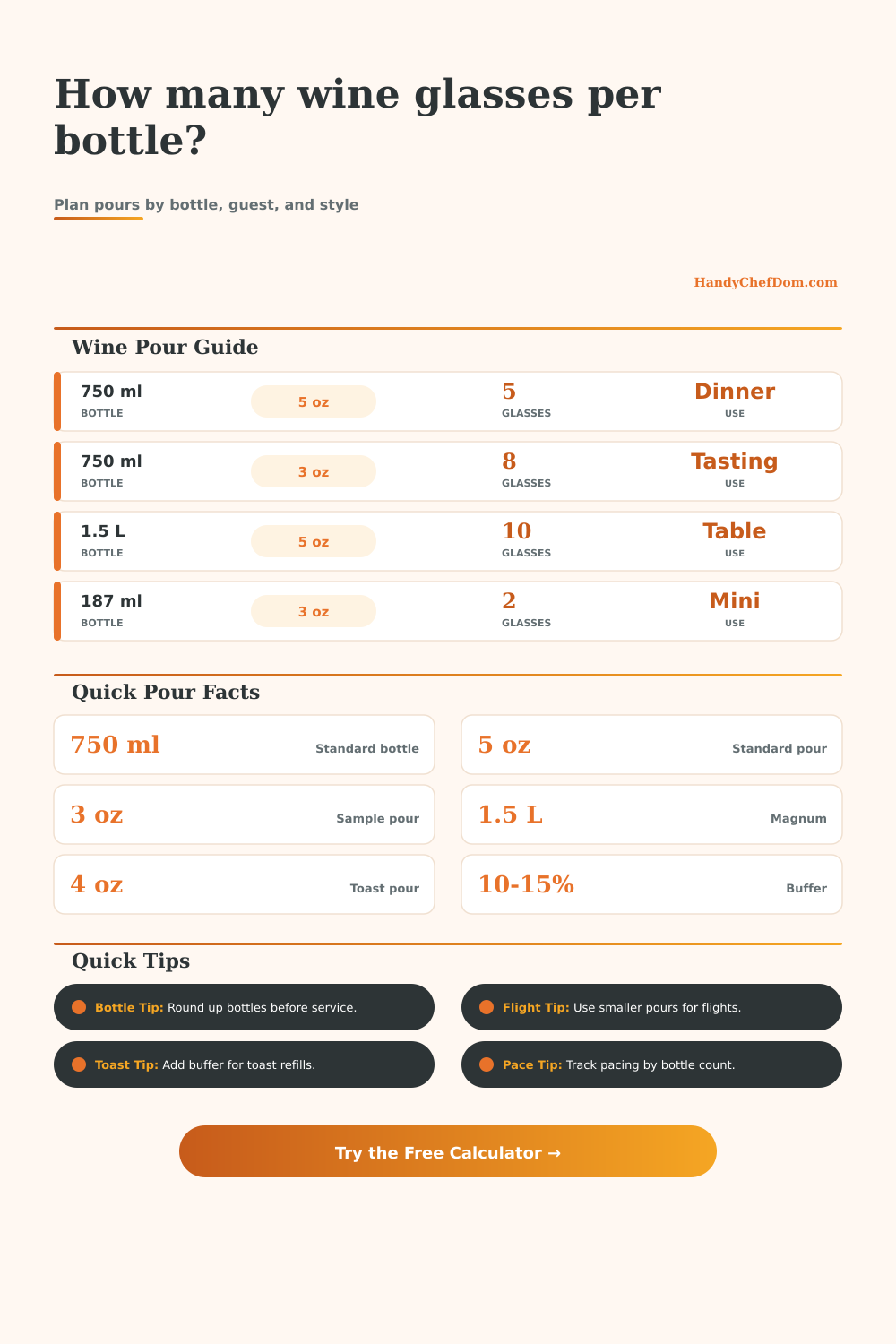
Where physics of the bottle intersects with the philosophy of the evening is in the pour size. The standard dinner pour is five ounces: just enough wine to get a good read on character of the vintage without numbing your palate. Three ounces makes more sense for a long reception or tasting flight; it lets you sample more varieties without becoming too tipsy (or too full) too fast. This is clearly laid out in the reference table on the page, which shows that one magnum bottle will stretch farther with smaller pours. You’re trading depth for breadth here. Smaller pours make more sense if the goal is variety and conversation. Indulge yourself by sticking to the standard five if the goal is indulgence.
The other element of service that varies with bottle size is how many glasses it will provide. For a table of four, a regular 750 milliliter bottle are perfect. If you want to make an impression, go for the magnum (1.5 liters), which provides more wine for a bigger group with fewer open bottles. Fewer open bottles equals less exposed wine to air, meaning better quality, not huge, but a real difference. There is also fewer bottles on your table. But usually magnums come at a premium price, so you’re paying for presentation and convenience. The tool considers bottle volume, allowing you to see what each bottle costs per-glass in comparison.
The same goes for red and white wines; they’re calculated by the same volume, but act differently in the glass. Mass-wise, it doesn’t matter: they’re treated the same way. It’s all about how quickly and at what temperature you serve it. Typically, sparkling wine is served faster and in smaller glasses because of the toast. For champagne, a typical pour is a modest four ounces, giving each person a proper taste without draining the bottle before your eyes. There are presets in the tool that will take care of this type of scenario (a casual dinner compared with a wedding toast) rather than having to tweak each setting yourself.
Leftovers can bust your wine budget. What’s worse than having an unfinished bottle? Not much. Why? First, you can’t save it. Second, you don’t want to drink it by yourself. If there’s only an ounce remaining in a bottle, it’s basically useless. This is true for most people. The calculator accounts for the overage buffer, then tells you how many full serving portion you have left. In other words, it’ll help you know if you should of get 3 or 2 bottles.
Does that third bottle sound wasteful? Maybe it is, or maybe it isn’t. But it factors in all of the ways people behave different when drinking. Are they distracted? Then they won’t drink as much. Are they happy? Then they will drink more. The tool includes this uncertainty.
And so it comes down to this: planning out wine is more than just a matter of pouring the stuff into the house; it’s also a matter of expectation management. How many bottles do I need such that we feel like we have plenty, but not so many that we end up drowning? That’s the sweet spot, the number we aim for: The last person at the party goes home with a full glass and an empty brain, while the host/hostess goes home with a clean table and a clean wallet.
And while the numbers will get us there, our instinct will keep us there. Let them help you find your baseline; trust your gut to fill in the rest. Because, after all, it’s supposed to be fun, not just efficient. But a little efficiency never hurts the party.