🍺 Yeast Attenuation Calculator
Estimate apparent attenuation, real attenuation, alcohol, expected final gravity, and whether a fermentation is finishing inside the yeast strain range.
Enter original gravity and final gravity as specific gravity readings. The calculator compares measured attenuation against the selected yeast range and a wort fermentability adjustment.
| Yeast profile | Apparent attenuation | Best temperature | Typical finish |
|---|---|---|---|
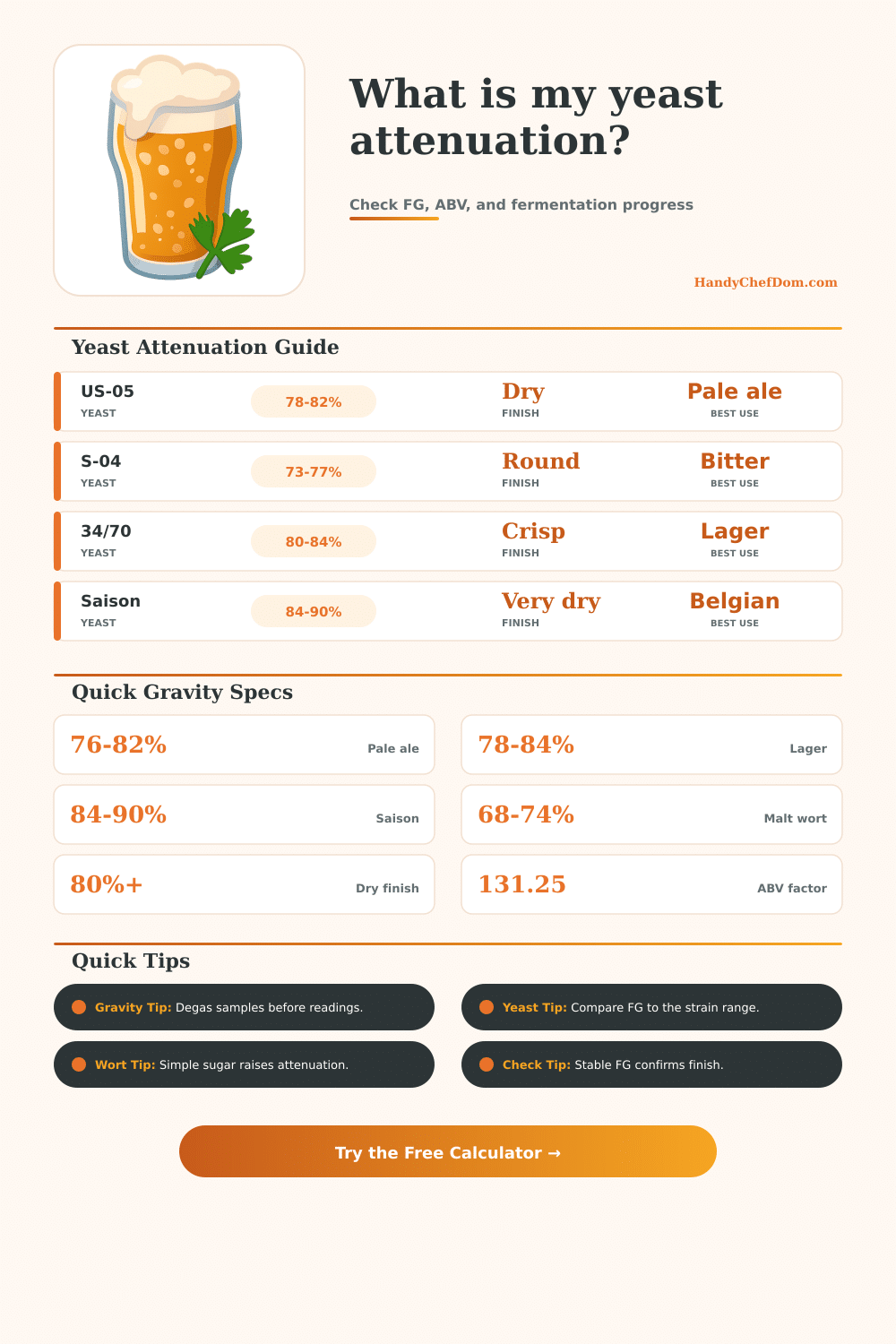
| SafAle US-05 American ale | 78-82% | 64-72 F | Clean and dry |
| SafAle S-04 English ale | 73-77% | 64-72 F | Round and malty |
| WLP001 California ale | 73-80% | 68-73 F | Clean medium-dry |
| SafLager W-34/70 | 80-84% | 50-59 F | Crisp lager finish |
| SafAle WB-06 wheat | 86-90% | 64-75 F | Dry wheat profile |
| Belle Saison | 84-90% | 68-95 F | Very dry saison |
| Voss kveik | 75-82% | 77-104 F | Fast fruity finish |
| Nottingham ale | 77-83% | 57-70 F | Neutral and dry |
| EC-1118 cider or wine | 85-95% | 50-86 F | Very dry fruit base |
| Wort fermentability | Adjustment | Common driver | Expected result |
|---|---|---|---|
| Very fermentable wort | +4 points | Lower mash rest, simple grist | Drier FG |
| Balanced all-malt wort | 0 points | Moderate mash profile | Normal FG |
| Malty dextrinous wort | -4 points | Higher mash rest, crystal malt | Fuller FG |
| Malt extract batch | -2 points | Extract fermentability fixed by maltster | Slightly higher FG |
| High adjunct grist | +2 points | Rice, corn, honey, sugar | Lighter body |
| Mixed culture base wort | +6 points | Long fermentation potential | Very low FG |
| Formula | Calculation | Use | Reading needed |
|---|---|---|---|
| Apparent attenuation | (OG - FG) / (OG - 1) | Yeast performance check | OG and FG |
| Expected final gravity | 1 + (OG - 1) x remaining | Target FG planning | OG and attenuation |
| Estimated ABV | (OG - FG) x 131.25 | Finished strength | OG and FG |
| Real extract | 0.1808 x OE + 0.8192 x AE | Real attenuation estimate | Plato values |
| Real attenuation | (OE - RE) / OE | Alcohol-corrected attenuation | Original and real extract |
| Fermentation style | OG example | Common FG | Common apparent attenuation |
|---|---|---|---|
| Ordinary bitter | 1.038-1.044 | 1.008-1.012 | 70-78% |
| American pale ale | 1.045-1.060 | 1.008-1.014 | 76-83% |
| Dry stout | 1.038-1.052 | 1.007-1.012 | 74-82% |
| German pilsner | 1.044-1.050 | 1.006-1.012 | 78-84% |
| Hefeweizen | 1.044-1.052 | 1.008-1.014 | 76-86% |
| Belgian tripel | 1.075-1.085 | 1.008-1.014 | 82-90% |
| Saison | 1.048-1.065 | 1.002-1.008 | 84-92% |
| Cider base | 1.045-1.060 | 0.995-1.006 | 85-95% |
Yeast attenuation determine how much of the original wort sugar becomes alcohol and how much of the original wort remains sweet. To understanding yeast attenuation, look at the difference between the original and final gravity. The original gravity measures the sugar in the wort before fermentation.
The final gravity measures the amount of sugar remaining in the beer after fermenting. The difference between these two readings is called the apparent attenuation. Apparent attenuation is useful for determine if the batch of beer was finished well.
What is yeast attenuation?
If the brewer dont monitor the attenuation of the yeast, a pale ale might taste too sweet, or a lager might taste too thin. Many factors play a role in yeast attenuation, but the most important is the type of yeast select for the fermenting process. Each brand of commercial yeast ferment the sugars to a different degree.
For example, English ale yeasts are often brewed to ferment the wort to a higher gravity to yield a rounder taste. On the other hand, American yeasts ferment the sugars more thoroughly to produce a drier product. Lastly, lager yeasts are in the middle of the range but produce a crisp product with less malt character than the original wort.
Using a calculator allow the brewer to determine the apparent attenuation from the original and final gravity. Using the calculator removes the guesswork in brewing this figure as the calculator can compare the yeast strain to the measured gravity figures. Another factor in yeast attenuation is the composition of the wort.
To produce a highly fermentable wort, use a low mash temperature and simple malts. If the recipe use alot of crystal malt, the wort will be more complex. In this case, the yeast will leave more of the original sugar behind.
Additionally, using simple sugars to sweeten the wort will ferment more of the carbohydrates as the yeast can easily consume them. The type of pitch rate and the health of the yeast culture can also impact attenuation. If the yeast is underpitched or stressed during the fermentation process, the yeast will stop fermenting early.
In such a scenario, the yeast will leave some of the gravity points of the wort behind that it could of fermented if it’s health had been better. The temperature at which the wort ferments can change the yeast metabolism. This factor yield an adjusted attenuation that considers the impact of these variables.
The apparent attenuation is different than the real attenuation. The apparent attenuation is the figure that most brewers focus on. However, the real attenuation is a more accurate reading of the amount of sugar that was fermented.
Real attenuation is different because the alcohol content is less dense than the water, so it will register a lower gravity than the original wort. The difference between these two figures will be small, but it is important to consider when making high-gravity fermentations. In high-gravity fermentations, the yeast will produce more alcohol that can kill the yeast cells.
Therefore, understanding the relationship between the original extract, apparent extract, and real extract is important before making any high-gravity fermentations. By converting these values to Plato, the brewer can find the true degree of fermentation of the wort. Many brewers make mistakes who dont understand the role of yeast attenuation.
For example, a brewer might use a specific strain of yeast but not understand that the type of wort will not ferment to such a degree. Additionally, a brewer might use the advertised attenuation of the yeast but not consider the potential impact of the mash temperature on the attenuation of the wort. Another mistake is to assume that a gravity reading no longer falling means that the yeast is exhibiting poor attenuation of the wort.
In this case, a second gravity reading must be taken to determine whether the yeast has stalled fermenting the wort.