🍺 Homebrew Bottle Calculator
Calculate exactly how many bottles, caps & cases you need for any batch size
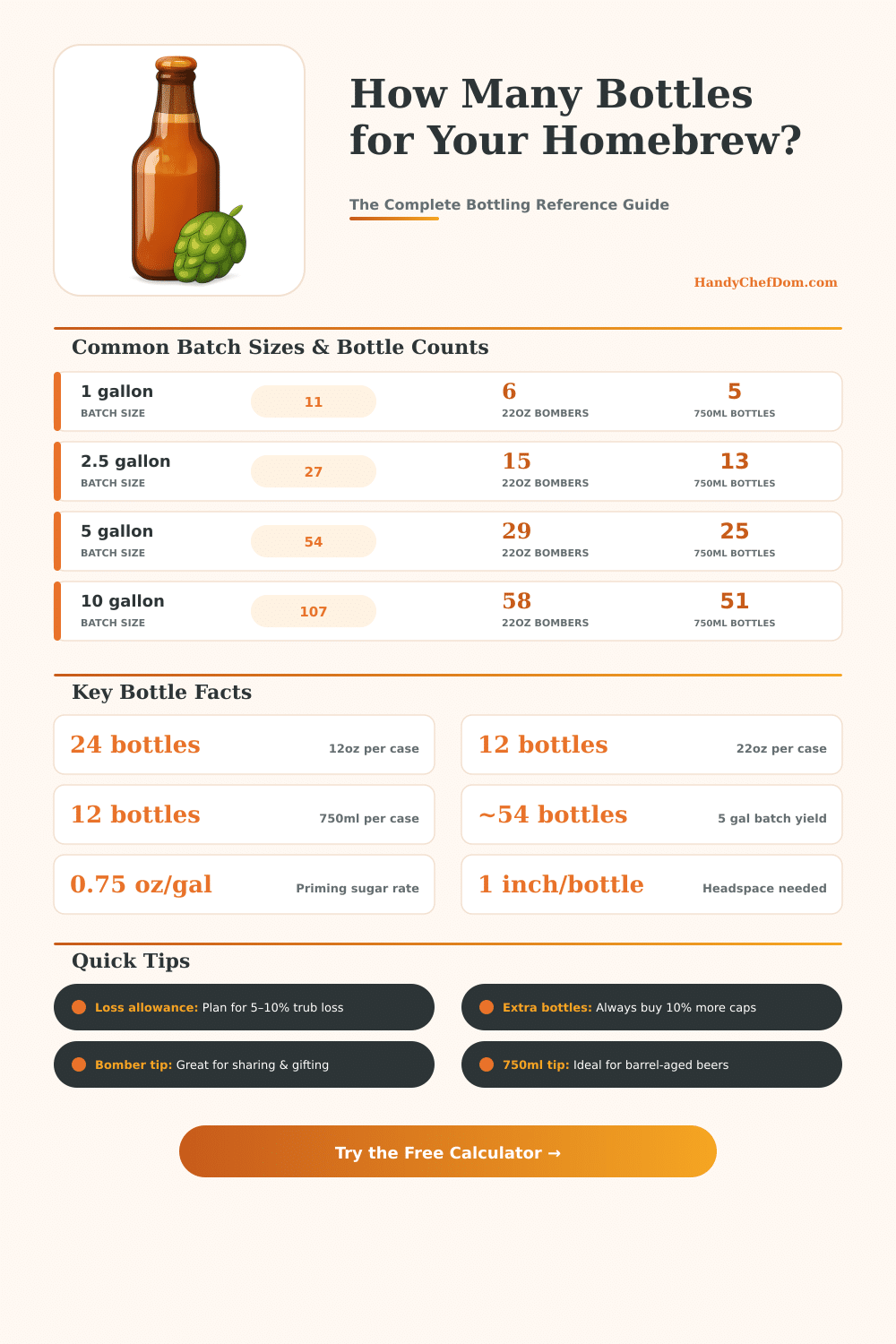
| Batch (US gal) | Batch (Litres) | 12 oz Bottles | 22 oz Bombers | 750 ml Bottles | Cases (24x12oz) |
|---|---|---|---|---|---|
| 1 gal | 3.8 L | 11 | 6 | 5 | 0.5 |
| 2.5 gal | 9.5 L | 27 | 15 | 13 | 1.1 |
| 3 gal | 11.4 L | 32 | 18 | 15 | 1.3 |
| 5 gal | 18.9 L | 54 | 29 | 25 | 2.25 |
| 6 gal | 22.7 L | 65 | 35 | 30 | 2.7 |
| 10 gal | 37.9 L | 107 | 58 | 51 | 4.5 |
| 15 gal | 56.8 L | 161 | 87 | 76 | 6.7 |
* Values assume 10% trub/yeast loss from stated batch volume.
| Bottle Type | Volume (oz) | Volume (ml) | Per US Gallon | Per Litre | Common Use |
|---|---|---|---|---|---|
| Standard / Longneck | 12 oz | 355 ml | 10.7 | 2.82 | Most homebrews, lagers, ales |
| Pint / Tallboy | 16 oz | 473 ml | 8 | 2.11 | Craft ales, IPAs |
| Bomber | 22 oz | 650 ml | 5.8 | 1.54 | Sharing, special releases |
| European / Wine | 25.4 oz | 750 ml | 5.1 | 1.33 | Belgian ales, saisons, meads |
| 1 Litre Swing-Top | 33.8 oz | 1000 ml | 3.8 | 1.0 | Wheat beers, ciders |
| Bottle Size | Corn Sugar (g) | DME (g) | Total per 5 gal batch |
|---|---|---|---|
| 12 oz (355 ml) | ~1.4 g | ~1.9 g | ~130 g corn sugar |
| 16 oz (473 ml) | ~1.9 g | ~2.5 g | ~130 g corn sugar |
| 22 oz (650 ml) | ~2.6 g | ~3.4 g | ~130 g corn sugar |
| 750 ml | ~3.0 g | ~3.9 g | ~130 g corn sugar |
| 1 Litre | ~4.0 g | ~5.2 g | ~130 g corn sugar |
* Based on 2.4 volumes CO2 target. Batch prime (bulk prime) rates: approx. 0.75 oz (21g) corn sugar per gallon.
Bottling consists simply in the process pump your fermented beer directly in bottles and close them by means of metal heads. Many homebrewers learn the troubles of bottling when they start, although genuinely it is not necessarily needed. On the other hand it commonly seems boring, and hence many homebrewers later switch to kegging.
For some, it ends up being the less fun part of the whole brewing process. But here the spot: none of the methods genuinely does objectively better beer. What genuinely matters, is which mode feels right for your setup and level of patience.
How to Bottle Your Homebrew Safely
For process bottles to usage, you require four main elements that work together: fermentation, sugar, temperature and time. When the beer enters the bottles, it yet is not entirely ended. The flavor continuously changes during weeks or months pass, occasionally improving and occasionally less.
Hence mind well during the phase of carbonation, conditioning and maturity, because that sets the final taste that you will have. Many use a clever trick: one lays a plastic homebrew bottle beside his glass. Press it to feel the pressure growing inward; that is a fast mode to control when the carbonation reach the ideal level, without having to guess.
The majority of homebrewers find that it lasts form some days until two weeks, but commonly the pressure grows already in the first week.
A standard five-gallon batch will fill either forty-eight 12-ounce bottles or around twenty-six 22-ounce bottles, and you will require the same number of heads. Always take some back-up, for security. The most common sizes are 12-ounce bottles, 22-ounce for craft beer, half-gallon bottles and 64-ounce growler bottles.
Moreover exist the 16-ounce flip-top swing bottles. They are designed for long keeping and come with closure that stay flat, ideal for beer, wine, kombucha ore cheese cider.
Brown glass beats clear when deal about protect beer against light damage. Before usage of any bottle, control it quickly for chips or cracks. Swing-top easy cap bottles come in green, cobalt or clear glass and give retro feel of cool Grolsch-style.
Regular pry-off bottles can be recycled again and again, but screw-top bottles can not be resealed after opening. Mind: some shorter bottles of certain breweries have lips that does not work with every capper.
No need to buy bottles from a homebrew supply shop. Bottles bought from store with beer work for once. The secret is to rinse each with warm water just after drinking and leave it dry upside down.
When the day of bottling arrives, everything requires full cleaning and sterilization. The bottling tube is your best helper here, pour your processed sugar mix in the bottom, later pour the beer up so that it mingles without spilling everywhere.
Old or expiring liquid yeast ferments slowly or occasionally does not end the task, and that is the main reason that homebrew bottle batches burst. Bottling too early is also a dangerous cause. If you do not make sure, simply leave the beer stand in the closed fermenter more long, that always is thesafer choice, even when the fermentation will end fine.