Keto Portion Size Calculator
Plan low-carb portions with a clean keto calculator that keeps guest counts, appetite, and carb caps moving in the same direction.
Pick a keto food, then tune appetite, leftovers, and the carb cap to get a practical portion size for the whole table.
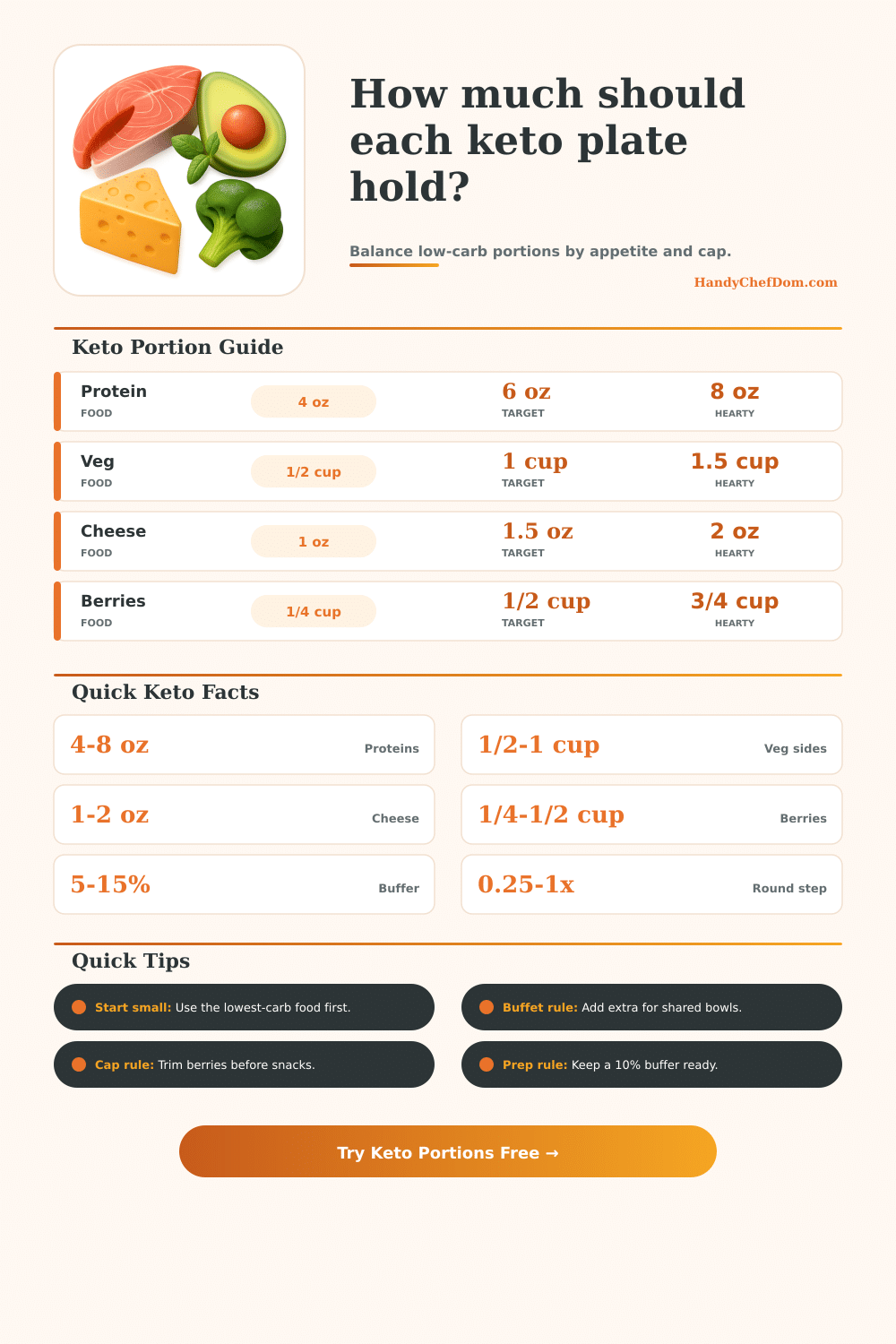
| Food | Light | Target | Hearty |
|---|---|---|---|
| Protein | 4 oz | 6 oz | 8 oz |
| Veg | 1/2 cup | 1 cup | 1.5 cup |
| Cheese | 1 oz | 1.5 oz | 2 oz |
| Berries | 1/4 cup | 1/2 cup | 3/4 cup |
| Food | Carbs | Protein | Fat |
|---|---|---|---|
| Protein | 0.5 g | 26 g | 11 g |
| Cheese | 1.0 g | 10 g | 12 g |
| Nuts | 2.5 g | 5 g | 15 g |
| Dessert | 8.5 g | 4 g | 18 g |
| Guests | Plated | Buffet | Note |
|---|---|---|---|
| 4-6 | 0.95x | 1.05x | Small table |
| 8-12 | 1.00x | 1.15x | Party tray |
| 14-20 | 1.05x | 1.20x | Big spread |
| 25+ | 1.10x | 1.25x | Event line |
| Imperial | Metric | Use | Note |
|---|---|---|---|
| 1 oz | 28 g | Protein | Quick weigh |
| 1 cup | 120 g | Veg | Rough bowl |
| 2 tbsp | 30 g | Dip | Spoon count |
| 1 slice | 90 g | Dessert | Plated cut |
This keto portion size calculator helps you size low-carb plates with a practical balance of appetite, guest count, and carb cap so portions feel generous without drifting off plan.
Planning a ketogenic meal requires that you account for several different variable. The variables of volume, carbohydrates, appetite, serving style, carbohydrate cap, and kitchen waste all plays a role in planning ketogenic meals. In planning ketogenic meals, you must account for the fact that food volume and carb limits works differently on a ketogenic diet than on a standard diet.
On a standard diet, people use foods like rice and pasta to provide individuals with volume. On a ketogenic diet, fats and proteins provides the satiety that individuals feel when eating meals. Because fats and proteins contain few carbohydrate, you cant use these foods to provide volume for a ketogenic diet meals.
How to Plan Keto Meals
Therefore, you must plan ketogenic meals with the nutritional content of fats and proteins in mind to ensure that everyone feel full after eating. Appetite is another variable to consider when planning ketogenic meals. Appetite isnt the same for each individual.
Some people has a very light appetite for the foods that they eat, while others have a hearty appetite and require more protein to feel satisfied. Using a calculator to plan meals for these different individuals can allow the host to account for these differences in appetite. This will ensure that individuals with a large appetite receives enough protein to feel satisfied after eating, and that individuals with a very light appetite do not feel as if they are eating too much.
Serving style is another variable to account for when planning ketogenic meals. The serving style will determine how much food must be prepared for the meals. For example, plated dinners require fewer serving of food than a buffet.
When individuals serve themself from a large tray of food, they will eat more food than they would from a plated dinner. To account for this, the host must prepare an excess amount of food in the case of a buffet dinner to ensure that there is enough food for all guest. Carbohydrate intake must also be accounted for when planning ketogenic meals.
Foods that contains a high amount of carbohydrates, such as berries, can add to the carbohydrate count of a meal. In this case, the calculator that hosts use to prepare ketogenic meals can use a trim factor to account for the high carbohydrate count of these foods. The purpose of the carbohydrate cap that hosts set for ketogenic diets is to ensure that carbohydrate intake remain low so that the body remains in fat-burning mode.
Without a carb cap, it is easy to consume too many carbohydrates from food items like nuts. Another factor to consider is kitchen waste. When cooking food in the kitchen, some food remains in the pan, on the grater, and can be lost during the cooking process.
When cooking for guests, it is necessary to account for this waste when planning meals. For instance, if a kitchen purchase protein for the guests, some of that protein will be lost during the cooking process. Therefore, it would of been better to purchase an excess amount of the food that would be cooked to account for the waste in the kitchen.
Meal prepping is another factor to consider when preparing ketogenic meals. Meal prepping involve cooking meals in advance to be prepared for the entire week. For instance, reference table can be used to determine the amount of protein that would be needed for a target serving size.
Using these reference tables to weigh chicken breast or other serving of produce eliminates the decision fatigue that could occur in the kitchen while preparing ketogenic meals for the week. The most important factor to consider when planning ketogenic meals is the protein that is contained within the meals. Protein is the most important component of ketogenic diets because protein provide the feeling of satiety to individuals who eat these meals.
After the host determines the amount of protein that will be included in the meals, the host can plan the other components of the meals. For instance, if alot of protein is included in a meal, the portion of items like berries or cheese can be lessened. Focus on the protein first when preparing meals for individuals on a ketogenic diet.
When doing so, individuals will feel full and have the energy to perform their daily task.