🍜 Parsley in Chicken Soup Calculator
Estimate fresh parsley, dried equivalent, garnish reserve, and herb timing for chicken soup that tastes bright without becoming grassy.
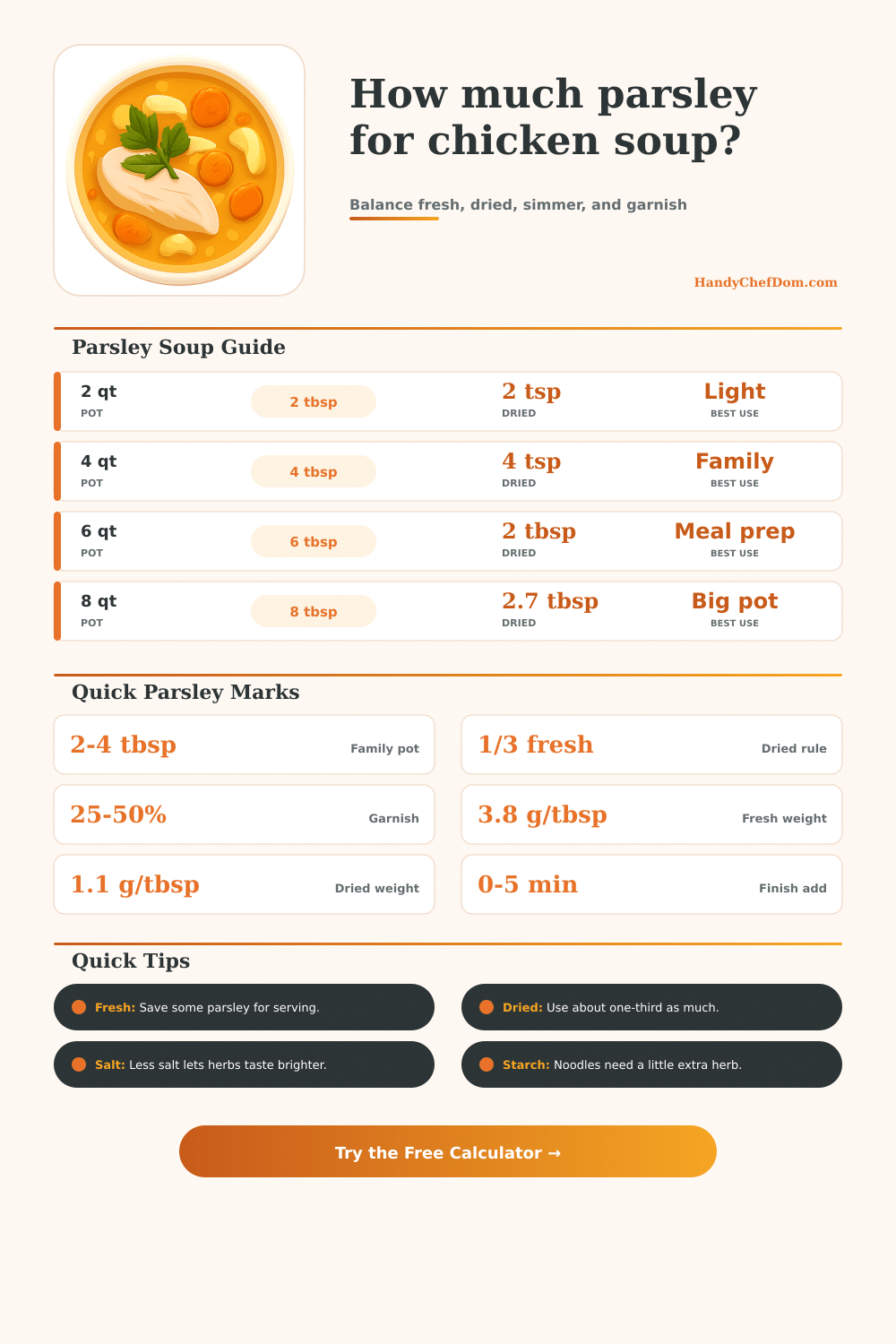
Fresh parsley is commonly about 2-4 tbsp chopped for a family pot, while dried parsley is usually about one-third of the fresh volume. This calculator scales that kitchen rule by broth, chicken, garnish style, starch, salt, and brightness.
| Parsley Measure | Fresh Chopped | Dried Equivalent | Approx Weight |
|---|---|---|---|
| Small lift | 1 tbsp | 1 tsp | 3.8 g fresh |
| Family hint | 2 tbsp | 2 tsp | 7.6 g fresh |
| Balanced pot | 4 tbsp | 4 tsp | 15 g fresh |
| Large pot | 6 tbsp | 2 tbsp | 23 g fresh |
| Very herby | 8 tbsp | 2.7 tbsp | 30 g fresh |
| Broth Volume | Typical Servings | Fresh Parsley | Dried Parsley |
|---|---|---|---|
| 2 qt | 3-4 bowls | 1.5-2 tbsp | 1.5-2 tsp |
| 3 qt | 4-5 bowls | 2-3 tbsp | 2-3 tsp |
| 4 qt | 6-8 bowls | 3-4 tbsp | 1-1.3 tbsp |
| 6 qt | 9-12 bowls | 5-6 tbsp | 1.7-2 tbsp |
| 8 qt | 12-16 bowls | 7-8 tbsp | 2.3-2.7 tbsp |
| Use Style | When To Add | Reserve | Flavor Result |
|---|---|---|---|
| Mostly garnish | At serving | 70-85% | Fresh and green |
| Split use | Last 10 min | 35-45% | Balanced herb |
| Mostly simmered | Last 15 min | 10-20% | Mellow parsley |
| Finish stir-in | Off heat | 50-65% | Bright aroma |
| Dried flakes | Last 15-20 min | 0% | Soft background |
| Bowl Style | Fresh Per Serving | Dried Per Serving | Best Match |
|---|---|---|---|
| Gentle broth | 1/2 tsp | Pinch | Clear soup |
| Balanced bowl | 1-2 tsp | 1/3-2/3 tsp | Family soup |
| Herby bowl | 2-3 tsp | 2/3-1 tsp | Noodle soup |
| Meal prep | 1 tsp now | 1/3 tsp | Add fresh later |
| Low salt bowl | 2 tsp | 2/3 tsp | Bright finish |
Chicken soup has A place for parsley. In almost every pot there is some (or more); usually it’s added at the last minute as a garnish, not a measure. But that makes all the difference: Just a little goes flat on the tongue, particularley if salt and starch blunt the other vegetables’ flavors. Simmer too long with too much parsley and you get something dull and grassy.
Figuring out how much of this herb to use in your particular pot depends less on measuring then on knowing its purpose. After entering the desired level of brightness, the volume of broth, the volume of chicken (and rice or no), recipe calculator figures out the rest. Why? The richness of your chicken will affect how strong the herb needs to be and what kind of starch you use. Both rice and noodles absorbs flavor, but these starches affects taste differently.
How to Use the Calculator for Your Soup
It’ll ask if you’re going to add any salt, too. That’s a factor that trades with brightness. If there isn’t much salt, then the herb can gets away with more. The same amount of parsley will have a bigger impact in an unsalted soup. A longer cook, however, will soften parsley initially added and force more of its bright taste toward whatever ends up in the bowl.
Most people already know the rough rule that dried parsley runs about one-third the volume of fresh. But how do you divide that up between what goes into the cooking pot and what gets put on the serving table? You can always add more at serving time if it’s the same day. If you’re batch-cooking into multiple days’ worth of lunches, or your soup sits overnight, saving some for garnish ensures each bowl won’t be tired-tasting by lunchtime. The calculator also automaticly adjusts for that. So when you change the plan from “serve today” to “meal prep,” the output changes.
The outcome is also influenced, perhaps too slightly to notice, by the time spent simmering and amount of vegetables in the pot. If it’s loaded up with carrots and celery, which impart their own aroma and sweetness, then you can keep the herb relatively quiet. Conversely, if there is a lighter vegetable base or a short cooking time, then the parsley must bears more of the flavor load. The same logic applies in reverse when you are making a very large batch. Because surface area, evaporation, and loss on reheating all rise proportionally, they’re not linear.
Another useful trick: Taste the stock before adding the finishing ingredient(s). You want it to be balanced and not flat, so if you taste something flat, a small finish of fresh parsley should of brighten things up without having to go back through the whole calculation. Or maybe the stock tasted too thin after cooking the chicken and veggies then the tool’s already nudged the overall number up.
Parsley or no parsley, though, it gets added right at the end instead of simmered down to nowhere. But it’s not about parsley being the right or wrong ingredient; in fact, that’s the point: to treat parsley like an adjustable dial. Salt, starch, holding time, and simmer length; these is all tools you can use intentionally once you understand how far in one direction your soup is leaning already. And the calculator merely helps you see the tradeoffs.
So now you’re adjusting before putting the pot on the stove, not after serving up your first unsatisfying bowl.