Coffee Maker Calculator for Brew Water, Dose, and Yield
Dial in your coffee maker with method-specific ratio math, realistic water-loss factors, and output targets so each batch lands closer to your mug count.
Pick a maker method first. Ratio, brew time, and loss defaults will sync so you can tune dose and yield without re-entering every field.
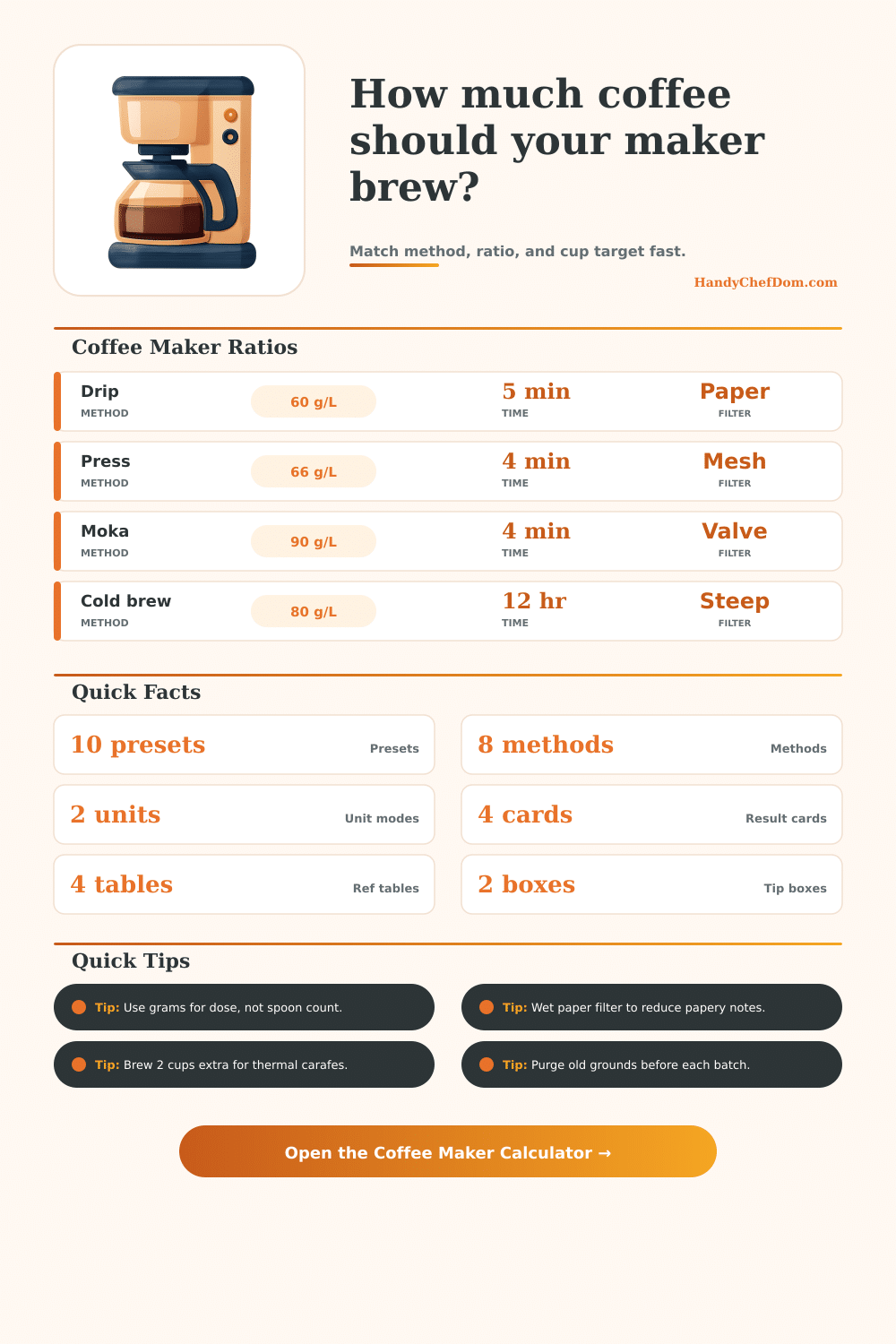
| Method | Dose (g/L) | Temp target | Contact time |
|---|---|---|---|
| Drip machine | 55-65 | 92-96 C | 4-6 min |
| Pour over cone | 58-68 | 91-96 C | 2:30-4:00 |
| French press | 60-70 | 90-94 C | 4:00 |
| Moka pot | 80-100 | 90-95 C | 3-5 min |
| AeroPress | 65-85 | 85-93 C | 1:30-2:30 |
| Cold brew | 70-90 | 4-22 C | 12-18 hr |
| Percolator | 60-75 | 92-96 C | 6-8 min |
| Vacuum siphon | 60-70 | 92-96 C | 2:30-3:30 |
| Maker label | Per cup | Total output | Mug equivalent |
|---|---|---|---|
| 4-cup maker | 5 oz | 20 oz | 2.5 mugs |
| 5-cup maker | 5 oz | 25 oz | 3 mugs |
| 8-cup maker | 5 oz | 40 oz | 5 mugs |
| 10-cup maker | 5 oz | 50 oz | 6 mugs |
| 12-cup maker | 5 oz | 60 oz | 7-8 mugs |
| Thermal 8 | 150 ml | 1200 ml | 5 mugs |
| Thermal 10 | 150 ml | 1500 ml | 6 mugs |
| Thermal 12 | 150 ml | 1800 ml | 7-8 mugs |
| Method | Grind cue | Filter type | Taste shift |
|---|---|---|---|
| Drip machine | Medium | Paper cone | Clean, sweet |
| Flat basket | Medium | Paper flat | Even body |
| French press | Coarse | Metal mesh | Heavier body |
| Moka pot | Fine | Steel basket | Dense cup |
| AeroPress | Med-fine | Paper disk | Bright, clean |
| Cold brew | Coarse | Mesh bag | Low acidity |
| Percolator | Coarse | Metal basket | Bold, rustic |
| Siphon | Medium | Cloth filter | Aromatic |
| Parameter | Target | Range | Kitchen note |
|---|---|---|---|
| Total dissolved solids | 150 ppm | 75-250 | Low TDS tastes flat |
| Total hardness | 68 ppm | 50-175 | Helps extraction |
| Alkalinity | 40 ppm | 40-70 | Buffers acidity |
| pH | 7.0 | 6.5-7.5 | Avoid extremes |
| Chlorine | 0 ppm | 0 | Pre-filter water |
| Sodium | 10 ppm | < 30 | Too high dulls cup |
| Magnesium | 10-20 ppm | 5-30 | Adds sweetness |
| Calcium | 15-30 ppm | 10-50 | Supports body |
When individuals brew coffee using coffee makers, it is common for the amount of water added to the coffee maker to not correspond to the amount of coffee that is ultimately extracted from the brew. The grounds of the coffee can act like a sponges and absorb much of the water that is added to the coffee maker. Furthermore, the coffee brewing machine itself may hold onto some of the water that is brewed by the machine, such as in the water pipes leading to the brew head, or as steam that emerge from the coffee machine.
Thus, the coffee brewing process absorbs the water that is absorbed by the coffee grounds; the amount of brewed coffee that is released from the coffee maker is the yield of the brewed coffee. In order to ensure that the coffee maker consistently dispense coffee according to a desired amount, it is important for those who brew coffee to understand the difference between the amount of water that is poured into the coffee maker (the brew water), and the amount of brewed coffee that is dispensed from the coffee maker (the yield). The difference between these two amounts is due to the amount of water that are retained by the coffee grounds (ground retention), as well as the amount of water that is lost to the coffee brewing machine (system losses).
Why the Water You Put In Is Not the Same as the Coffee You Get
Thus, in order to reach a target yield, it is necessary to account for the ground retention of the coffee grounds. In addition to accounting for the amount of water that is lost to the coffee grounds, it is also necessary to understand dose ratio to ensure that the brewed coffee maintains a consistent strength. Many coffee makers include a scoop for measuring the coffee that will be brewed.
However, a scoop is not a precise measurement tool for measuring the coffee; different types of coffee bean can contain different densities of coffee solids. For example, dark roast coffee beans often contain more pores in the solid particles than do lighter roast coffee beans. Thus, a scoop of dark roast coffee beans will contain less weight of the coffee solids than a scoop of light roast coffee beans.
Using a scale to measure the coffee that is to be brewed will ensure that the dose ratio (the ratio of the weight of coffee to the amount of brew water) is the same each time that coffee is brewed, which will allow for each cup of coffee to have the same strength. Depending upon the type of coffee brewing machine that is used, different approaches can be used in brewing the coffee. Coffee brewing machines that utilize drip machines allow coffee to drip through the coffee grounds in a continuous process.
In contrast, coffee brewing machines that utilize methods like French press allow the coffee grounds to remain in contact with the brewed coffee. Because of the length of time that the coffee grounds are in contact with brewed coffee in methods like a French press, it is possible that a different dose ratio of brew water to coffee grounds is used in methods like a French press than is used with drip coffee machines. In either case, a calculator can be used to determine how many gram of coffee should of be used per liter of water to brew the coffee with a desired strength.
In addition to understanding dose ratios, grind sizes can also have an impact upon the yield of brewed coffee. Using a coarse grind allows the water to move through the coffee grounds more easily than if fine grind coffee beans were utilized. Fine ground coffee solids will tend to hold onto the brewed water; thus, using a fine grind will lead to a decrease in the yield of brewed coffee when the amount of brew water that is utilized is not increased.
Beyond grind size, the bloom that occurs in coffee brewing can also impact the yield of brewed coffee. Bloom is the process by which the coffee grounds are wetted slightly with brewed water, after which the coffee grounds are allowed to sit for a few seconds to allow the dissolved carbon dioxide in the wet coffee grounds to escape. The water that is used in the bloom process will impact the total yield of brewed coffee; if this water is not accounted for in the total amount of brew water that is measured for brewing coffee, the yield will be less than the target yield.
Thus, the bloom water must be accounted for. In addition to water amount, another factor in brewing coffee is the quality of the water that is utilized. Since brewed coffee is mostly water, the minerals that is contained in the water will impact the taste of the brewed coffee.
Water that contains too many minerals (often referred to as “hard” water) can impart a harsh taste to brewed coffee; water that contains too few minerals (often referred to as “soft” water) can lead to brewed coffee that lack flavor. Thus, water with a balanced content of minerals is best utilized in brewing coffee. Finally, it is also possible that the type of carafe that brewed coffee is dispensed into may impact the yield of brewed coffee.
For example, many coffee makers that utilize thermal carafes may have a dead zone at the bottom of the carafe; coffee that is placed in this dead zone will not be dispensed from the carafe. Thus, a small amount of extra water can be added to the brew prior to dispensing the coffee from the thermal carafe, to ensure that there is enough coffee to fill the carafe. This extra water accounts for the dead zone at the bottom of the carafe.
Thus, by accounting for dose ratios, grind sizes, bloom, and water quality, an individual can ensure that the coffee brewing process can be performed in a consistent manner. If the brewed coffee contains too thin of a yield, the dose of coffee can be increased. If the brewed coffee is too bitter, the brew temperature can be adjusted or the coffee grind size can be adjusted.
Furthermore, by accounting for the water that remains within the coffee grounds, the amount of coffee that is brewed can be ensured to reach the target yield each time that coffee is brewed.