Macro Calculator
Estimate calories and split daily protein, carbs, and fat using your weight, activity level, and goal pace, then compare practical plan targets in one view.
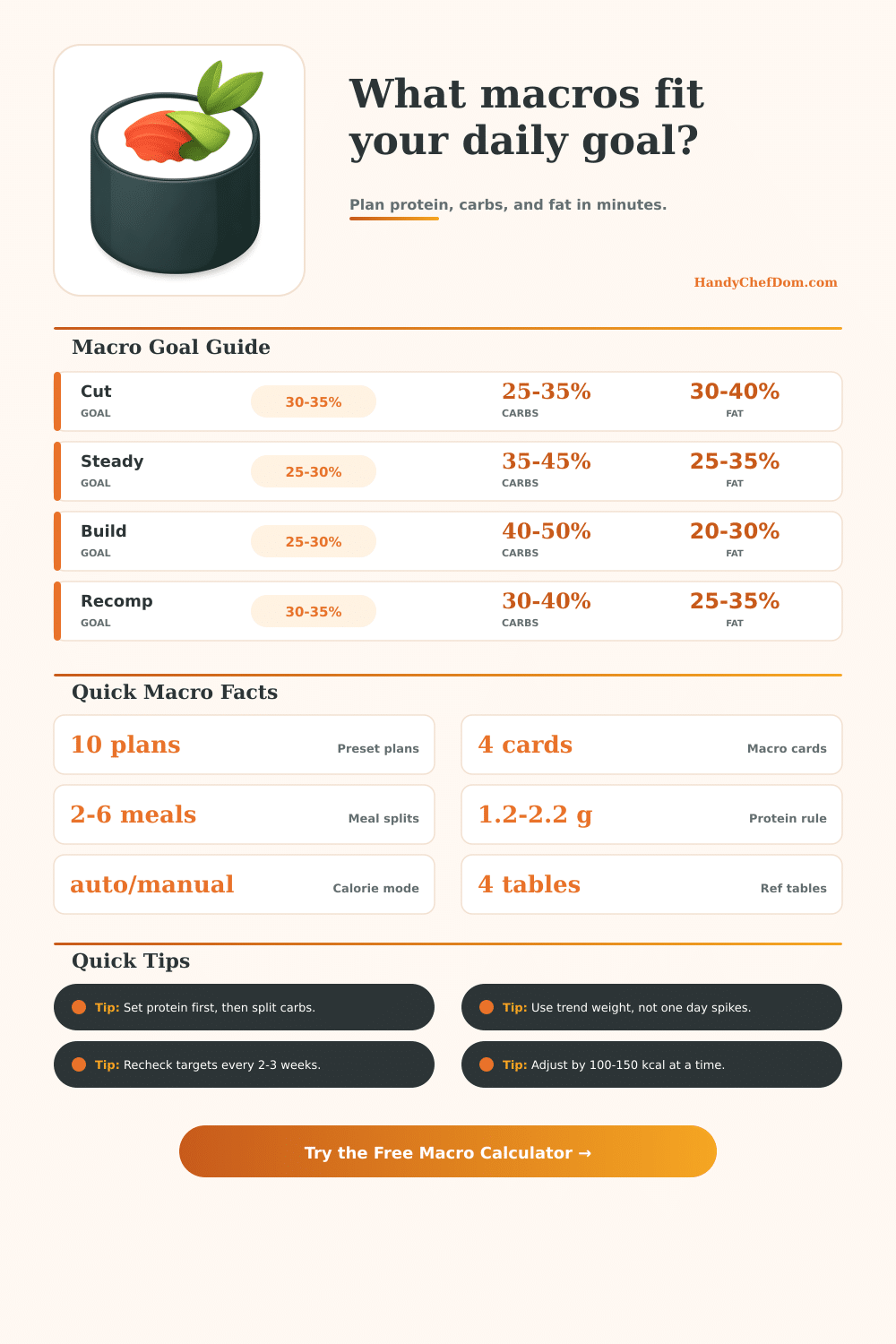
Pick your unit and goal, then tune protein rule and meal count to get a daily macro plan with a clear calorie source.
| Goal | Protein | Carbs | Fat |
|---|---|---|---|
| Cut | 35% | 30% | 35% |
| Steady | 30% | 40% | 30% |
| Build | 25% | 45% | 30% |
| Recomp | 33% | 37% | 30% |
| Level | Factor | Sessions | Use case |
|---|---|---|---|
| Low | 1.35x | 0-2 / wk | Desk day |
| Moderate | 1.50x | 3-4 / wk | Mixed week |
| High | 1.70x | 5-6 / wk | Active job |
| Athlete | 1.90x | 7+ / wk | Double days |
| Goal | Range g/kg | When | Note |
|---|---|---|---|
| Cut | 1.8-2.2 | Diet phase | Preserve lean |
| Steady | 1.4-1.8 | Normal week | Balanced |
| Build | 1.6-2.0 | Lift blocks | Muscle gain |
| Recomp | 1.8-2.2 | Tight cals | High satiety |
| Meals | Protein split | Carb split | Best for |
|---|---|---|---|
| 2 meals | 50/50 | 40/60 | Busy days |
| 3 meals | 33/33/33 | 30/40/30 | General use |
| 4 meals | 25 each | 25 each | Training |
| 5 meals | 20 each | 15-30 var | High intake |
This macro calculator gives a practical daily target, plus per-meal splits and reference tables you can use for grocery planning, meal prep, and training weeks.
A macro calculator take the specific data from an individual and calculate the nutritional targets that the individual should aim to consume daily. Using an individual’s age, weight, height, activity level, and goal, a macro calculator can calculate the number of calories that should be consumed each day as well as the amount of protein, carbohydrate, and fats that an individual should consume each day. These calculations is performed through mathematical calculations.
However, the individual must select their goal to determine their nutritional targets. Based on these targets, the individual can determine the macronutrient split that best suits their body and schedule. The primary nutrient for many bodybuilders is protein, as protein will protect the individual’s muscle tissue if their calorie intake are dropping, as well as contribute to the muscle recovery of the individual if they are performing any type of resistance training.
How to Use a Macro Calculator
The macro calculator will allow the individual to select a protein multiplier if they are performing these two function. For individuals performing a cutting phase, a higher protein intake will allow them to retain as much lean body mass as possible. For individuals performing a building phase, individuals will require more calorie to aid in the recovery of their muscles.
Additionally, the amount of protein that an individual chooses to include in their diet will impact both how full they will feel after eating and how quick their strength will return between training sessions. The activity level that an individual select for the macro calculator will impact the number of calories that that individual burns. Activity level is not limited to the number of exercise routines that are performed each week.
An individual’s activity level includes the amount of movement that they incorporate into their daily life outside of the gym. For instance, if an individual stands at their job site all day or walks between job sites, their activity level will increase. The macro calculator uses the activity level to multiply an individual’s resting metabolism rate.
This results in a more accurate calculation of an individual’s calorie output per day. After the individual sets their total calorie target, they must select the split between the carbohydrates and fats that the individual will consume each day. Some individuals may want to include more carbohydrates into their diet during their training routines.
Other individuals may desire the inclusion of more fats into their diet. The carbohydrate option allow an individual to shift the ratio of carbohydrates to fats that the individual consumes daily. Carbohydrate intake can be lower when performing a cutting phase and higher when performing a building phase.
By adjusting the carbohydrate split, the macro calculator can calculate the amount of grams of each macronutrient that the individual must consume each day. The number of meals that an individual consumes each day can also be entered into the macro calculator. Individuals who eat fewer meal will have larger portions of food to consume.
Fewer meals may not be for everyone, but some individuals may find it difficult to eat three meal per day. Those who eat more meals will consume fewer portions of food, but have more meals to prepare. The macro calculator will calculate the amount of grams of each macronnutrient that will be consumed per meal once the individual select the total number of calories that they will consume each day and the number of meals that they will eat.
The comparison cards allow the individual to select if they would like to adjust their targets for the bodys macronutrients. The cards will display the number of calories that the individual would consume if they chose to adjust their target according to the bodys targets. For instance, one option may be to select a higher amount of calories consumed each day so that the individual does not feel hungry throughout the day.
Alternatively, the individual can select their target to be at a stricter cut of body fat and weight, or they may want to adjust their target to include more protein in their diet without increasing the number of calories that they consume. The four targets will allow the individual to decide if their target is aggressive enough, or if they would like to consume more calories each day to avoid hunger. The reference tables will display the ranges of macronutrients that is recommended for an individual according to their goals, activity level, and other factors.
One table may display the amount of protein that is recommended for individuals with different body goals. Other tables may display the activity level multiplier for each individual’s activity level. The third table may display the typical split for macronutrients in an average individual’s diet.
These tables are not strict requirement for each individual, but they can help to guide the individual in setting their targets for their macronutrients. For instance, if an individual is dropping their calories to burn body fat during a cutting phase but maintaining their protein intake, these tables will allow that individual to determine how many grams of fats and carbohydrates they should consume to meet these goals. An individual’s progress with the macro calculator may be impacted by a number of other variables.
These variables can include the amount of sleep that the individual gets, the levels of stress that the individual feels in their daily life, and even the phases of their menstrual cycle. Additionally, the amount of weight that the individual measures their food can also have an impact on their results. For example, if the individual consumes a large meal or does not get sleep one night, their weight may change by as little as one or two pound.
Due to these variables, the macro calculator suggests that the individual makes weekly adjustments to their targets instead of daily adjustments. This will allow for the individual to adjust their targets for their gains in muscle or the loss of body fat without reacting to temporary changes in their body weight. An individual should separate the mathematical calculations of the macro calculator from how their body feels while consuming the calculated amount of macronutrients.
While the calculated targets for protein, fat, and carbohydrates may visually appear correct for an individual, they may still feel drained or hungry after consuming these amount of nutrients. In these cases, the individual should first review the quality of the food that they are consuming and at what times they are consuming those meals. For instance, increasing the amount of vegetables that are consumed will increase the volume of food that the individual consumes.
Additionally, adding protein to every meal and consuming carbohydrates around the individual’s training will help them maintain their energy throughout the day. If an individual experiences a stall in their progress, they should first review their activity levels and the intensity of their training. If their activity or training level has dropped, their energy expenditure will change, even if their macro calculator is set to that expenditure level.
By tracking the number of steps that they walk each day, or by noting their training efforts each week, they can adjust their training load, instead of adjusting their calculated targets. The macro calculator can be used as a tool to periodically review an individual’s nutritional targets. The individual should use the macro calculator if they experience any changes to their schedule, training goals, or if their body measurements remain the same for two or three weeks.
Between these periods, the individual should focus on achieving their protein target, maintaining their carbohydrate to fat split, and adjusting the portion size for each meal. While the macro calculator will provide an individual with a map of their nutritional targets, they are responsible for performing the meals that map out their nutritional plan.