How Much Cheese per Person Calculator
Scale cheese for meals, trays, and events with practical buy targets, per-person portions, and nutrition totals based on real density and serving data.
📌Preset Scenarios
⚙Calculator Inputs
Pick cheese type, serving role, and format first. Then tune appetite, waste, and buffer to get a rounded buy amount that still covers every guest.
Cheese planning snapshot
Rounded buy amount, per-person portion, serving coverage, and protein total from your selected cheese setup.
📐Serving Benchmarks
📑Reference Tables
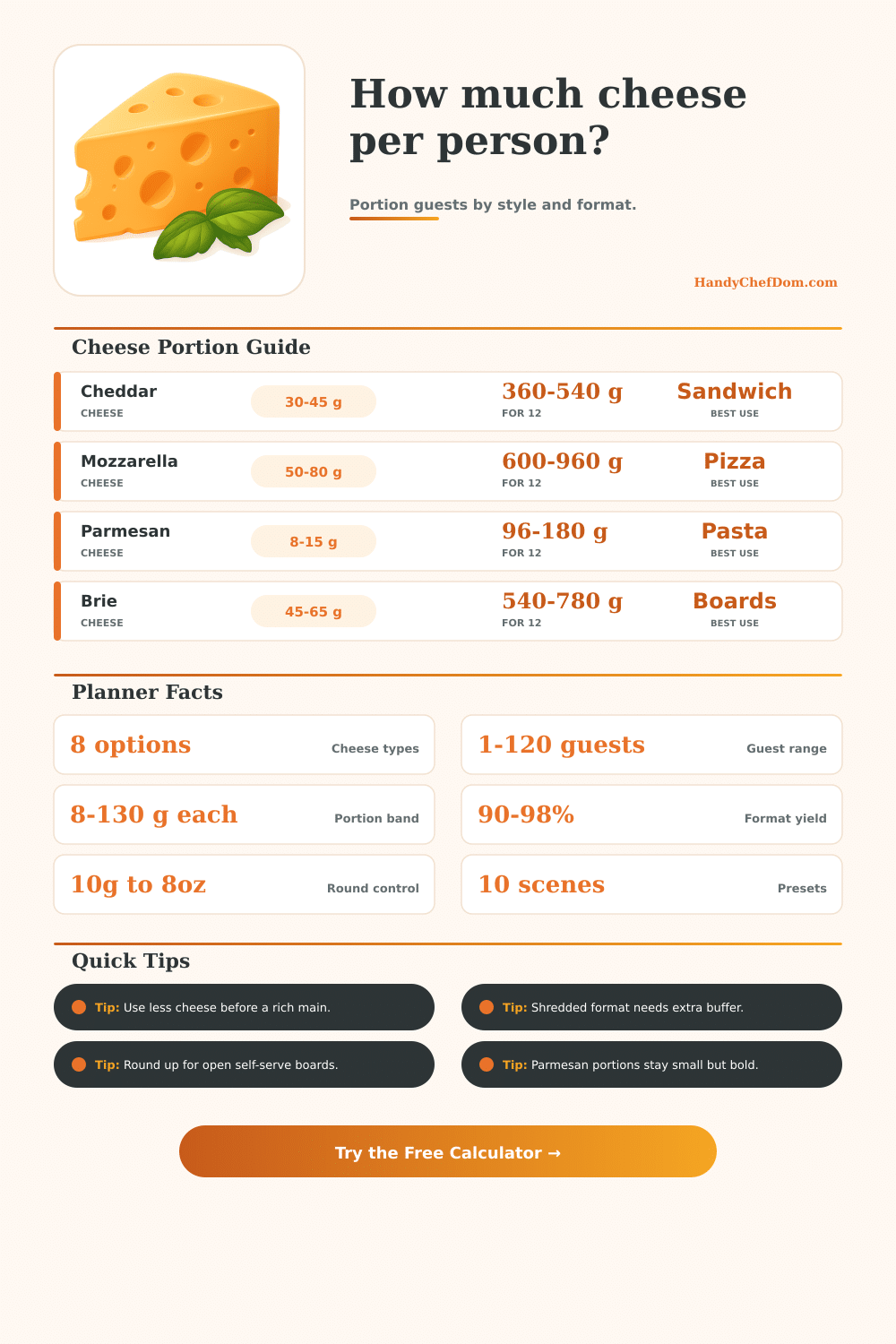
| Cheese | g per cup | Protein | Std serve |
|---|---|---|---|
| Cheddar | 113 g | 25 g/100g | 30 g |
| Mozzarella | 112 g | 22 g/100g | 35 g |
| Parmesan | 100 g | 38 g/100g | 15 g |
| Gouda | 110 g | 25 g/100g | 30 g |
| Brie | 95 g | 21 g/100g | 35 g |
| Feta | 150 g | 14 g/100g | 30 g |
| Swiss | 108 g | 27 g/100g | 30 g |
| Blue | 135 g | 21 g/100g | 25 g |
| Format | Usable yield | Loss | Good for |
|---|---|---|---|
| Block pieces | 98% | 2% | Boards |
| Sliced | 96% | 4% | Sandwiches |
| Shredded | 94% | 6% | Bakes |
| Crumbled | 92% | 8% | Salads |
| Cubed | 95% | 5% | Skewers |
| Fine grated | 90% | 10% | Pasta |
| Board mixed | 93% | 7% | Events |
| Hot service | 91% | 9% | Buffets |
| Guests | Light share | Meal share | Board share |
|---|---|---|---|
| 4 | 60 g | 120 g | 240 g |
| 8 | 120 g | 240 g | 480 g |
| 12 | 180 g | 360 g | 720 g |
| 16 | 240 g | 480 g | 960 g |
| 20 | 300 g | 600 g | 1.2 kg |
| 30 | 450 g | 900 g | 1.8 kg |
| 40 | 600 g | 1.2 kg | 2.4 kg |
| 50 | 750 g | 1.5 kg | 3.0 kg |
| Amount | Slices* | Shred cups | Use cue |
|---|---|---|---|
| 120 g | 6 | 1.1 | Small meal |
| 240 g | 12 | 2.2 | Family tray |
| 480 g | 24 | 4.3 | Party start |
| 720 g | 36 | 6.5 | Buffet line |
| 960 g | 48 | 8.6 | Large board |
| 1.2 kg | 60 | 10.8 | Event prep |
| 1.8 kg | 90 | 16.2 | Big group |
| 3.0 kg | 150 | 27.0 | Heavy share |
📊Nutrition Snapshot
💡Practical Tips
When calculating the amount of cheese that will be needed for a group of people, it is important to consider that the amount of cheese that is provide to the group will determine whether the group of people will feel satisfied after the meal, or whether they will still be hungry after eating. If you buy too little cheese, there will be no cheese left for the guest who have finished eating. However, if you buy too much cheese, the cheese that has not been eaten will dry out in the refrigerator.
In order to calculate the amount of cheese that will be needed for a group of people, there is several factors that must be considered. One of the factors to consider is the role that the cheese will play in the meal. For instance, if you use the cheese as a topping for food items like pizza or pasta dish, individuals will eat more cheese than if you were to serve the cheese on a cheese board with other food.
How Much Cheese to Buy for a Group
A slice of cheese on a burger is different than cheese that is served on a cheese board, and this difference in role for the cheese will impact the amount of cheese that you need to purchase for the group of individuals that will eat. Another factor to consider is the format in which the cheese will be provided. For example, if you use cheese that come in blocks, you will have access to the entire weight of the cheese for each guest that visits your event.
If, however, you use cheese that comes in shredded or crumbled formats, there will be some wastes in the cheese that may still be in the bag of cheese. This waste becomes a more significant problem if you are serving many guests to your event. You must account for waste from the cheese rinds, as well as purchase extra cheese to ensure that individuals who eat cheese will have enough for there second portions.
Another factor to consider is the appetite of the guests that will attend your event. Some groups of people may eat very little cheese, such as individuals that are performing grazing type meal. Other groups of people may eat a significant amount of cheese.
In order to account for this factor, you can use a cheese calculator to ensure that you account for difference in appetite, and to ensure that you are providing for those hearty eater. Another factor to consider is the nutritional content of the cheese. For instance, parmesan cheese contain more protein per gram than mozzarella cheese.
Therefore, the amount of protein in parmesan cheese is more than the amount of protein in mozzarella cheese, even if the portion of parmesan cheese is smaller than the portion of mozzarella cheese. Considering this factor can be helpful if you are concerned with the dietary need of the individuals who will attend your event. In real events, there will be unexpected event.
For instance, it is possible that one of your guest will bring extra cheese for those who would like more. Additionally, there may be unexpected change in the weather, which would cause the guests to remain at your event and eat more food. Because these types of events are likely to happen, it is necessary to purchase a buffer of extra cheese to account for these instance.
Additionally, it is also possible to purchase cheese in two different format to avoid waste of cheese. The amount of cheese that people will eat also depends upon the other food that will be on the table for the guests at your event. If there will be a variety of rich food items to eat, individuals will eat less cheese.
If the meal will include light food item, individuals will eat more cheese. Therefore, the context of the menu will have an impact upon the amount of cheese that is need to be purchased for the event. Using a calculator to determine the amount of cheese to purchase will enable you to learn more about how your group of individuals eat.
After throwing several events, you will be able to recognize if your group of individuals are a group of hearty eater of cheese, or if they tend to eat cheese as a garnish for their food. This information will make it easier for you to plan the amount of cheese that you will purchase for the group of individuals that you are hosting events for. Your goal will be to purchase an amount of cheese that ensure that you will supply all of the guests with cheese, but that you dont purchase an excess of cheese for which you will not be able to use it altogether.