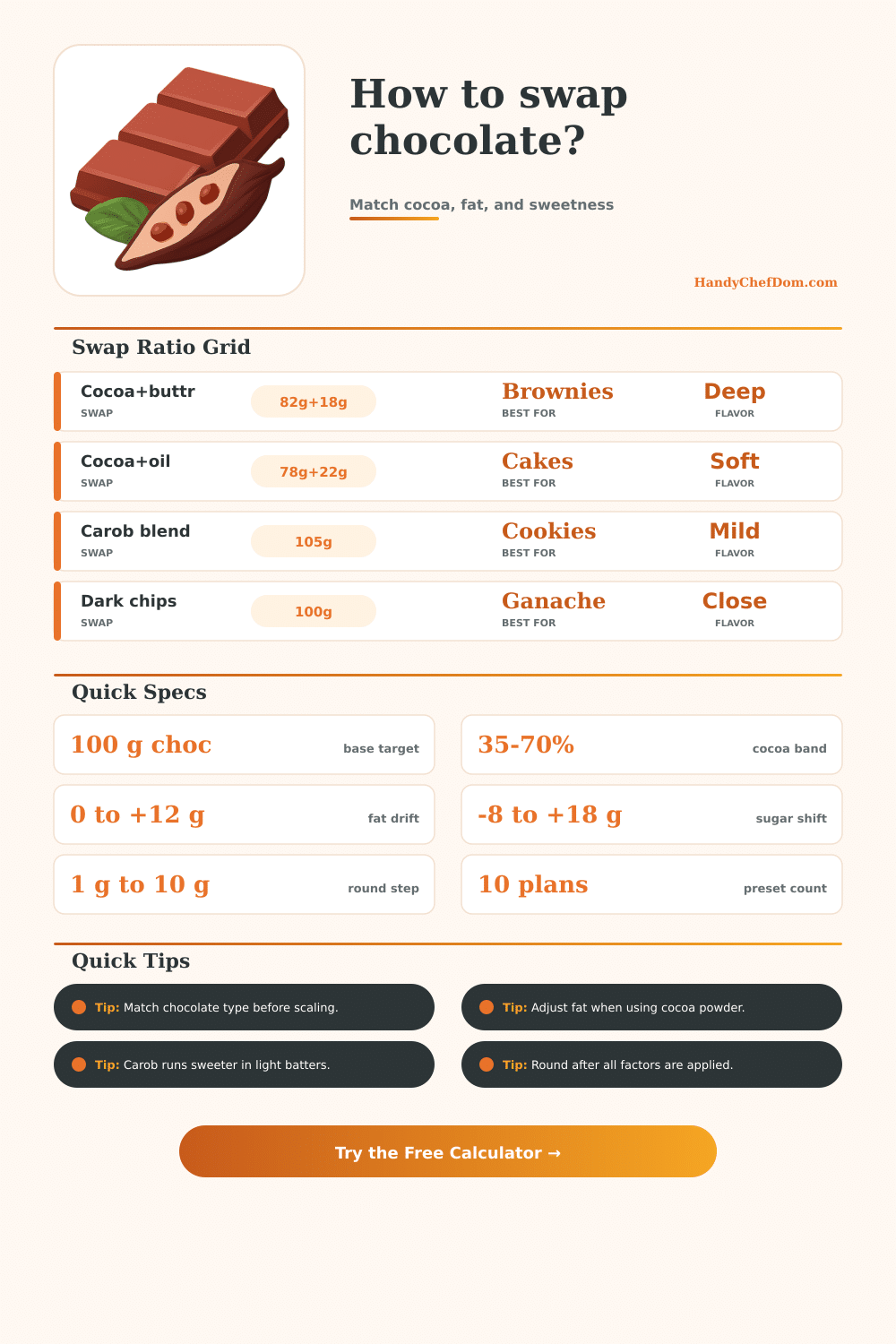
Chocolate Substitute Calculator
Swap chocolate with precise cocoa, fat, and sweetness balancing so brownies, cakes, ganache, and cookie dough stay close to your target flavor and texture.
📌Preset Scenarios
⚙Calculator Inputs
Set the chocolate type first, then pick a substitute strategy. The calculator adjusts for cocoa intensity, fat carry, sweetness drift, and recipe behavior.
Substitute plan snapshot
Review main substitute amount, add-on fat, sugar adjustment, and estimated flavor match before final mixing.
📐Substitute Profile Grid
📑Reference Tables
| Substitute | Base ratio | Cocoa score | Best recipe |
|---|---|---|---|
| Cocoa + butter | 0.82 + fat | High | Brownies |
| Cocoa + oil | 0.78 + fat | Mid high | Cakes |
| Cocoa + cream | 0.80 + cream | Medium | Frosting |
| Dark chips | 1.00 | Medium | Ganache |
| Carob blend | 1.05 | Low | Cookies |
| Cacao paste | 0.95 | Very high | Truffles |
| Compound coat | 1.02 | Low mid | Sauces |
| Cocoa + ghee | 0.81 + fat | High | Bars |
| Chocolate type | Cocoa % | Sugar % | Fat % |
|---|---|---|---|
| Dark 65% | 65 | 28 | 36 |
| Semisweet 55% | 55 | 38 | 34 |
| Milk 40% | 40 | 50 | 31 |
| White chocolate | 0 | 57 | 32 |
| Unsweetened | 100 | 0 | 53 |
| Baking chips 48% | 48 | 42 | 33 |
| Bittersweet 70% | 70 | 24 | 38 |
| Coating wafers | 22 | 54 | 30 |
| Recipe style | Flavor weight | Fat weight | Sweet weight |
|---|---|---|---|
| Brownie | 1.25 | 1.20 | 0.85 |
| Cake | 1.05 | 0.95 | 1.00 |
| Cookie | 1.10 | 1.05 | 0.95 |
| Ganache | 1.30 | 1.30 | 0.75 |
| Frosting | 0.95 | 0.90 | 1.20 |
| Sauce | 0.90 | 0.80 | 1.15 |
| Muffin | 1.00 | 0.90 | 1.05 |
| Truffle | 1.35 | 1.25 | 0.70 |
| Target amt | Metric | Imperial | Typical use |
|---|---|---|---|
| 60 g | 0.26 cup eq | 2.1 oz | Drizzle sauce |
| 120 g | 0.51 cup eq | 4.2 oz | Cookie dough |
| 180 g | 0.77 cup eq | 6.3 oz | Muffin batch |
| 240 g | 1.03 cup eq | 8.5 oz | Cake layer |
| 360 g | 1.54 cup eq | 12.7 oz | Sheet cake |
| 480 g | 2.06 cup eq | 16.9 oz | Party tray |
| 720 g | 3.09 cup eq | 25.4 oz | Bulk prep |
| 960 g | 4.12 cup eq | 33.9 oz | Event batch |
🧪Nutrition Impact Grid
💡Practical Tips
A chocolate substitute calculator will help you to find a replacement for chocolate if you dont have the specific chocolate that is required for the recipe. A chocolate substitute calculator is not used to give a mathematical calculation of the replacement of chocolate. Instead, a chocolate substitute calculator will ask you an series of questions that will help it to determine the correct measurements of cocoa powders, fat, and sugar if you are using those ingredients as a replacement for chocolate.
Often, cocoa powder and a fat source is used as a replacement for chocolate. Cocoa powder contains very little fat; therefore, you must add a fat source to recipes that use cocoa powder. Depending on the type of recipe that will be used, the fat that you use in the recipe can make a difference.
How to Use a Chocolate Substitute Calculator
For instance, brownie batter can take in heavy fats, but using either too firm or too liquidly fats can affect cake batter. When you choose the type of recipe in the chocolate substitute calculator, you are essentially choosing how the chocolate substitute calculator will weight the flavor, fat, and sugar that will be used in the recipe. For instance, ganache require a specific amount of cocoa and fat to achieve the desired result with the ganache.
Cookie dough recipes are more forgiving of different amounts of sugar because cookies can mask any difference in the cocoa powder that is used. When you select the recipe type in the chocolate substitute calculator, it will adjust the amount of the main ingredient (which is typically cocoa powder), the amount of fat, and the amount of sugar. You will still have to adjust the texture of the recipe, but the chocolate substitute calculator will provide you with a starting point to prepare the ingredient mixture.
Because cocoa powder contains very little fat, it is necessary to correct for the fat component of the cocoa powder. If you use cocoa powder in place of chocolate, your brownies may be dry or your frosting may be grease. Butter adds flavor to recipes and sets in a way that is suitable for recipes such as brownies.
Oil will set the recipe in a way that is more suitable for cakes. Cream adds fat and moisture to recipes. By selecting a light body, neutral body, or rich body in the chocolate substitute calculator, it will adjust the amount of fat that is required in the recipe.
An additional variable that you will have to account for is sweetness. Different forms of chocolate contain different amount of sugar. Dark chocolate, for instance, contains less sugar then milk and white chocolate.
If cocoa powder is used in place of chocolate, recipes may contain more bitterness. By setting the target for sweetness in the chocolate substitute calculator, you can adjust for how sweet you want the recipe to be. Since the chocolate substitute calculator is aware of the sugar content of chocolate, it can suggest an adjustment in recipes if you use cocoa powder instead of chocolate.
Another group of settings within the chocolate substitute calculator is settings for batch size and safety buffer. If you are making a batch of dessert for a large group of people, you can use the safety buffer percentage to make extra of the dessert. The round step setting for the chocolate substitute calculator helps you avoid fraction that may be difficult to measure with your measuring spoon.
These settings will provide you with a suggestion from the chocolate substitute calculator that can be realistically used in the kitchen. The reference tables provide additional information about the type of chocolate that is used in various recipes. The reference tables show the component of chocolate, such as cocoa, sugar, and fat in each type of chocolate.
The reference tables also show how the components are weighted in different types of recipes. While the information in the tables does not have to be memorized, they can help you to understand the suggestion from the chocolate substitute calculator. Kitchen environments has variables that the chocolate substitute calculator cannot account for.
For instance, variations in humidity can affect the results of recipes that use cocoa powder. Oven temperatures impact how the fat set into the baked good. The age of the baking powder or the brand of the sugar can affect the sweetness of the final product.
Because the chocolate substitute calculator does not account for these variables, it is always a good idea to make a small batch of the dessert to test the flavor and to bake the final recipe in small batches. Carob behaves different than cocoa powder. Carob is naturaly sweeter and less bitter than cocoa powder.
Carob may not be as noticeable in light batters for dessert recipes. The chocolate substitute calculator treats carob powder as if it had a higher ratio of sugar to cocoa powder and less bitterness. Chocolate is made up of cocoa powder, fat, sugar, and flavor compound.
By changing the amount of one component of chocolate, others must be changed, as well. The chocolate substitute calculator allows you to change the components of chocolate and still maintain a balance to the other ingredient. While the chocolate substitute calculator does not eliminate the necessity of tasting your baked goods, it does eliminate the guesswork before you begin to mix the ingredient.
Through using the chocolate substitute calculator multiple times, you will begin to recognize pattern in how different recipes respond to changes in the fat and cocoa powder components.