Nacho Bar Calculator
Plan a nacho bar that has enough chips, queso, protein, beans, toppings, salsa, guacamole, sour cream, serving pans, and backup food for the way guests will actually build their plates.
Start with a real hosting scenario, then adjust guest mix, meal role, appetite, protein style, queso plan, topping load, and buffer. Presets are practical starting points for shopping and prep.
Your nacho bar estimate
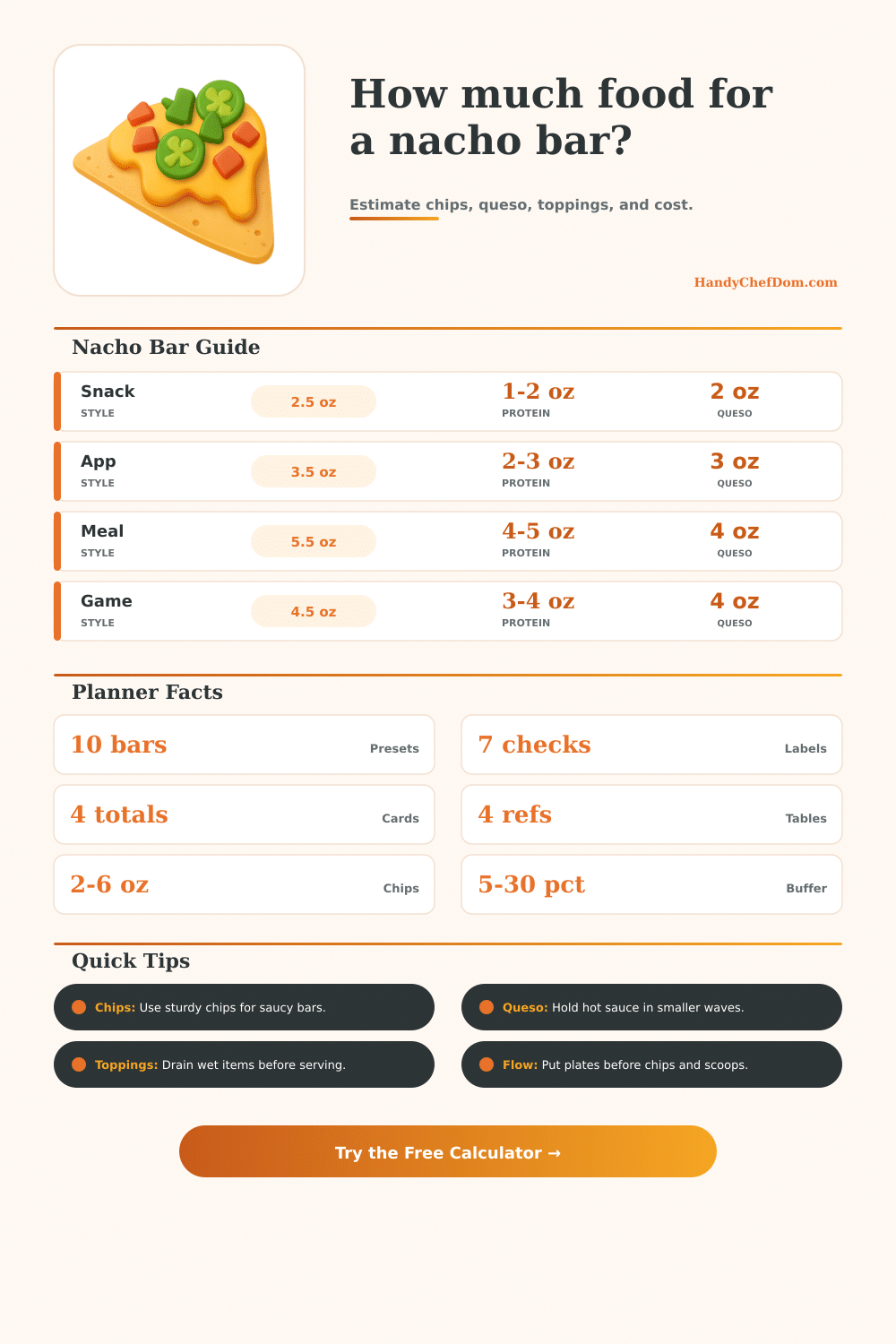
Chips for this crowd when nachos are just a pre-dinner snack.
Heartier chip and protein plan when the nacho bar is the meal.
Extra queso and dips for repeat grazing during games.
Estimated food cost divided by the listed headcount.
| Nacho bar role | Chips per guest | Protein per guest | Queso per guest | Best use |
|---|---|---|---|---|
| Light snack | 2 to 3 oz | 0 to 2 oz | 1.5 to 2 oz | Movie nights, pre-dinner bites, happy-hour tables. |
| Appetizer bar | 3 to 4 oz | 2 to 3 oz | 2.5 to 3.5 oz | Most parties where dinner or other food also appears. |
| Game-day graze | 4 to 5 oz | 3 to 4 oz | 3 to 4 oz | Long viewing windows with repeated trips to the table. |
| Main meal | 5 to 6 oz | 4 to 5 oz | 3.5 to 4.5 oz | Dinner bars, office lunches, teen crowds, casual catering. |
| Late-night food | 4 to 5.5 oz | 3 to 4 oz | 3 to 4.5 oz | After sports, weddings, parties, or events with active guests. |
| Item | Light bar | Balanced bar | Meal bar | Host note |
|---|---|---|---|---|
| Cooked seasoned beef | 1.5 to 2 oz | 2.5 to 3.5 oz | 4 to 5 oz | Cooked weight is lower than raw weight; buy extra if draining fat. |
| Shredded chicken | 1.5 to 2 oz | 2.5 to 3.5 oz | 4 to 5 oz | Hold moist with a little broth or salsa so it does not dry out. |
| Beans or plant protein | 1 to 2 oz | 2 to 3 oz | 3 to 4 oz | Beans stretch the bar and support vegetarian plates. |
| Queso sauce | 1.5 to 2.5 oz | 2.5 to 4 oz | 4 to 5 oz | Plan hot refills because queso disappears faster than shredded cheese. |
| Shredded cheese | 0.5 to 1 oz | 1 to 1.5 oz | 1.5 to 2 oz | Use as backup texture even when queso is the main cheese. |
| Topping or dip | Planning amount | Why it matters | Prep note |
|---|---|---|---|
| Salsa or pico | 1 to 2 oz per guest | Adds moisture, acid, and freshness to salty chips. | Drain pico slightly so chips do not collapse. |
| Guacamole | 0.75 to 1.5 oz per guest | Often runs out first when offered. | Serve in smaller bowls and refill often to reduce browning. |
| Sour cream or crema | 0.5 to 1 oz per guest | Cools spicy queso, jalapenos, and seasoned meat. | Squeeze bottles are neater than open bowls. |
| Lettuce, tomato, onion | 1.5 to 3 oz per guest | Makes meal plates feel complete without only adding chips. | Keep cold toppings chilled until close to service. |
| Jalapenos, olives, corn | 0.5 to 1 oz per guest | Small high-flavor toppings prevent bland plates. | Use spoons, labels, and separate spicy items clearly. |
| Extra hot sauce | 1 bottle per 20 to 30 guests | Lets spice lovers adjust without making the base queso too hot. | Offer at the end of the line to avoid slow decisions early. |
| Guest count | App chips | Main chips | Balanced protein | Queso target |
|---|---|---|---|---|
| 8 guests | 1.8 to 2.2 lb | 2.8 to 3.4 lb | 1.5 to 2 lb | 1 to 1.5 qt |
| 12 guests | 2.6 to 3.2 lb | 4.1 to 5 lb | 2.3 to 3 lb | 1.5 to 2 qt |
| 20 guests | 4.4 to 5.3 lb | 6.9 to 8.3 lb | 3.8 to 5 lb | 2.5 to 3.5 qt |
| 35 guests | 7.7 to 9.2 lb | 12 to 14.5 lb | 6.6 to 8.8 lb | 4.5 to 6 qt |
| 50 guests | 10.9 to 13.1 lb | 17.2 to 20.6 lb | 9.4 to 12.5 lb | 6.5 to 8.5 qt |
| 75 guests | 16.4 to 19.7 lb | 25.8 to 30.9 lb | 14.1 to 18.8 lb | 9.5 to 13 qt |
How the nacho bar calculator works
The calculator starts by turning adults, kids, and teens into adult-equivalent eaters. That prevents a kids party from being overbuilt and a teen-heavy game night from being underfed. It then applies the nacho bar role: snack, appetizer, main meal, only food, or late-night food.
Chips, protein, queso, shredded cheese, toppings, and dips are calculated separately because they run out at different speeds. Chips break and disappear early, queso gets revisited often, and wet toppings need smaller refill bowls so the bar stays clean and crisp.
The final estimate adds appetite, serving window, planning mode, buffer, and leftover goal before rounding chips into large bags and queso into practical quarts. Use the tables below the calculator to sanity-check the result against your menu, grocery packaging, and serving setup.
To prepare a nacho bar, you must take careful note about the amount of food you will need. The amount of food you will need to prepare is dependent upon several different factor. For instance, you must consider the amount of adults, children, and teens that will be attending the event.
In addition to the number of guests that will attend, you must also consider how long the nachos will be available for eat. The role of the nachos is one of the critical factor in determining how much food will be needed. For instance, if the nachos are to serve as a snack, there will be less food that is needed compared to if the nachos are to serve as the main meal for those who eat them; guests that consume the nachos as a main meal will consume more protein and more queso compared to if those nachos are to be eaten as a snack.
How Much Food to Make for a Nacho Bar
The calculator help to determine the amount of food that will be needed for the nacho bar by first asking you about the role that the nachos will play at the party. If the nachos are to play the role of a main meal, the calculator will increase the amount of chips and protein that should be prepared. If there are other types of food that will be present at the party, the portion of the nachos will be less because guests will balance the types of food that they consumes at the party.
In addition to the role of the nachos, the calculator will also ask how long the food will be sitting out. A two-hour period of food that is sitting out will require different amount of food than a four hour period during which guests may return to the nacho bar several times. In addition to the role and the length for which the nachos will be available, the calculator will also ask about the appetite of the guests.
A light group will consume less food than a group that consists of many teens or athletes; a group that contains many teens or athletes may increase the amount of food needed by twenty-five percent at the party. The calculator can adjust for these different level of appetites. In addition, the calculator will include a buffer percentage in the calculations.
The buffer percentage will account for the fact that some chips will break, some guests will arrive late to the party, or that some guests may eat two helping of the nachos. The nacho bar require the use of chips. There are different type of chips that can be used for the nacho bar.
Thin chips are often quickly covered in queso, which can make the chips soggy; however, the sturdy chips will hold up to the toppings that are added to the chips. The calculator will ask for the type of chip that will be used, as the total weight of the chips will need to account for the broken chips that will be lost. In addition, the calculator will ask for the portion of queso that will be used at the party.
Queso is typically consumed more at the party than shredded cheese, so the amount of queso should be measured in quarts, allowing for the queso to be replenished from a backup warmer. The calculator will also ask for the amount of wet topping, such as salsa and guacamole, that will be used at the party. The amount of wet toppings will be measured separately from the dry toppings, as the wet toppings are consumed at a different rate.
Additionally, the amount of wet toppings can be measured in smaller portion of bowls than would be used for the dry toppings; smaller portions of salsa and guacamole bowls will be used instead of one large bowl of salsa and guacamole so that the edges of the wet toppings will not brown. The comparison feature of the calculator will allow you to compare the amount of headcounts for the nachos that are to serve as a snack to those that are to serve as a main meal. This feature will help you to ensure that there is enough food for each of the guests at the party.
The cost of the nachos can also be calculated using the cost per guest feature. The cost of the food can be entered into the calculator to determine the total cost of the nachos will be. However, the cost will not be exact, as costs may vary from location to location.
The nacho bar can also be planned according to the features in the calculator; a single station for the queso may become a bottleneck in which guests may all gather. Instead, there can be two side of service; this will allow for both hot and cold food to be served at different times. Additionally, the calculator can place the chips and plates at the beginning of the line, and the cold food can be placed at the end of the line to prevent the cold food from wilting from the heat of the chips and queso.
It is common for hosts to not take into consideration the fact that not all guests will have the same amount of food that they will eat. For instance, children will eat less than adults; however, teens will eat as much as or more than an adult. If the host does not take into consideration the different appetites of the guests, the host may either have too much food left over or may not have enough food for each guest.
In addition, it is common for the host to underestimates the amount of queso that will be consumed. It is suggested, therefore, that each host use the calculator to separate the portion of queso from the shredded cheese. Additionally, the wet toppings should be drained prior to placing them on the chips; otherwise, the chips may become a soggy mess.
The leftover nacho bar goal can be set according to the host’s desires for the amount of nachos that remain after the guests have eaten. Some hosts may desire to have no nachos left over, while others may want to make sure that there are some nachos left over for the following day. A small amount of food will be prepared in addition to the calculated amount of nachos to provide for any unforeseen event during the party.
The nacho bar will succeed in providing food for the guests if the host mathematically calculate the amount of food to be prepared according to the host’s considerations of the guests, and if the nachos are arranged for the guests to easily access the food; the food should be replenished before it becomes completely empty.