Mixed Drink Alcohol Content Calculator
Estimate how strong a cocktail, highball, punch, or batch drink will be after spirits, liqueurs, wine, beer, mixers, ice melt, servings, and pour loss are combined. Use it for recipe testing, menu notes, party batches, and safer strength labels.
Start with a familiar drink style, then adjust the ounces or milliliters, ABV values, mixer volume, dilution, and servings. The calculator treats each alcoholic ingredient separately so a liqueur-heavy sour behaves differently from a simple spirit and soda.
Mixed drink alcohol estimate
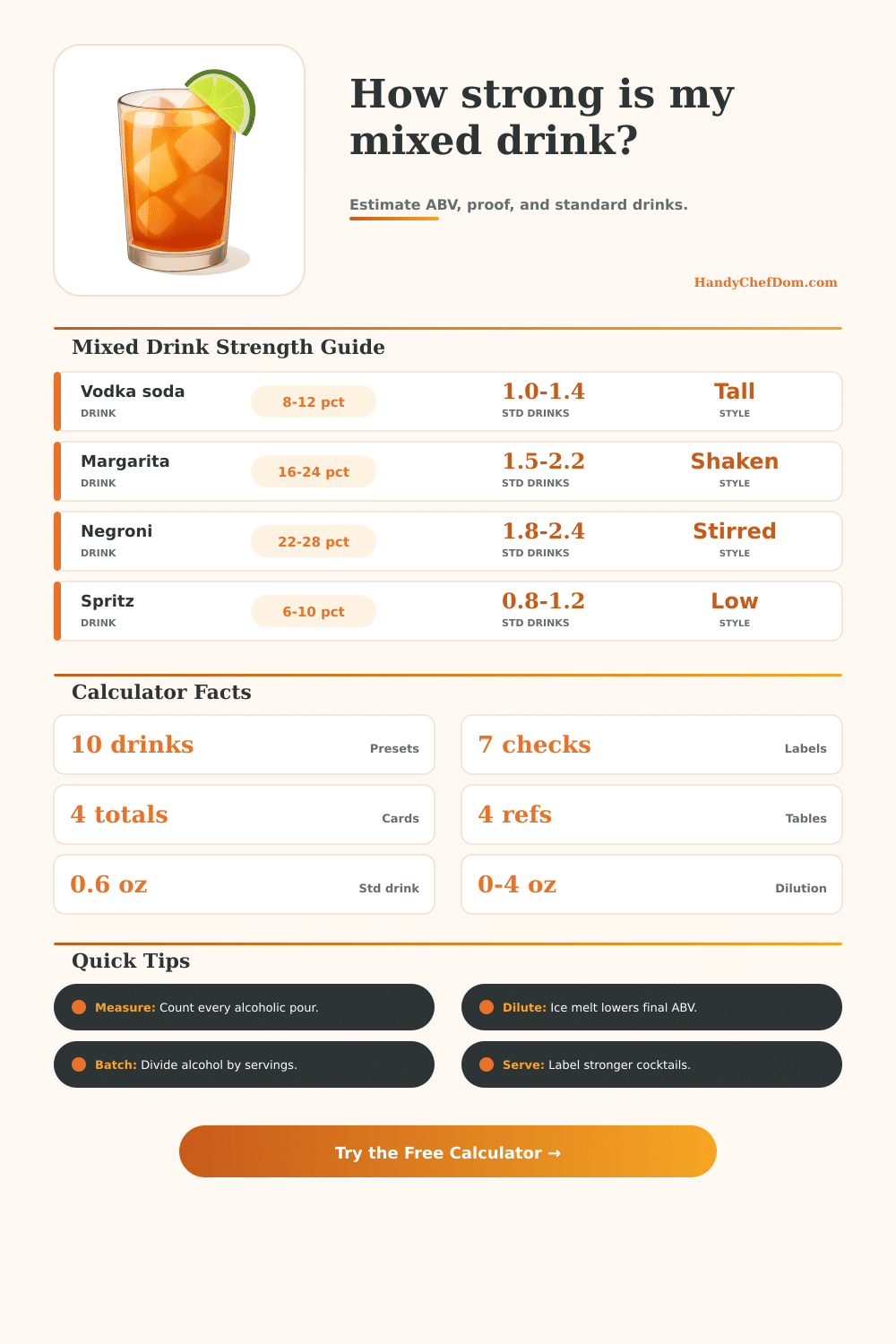
Similar to many beer-strength highballs, spritzes, shandies, and long patio drinks.
Common for spirit plus soda, juice highballs, and shaken sours with plenty of dilution.
Typical for margaritas, daiquiris, cosmos, and many drinks served up or on rocks.
Martinis, old fashioneds, negronis, and compact stirred drinks often land here.
How this mixed drink calculator works
The calculator multiplies each alcoholic ingredient volume by its ABV, adds those pure alcohol amounts together, subtracts any pour loss, then divides by the final drink volume. That final volume includes alcohol, mixer, juice, wine, beer, and dilution from ice or added water.
For United States standard drinks, the calculator uses 0.6 fluid ounce of pure alcohol per standard drink. In metric mode, it still reports the same standard-drink logic while showing volumes in milliliters for easier recipe scaling.
| Drink style | Typical ingredients | Common final ABV | Planning note |
|---|---|---|---|
| Vodka soda or gin tonic | 1.5 to 2 oz spirit plus 4 to 6 oz mixer | 7 to 13 pct | ABV depends heavily on glass size and ice melt. |
| Margarita or daiquiri | Spirit, citrus, sweetener, orange liqueur | 16 to 24 pct | Shorter shaken drinks are stronger than many guests expect. |
| Old fashioned | Whiskey, bitters, sugar, small dilution | 28 to 36 pct | Compact stirred drinks stay spirit-forward. |
| Negroni or boulevardier | Spirit, bitter aperitif, vermouth | 22 to 30 pct | Liqueurs add both alcohol and sweetness. |
| Spritz or shandy | Aperitif, wine or beer, soda | 4 to 10 pct | Large volume can make the drink feel lighter. |
| Technique | Typical dilution | Effect on ABV | When to use |
|---|---|---|---|
| Built over ice | 0.25 to 0.75 oz | Small drop at first, more as it sits | Highballs, spritzes, rocks drinks. |
| Stirred | 0.5 to 1 oz | Moderate drop with smoother texture | Martini, manhattan, negroni, old fashioned. |
| Shaken | 0.75 to 1.5 oz | Noticeable drop and brighter chill | Sours, margaritas, daiquiris, cosmos. |
| Frozen or blended | 1.5 to 4 oz | Large drop because ice becomes drink volume | Frozen margarita, pina colada, slush cocktails. |
| Measure | Imperial shortcut | Metric shortcut | Meaning |
|---|---|---|---|
| Pure alcohol | Volume oz times ABV decimal | Volume ml times ABV decimal | The alcohol portion before mixers. |
| US standard drink | 0.6 fl oz alcohol | About 17.7 ml alcohol | Common US serving benchmark. |
| Proof | ABV pct times 2 | ABV pct times 2 | Used mostly for spirits in the US. |
| Final ABV | Pure alcohol divided by total volume | Pure alcohol divided by total volume | The finished mixed drink strength. |
| Preset | Alcohol sources | Default dilution | Why it is useful |
|---|---|---|---|
| Vodka Soda | Vodka only | Light built-over-ice melt | Shows how mixer volume changes a simple highball. |
| Margarita | Tequila and orange liqueur | Shaken dilution | Balances spirit, liqueur, citrus, and ice water. |
| Negroni | Gin, aperitif, vermouth | Stirred dilution | Demonstrates a compact but alcoholic equal-parts build. |
| Rum Punch | Rum plus liqueur | Juice and ice dilution | Useful for party bowls that taste fruit-forward. |
| Batch Sangria | Wine, brandy, liqueur | Fruit, juice, and chill water | Splits a whole pitcher into realistic servings. |
When you mix a drink at home, it is the total amount of alcohol in your glass that you should consider. It is more important to consider the total amount of alcohol in your glass than the amount of liquid that you pours from each bottle of beverage. The reason that the total amount of alcohol is more important than the amount of liquid is because mixers adds to the total volume of the drink and ice adds water to the drink as it melts.
Additionally, if you are batch making a drink, the total amount of alcohol is divided among several serving, so the amount of alcohol in each serving is naturaly different from the total amount of alcohol in the batch. A cocktail calculator requires specific types of input due to the fact that each of the ingredients has a different effect upon the alcohol percentage of the batch. Spirit volume and ABV contribute to the percentage of alcohol in the drink.
How to Measure Alcohol in Your Drink
The amount of liqueurs and fortified wine that you use will add both alcohol and sweetness to the drink. The ABV of the wine and beer that is used in the recipe will also contribute to the percentage of alcohol in the batch, especially when making a batch for a crowd. The volume of the mixer and the dilution of the drink with ice or water will increase the size of the drink but will have no effect upon the total amount of alcohol in the batch.
Finally, the number of servings that are to be poured from the batch will affect the percentage of alcohol per serving. Many people tend to think about the amount of volume of spirits in their recipe, but each ingredient for the cocktail changes the percentage of alcohol in the cocktail differently. For instance, a cocktail that consists of three moderate pours of spirits is likely to have a higher percentage of alcohol than a cocktail that consists of a large pour of spirits.
When you pour rum into a drink and juice and shake the drink, you may make a cocktail that is flavored different than the rum alone, but it will have a similar percentage of alcohol. Strength bands allow people to understand the use of the calculated percentage of alcohol in the cocktail. A cocktail that features an alcohol percentage between 8% and 15% is similar to many highballs.
A cocktail with an alcohol percentage less than 8% will taste similar to beer, and people may drink several serving of the cocktail without understanding how much alcohol their bodies have consumed. A cocktail with an alcohol percentage above 25% is likely to be a compact stirred cocktail, where more alcohol is delivered to the drink per ounce of cocktail. The strength bands do not describe the best way to serve the cocktail, but it does allow people to understand whether more mixers or liqueurs should be used to the recipe, or if warnings should accompany the cocktail.
If you batch a cocktail, the total amount of alcohol increases, but the amount of alcohol per serving decreases. For instance, a sangria may be mild to five people, but it may contain more than one standard drink per person. With the batch cocktail calculator, you can enter the batch and the number of servings of the batch.
This information is crucial for understanding whether or not you should label the batch of cocktails or adjust the recipe according to the number of guests you have for the evening. Drinks that are stirred will contain less water than drinks that are shaken or frozen to the point of adding several ounces of melt out of the ice cubes. The dilution field is asked of cocktail recipes to allow people to either estimate the amount of dilution that their mixing method will create or to measure that amount in a test batch of the cocktail.
Using this field allows people to avoid the mistake of assuming that the percentage of alcohol in the cocktail will be the same in the mixing bowl as it is when it is poured into the glasses. Standard drink math allows people to understand the total amount of alcohol as standard drinks, as defined in the United States as six-tenths of an ounce of pure alcohol. The number of standard drinks in a batch allows you to understand how much alcohol each guest will consume.
For instance, a single glass of liquor containing two standard drinks is not the same as two glasses with one standard drink each. The difference in amount of alcohol in each of these scenarios will affect how quickly the guests feel the effect of the alcohol in there bodies. Common mistakes in making cocktails include treating the recipe as a fixed number.
People pour the same amount of liquor into different sizes of glasses and use varying amounts of ice in different venues. Additionally, a recipe can taste the same for four people but differ for twelve. However, by using the cocktail calculator, individuals can determine whether altering the recipe will change the alcohol percentage of the cocktail.
The calculator allows people to understand if more mixers or dilution are necessary to the recipe for it to taste the same for each guest. The value of the cocktail batch calculator is best used before beginning to mix the cocktails. Using the batch calculator allows people to determine whether altering the recipe will keep it within the same strength band of alcohol.
Additionally, people can use the batch calculator to determine whether the recipe needs to be altered for a large group of people. By using the batch calculator, people turn a guessing game into a decision. The numbers cannot replace the 5 senses to enjoy the taste of the cocktails being mixed.
However, they can eliminate the reliance on memories of how strong certain cocktails were when they were mixed.