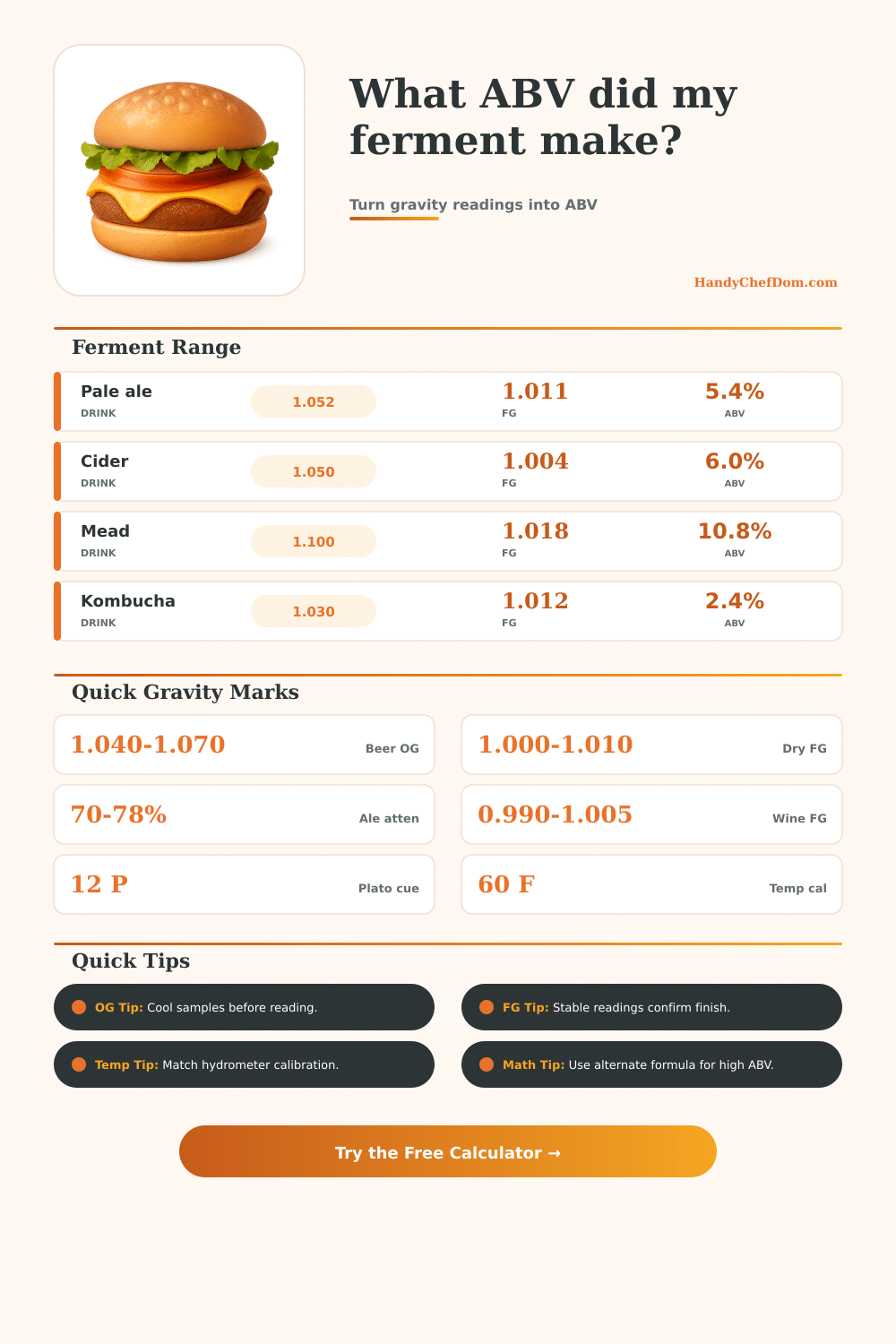
🍺 Specific Gravity to ABV Calculator
Convert original gravity and final gravity into ABV, attenuation, Plato, gravity points, and hydrometer temperature corrections for fermented drinks.
Enter hydrometer readings as specific gravity, such as 1.052 and 1.011. Temperature correction is optional, but useful when samples are warmer than the hydrometer calibration mark.
| Ferment | Typical OG | Typical FG | ABV Range |
|---|---|---|---|
| Light ale | 1.036-1.044 | 1.006-1.012 | 3.8-4.8% |
| Pale ale | 1.045-1.060 | 1.008-1.014 | 4.8-6.2% |
| IPA | 1.056-1.075 | 1.010-1.018 | 6.0-8.0% |
| Stout | 1.040-1.060 | 1.010-1.018 | 4.0-6.5% |
| Cider | 1.045-1.065 | 0.998-1.010 | 5.5-8.0% |
| Mead | 1.080-1.120 | 0.996-1.030 | 9.0-14.0% |
| Wine | 1.070-1.100 | 0.990-1.010 | 9.0-13.5% |
| Kombucha | 1.020-1.050 | 1.006-1.020 | 0.5-3.0% |
| Drop Points | Approx ABV | Example OG | Example FG |
|---|---|---|---|
| 20 | 2.6% | 1.030 | 1.010 |
| 30 | 3.9% | 1.042 | 1.012 |
| 40 | 5.3% | 1.052 | 1.012 |
| 50 | 6.6% | 1.065 | 1.015 |
| 65 | 8.5% | 1.082 | 1.017 |
| 85 | 11.2% | 1.105 | 1.020 |
| SG | Plato | Points | Use |
|---|---|---|---|
| 1.030 | 7.6 P | 30 | Small beer |
| 1.040 | 10.0 P | 40 | Session ale |
| 1.050 | 12.4 P | 50 | Pale ale |
| 1.060 | 14.7 P | 60 | Strong ale |
| 1.080 | 19.3 P | 80 | Big beer |
| 1.100 | 23.8 P | 100 | Mead |
| Hydrometer | Common Cal | Sample Temp | Action |
|---|---|---|---|
| Beer meter | 60 F | 60-70 F | Small adjust |
| Modern kit | 68 F | 65-75 F | Check paper |
| Warm wort | 60 F | 80-100 F | Cool first |
| Wine sample | 68 F | 60-75 F | Degas sample |
| Pulp sample | 60 F | Varies | Strain solids |
| Final check | Any | Room temp | Repeat read |
Formula references used in this calculator: standard ABV equals (OG - FG) x 131.25; advanced ABV equals (76.08 x (OG - FG) / (1.775 - OG)) x (FG / 0.794); Plato uses a cubic SG approximation.
A specific gravity to ABV calculator are used to calculate the percentage of alcohol by volume in a liquid based off it’s specific gravity. To use this calculator, you need to understand that a single hydrometer reading will reveals the density of a liquid. You need to take two specific gravity readings to find the alcohol by volume percentage.
The brewer will take the first reading of specific gravity before the fermentation process begin, and the second specific gravity reading will be taken after the liquid has fermented. Using these two readings, the difference in specific gravity will reveal how much alcohol has been produced during the fermentation process. Because the temperature of a liquid can change its density, the brewer must measure the temperature of the liquid sample at the time of taking the hydrometer reading.
How to Use a Specific Gravity to ABV Calculator
If the temperature of the sample is not accounted for in the calculation of the alcohol by volume percentage, the percentage will be inaccuracy due to the change in the density of the liquid. This calculator allow the user to account for the temperature of the sample, but only if the user provides the actual temperature of the sample to the calculator. The temperature of many samples is often forgotten when taking the reading.
If the temperature is forgotten, the calculation of the percentage of alcohol by volume will be incorrect. Depending on the type of fermented liquid that is being measured, there is different formulas within this calculator. For instance, beer and ciders uses a simple formula to calculate the percentage of alcohol by volume.
However, for stronger liquors like mead and wine, a more advanced formula is used. An advanced formula should of been used if the specific gravity of the original liquid is high. This formula will provide a more accurately calculation of the percentage of alcohol by volume in the fermented liquid.
Along with the percentage of alcohol by volume, many specific gravity to ABV calculators also provides a measurement of the attenuation of the liquid. The attenuation percentage will indicate how much of the sugar in the liquid was consume by the yeast during the fermentation process. A higher percentage of attenuation means that the yeast consumed more of the sugar during fermentation, which results in a dryer liquid.
With a lower percentage of attenuation, the yeast did not consume as much of the sugar in the liquid, which result in a sweeter liquid. The attenuation percentage is useful for determining if the yeast reached the alcohol percentage that it is capable of fermenting, or if the initial temperature of the mash create unfermentable sugars. Another tool that can be used within the calculator is the reference tables.
These table show the range of specific gravities for different types of beverages. For instance, an original gravity of 1.052 is common for pale ales, but 1.052 for mead is relatively unusual. By referring to these tables, a brewer or winemaker can determine if the specific gravity of their beverage is within the expected range of gravity for that type of beverage.
By taking the final gravity reading twice, it is possible to obtain a more accurate measurement of the alcohol by volume percentage of the fermented liquid. The second reading should be taken several days after the first to ensure that the fermentation process is complete. If the gravity readings is the same for both takes, this indicate that the fermentation process is done.
This will result in an accurate alcohol by volume percentage value from the calculator. Finally, if any liquids were added to the fermenting liquid after the initial gravity reading was taken, that total volume of the liquid will change. Whether it be water, fruit juice, or hops, the total volume will change and the density will change as a result.
The creator of the specific gravity to ABV calculator must account for these new values to ensure that the percentage of alcohol by volume is accurate. While the calculator may eliminate the need for manual calculations for the percentage of alcohol by volume in the beverage, the calculator only provide that percentage if the values provided to it are accurate.