🧀 Paneer Calculator
Estimate paneer yield, acid amount, whey volume, pressing loss, and servings from your milk volume, fat level, acid type, and texture target.
Enter the milk batch and texture plan. The calculator estimates curd yield, acid demand, drained whey, and how many paneer servings the batch should cover.
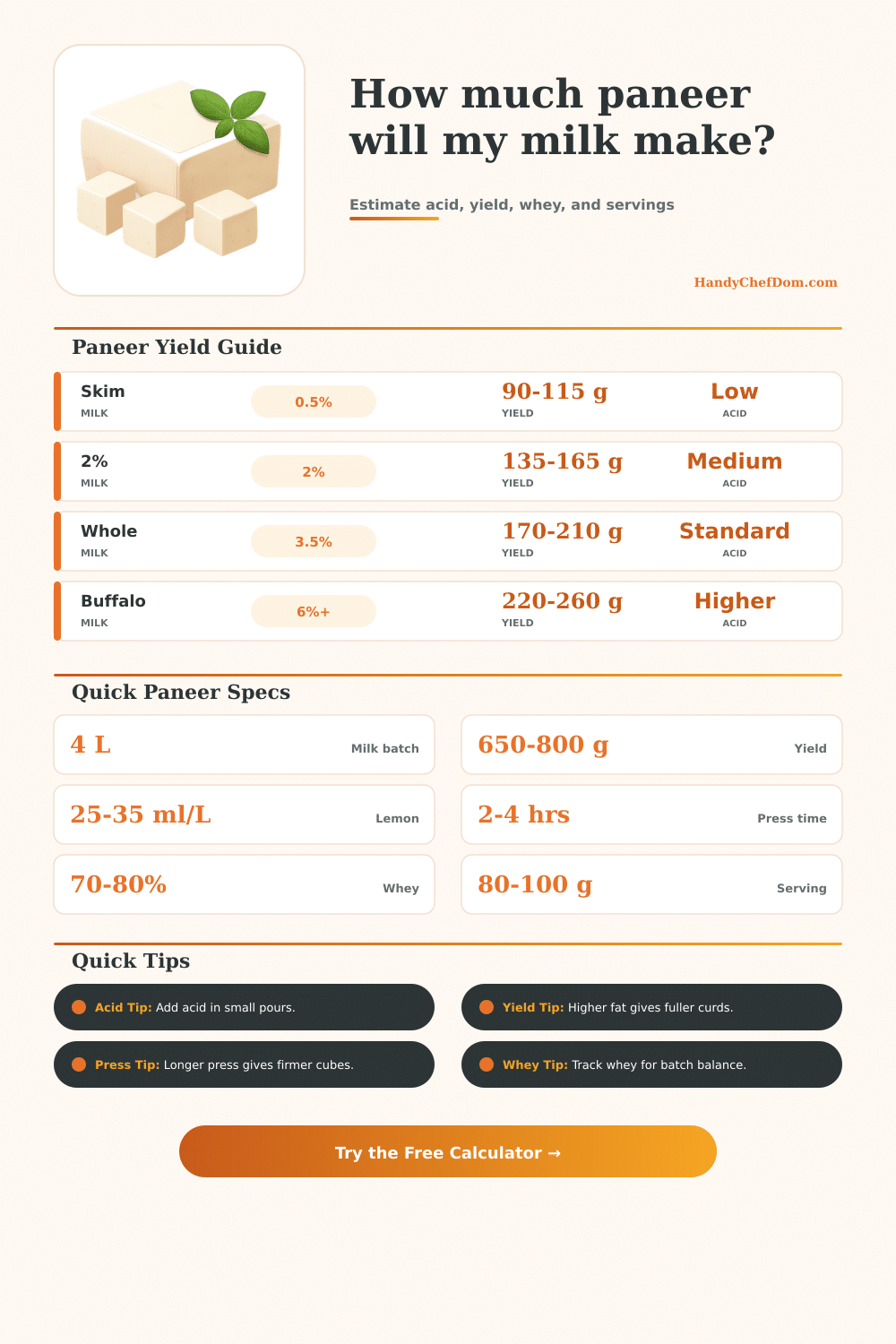
| Milk type | Typical fat | Yield per L | Best texture |
|---|---|---|---|
| Skim milk | 0.5% | 90 to 115 g | Lean and crumbly |
| Low fat milk | 1% | 110 to 140 g | Light blocks |
| 2 percent milk | 2% | 135 to 165 g | Everyday cubes |
| Whole cow milk | 3.5% | 170 to 210 g | Classic paneer |
| Jersey cow milk | 4.8% | 190 to 230 g | Rich curd |
| Buffalo milk | 6.5% | 220 to 265 g | Dense blocks |
| Cow and buffalo mix | 5% | 200 to 245 g | Firm cubes |
| Goat milk | 3.8% | 145 to 180 g | Soft curds |
| Acid type | Working amount | Unit | Curd behavior |
|---|---|---|---|
| Lemon juice | 25 to 35 | ml per L | Soft bright curd |
| White vinegar | 18 to 25 | ml per L | Clean firm curd |
| Citric acid solution | 10 to 16 | ml per L | Precise curd set |
| Citric acid powder | 0.9 to 1.4 | g per L | Fast curd break |
| Plain yogurt | 100 to 150 | g per L | Mild and creamy |
| Buttermilk | 140 to 200 | ml per L | Gentle curd set |
| Pressing style | Time | Yield effect | Best use |
|---|---|---|---|
| No press | 0 hr | Highest moisture | Bhurji and stuffing |
| Light press | 0.5 to 1 hr | Soft yield | Crumbles and salads |
| Classic press | 2 to 3 hr | Balanced yield | Curries and cubes |
| Firm press | 4 to 5 hr | Lower yield | Sauteed cubes |
| Extra firm press | 6 to 8 hr | Lowest moisture | Skewers and grills |
| Serving plan | Paneer per person | 4 L whole milk | Notes |
|---|---|---|---|
| Side dish | 55 to 70 g | 10 to 13 servings | With dal or rice |
| Main curry | 80 to 100 g | 7 to 9 servings | Classic dinner use |
| Tikka starter | 70 to 90 g | 8 to 10 servings | Firm cubes help |
| Meal prep | 100 to 125 g | 6 to 8 servings | Portion into boxes |
| Party tray | 45 to 60 g | 12 to 16 servings | Small appetizer pieces |
Making paneer at home require an understanding of the relationship between the volume of milk that you start with and the weight of the paneer that will be produce. While four liter of milk might be a good starting point for making paneer, the weight of the paneer that is produced is dependent upon the amount of whey that is drained from the curds that are produced from the milk. Thus, in order to determine how much paneer will be produced with a given volume of milk, it is first necesary to account for the difference in weight between the initial milk and the finished paneer.
The calculator that is provided on this page will help you to determine the weight of paneer that will be produced with a given volume of milk. To utilize the calculator, you must enter the volume of milk that you will use to make your paneer, you must select the type of milk that will be used, you must enter the fat percentage of the milk, you must select the type of acid that will be added to the milk, and you must select the firmness of paneer that you will produces. Based upon these variables, the calculator will produce an estimate of the weight of paneer that will be produced, the volume of acid that will be required, the volume of whey that will remain after the paneer is set, and the numbers of servings that the paneer will provide.
How Much Paneer You Can Make from Milk
The fat content of the milk will have an impact upon the amount of paneer that is produced. Milk that is highly in fat will produce paneer that is more full and that holds together well during the pressing stage. Low-fat milk, however, can produce paneer that is light in weight and may become crumbly if the milk is pressed for too long.
The calculator accounts for these different types of milks and their impact upon the paneer that is produced. Additionally, the fat percentage of the milk will also impact the amount of acid that is required to separate the curds from the milk. Higher fat milks may require more or less acid then lower fat milks in order to achieve the same results in the formation of paneer.
The type of acid that is added to the milk will impact the flavor of the paneer that is produced. For instance, lemon juice will produce paneer that contains a brighter flavor than vinegar, but the paneer that is produced with vinegar will tend to create a firmer curd. Yogurt and buttermilk creates a mild flavor to the paneer that is produced with them.
The calculator will calculate the amount of acid that is required according to the strength of the acid that you choose. For example, you will not require the same amount of five percent lemon juice as you will ten percent citric acid. Using too much acid will produce paneer that contains a grainier texture.
The firmness of the paneer that you would like to create will impact the amount of time that the curds are pressed. Paneer that is pressed for longer periods will become firmer and retain less moisture. Paneer that is pressed for shorter periods will produce softer paneer that will retain more moisture.
Paneer that is use in recipes like bhurji requires shorter pressing periods than paneer that is to be used in recipes like tikka. The calculator accounts for the firmness of paneer that will be produced. Additionally, knowing the weight of the paneer that will be produced will allow you to determine if the paneer will be used for main dish or side dishes.
Furthermore, the volume of whey that will be produced can be used to help determine how the whey can be used for other recipes in the kitchen. The amount of paneer that can be produced is not likely to be precisely the same as that which is produced with the calculator. For example, the temperature of the kitchen, the length of time in which the curds are allowed to drain, and the tightness of the muslin cloth that is used to press the paneer can impact the texture of the paneer that is produced.
In addition to these variables, it is possible that additional acid will have to be added to the milk as the curds separate to ensure that the paneer is even and clean. However, the calculator is a starting point for understanding how much paneer can be produced with the available milk and acids in the kitchen. You could use the reference tables on this page to determine how different types of milk or acids impact the production of paneer without using the calculator.
Many common mistakes can be made in attempting to produce paneer at home. For instance, some cooks may not adjust for different types of milk in their calculations. Others may use the same amount of acid for high fat milks and low fat milks.
Additionally, some cooks may press the paneer for too long or for too short of a period of time. These different mistakes may create paneer that is either too dry to eat or too soft and that tends to fall apart when place into a pan. By adjusting the parameters of the calculator according to the type of paneer that you would like to produce, you can avoid these common mistakes.
By utilizing the calculator to determine the amount of paneer that will be produced, you can better manage the storage of the paneer that will be produced and the portion of the paneer that will be used in each meal. Paneer may be required in different portions for different meals each week. Thus, knowing the amount of servings of paneer that will be produced will allow you to ensure that there is enough paneer to last each person in the household for the meals of the week.
Furthermore, the calculator can be used to determine how many servings of paneer will be required for guests. The portions for guests may be less than the portions that are used in the preparation of meals. Thus, the amount of servings will allow you to prepare enough paneer for each guest to eat.
One more factor to consider is the volume of whey that will be produced during the production of paneer. Because the whey that is produced can be used for other recipes in the kitchen, it is important to have a container in which to store the whey. The volume of whey will be produced in relation to the volume of milk that is used to produce the paneer.
Thus, since you may have several liters of whey after you produce the paneer, it is a good idea to have a container ready to hold the whey. The calculator will provide an estimate of the amount of whey that will be produced. Once you understand the impact of the type of milk, the type of acid, and the amount of time during which the paneer will be pressed, you can use the calculator to produce paneer at home in a repeatable manner.