🥩 Corned Beef Cooking Time Calculator
Estimate corned beef brisket timing by weight, flat or point cut, stovetop, oven, slow cooker, or pressure cooker method, desalting soak, tenderness target, vegetables, rest, slices, and guests.
Choose a starting plan or enter your own brisket details. The result gives a first tenderness-check window, vegetable timing, resting time, and serving math.
Classic gentle simmer for flat or point cuts when you want easy vegetable timing in one pot.
Steady covered heat works well for larger or thicker briskets and keeps the pot out of the way.
Best for set-and-check planning; low is gentler while high is useful for smaller cuts.
Fastest meat timing, with vegetables usually handled after the brisket rests or depressurizes.
| Method | Flat cut | Point cut | Best first check |
|---|---|---|---|
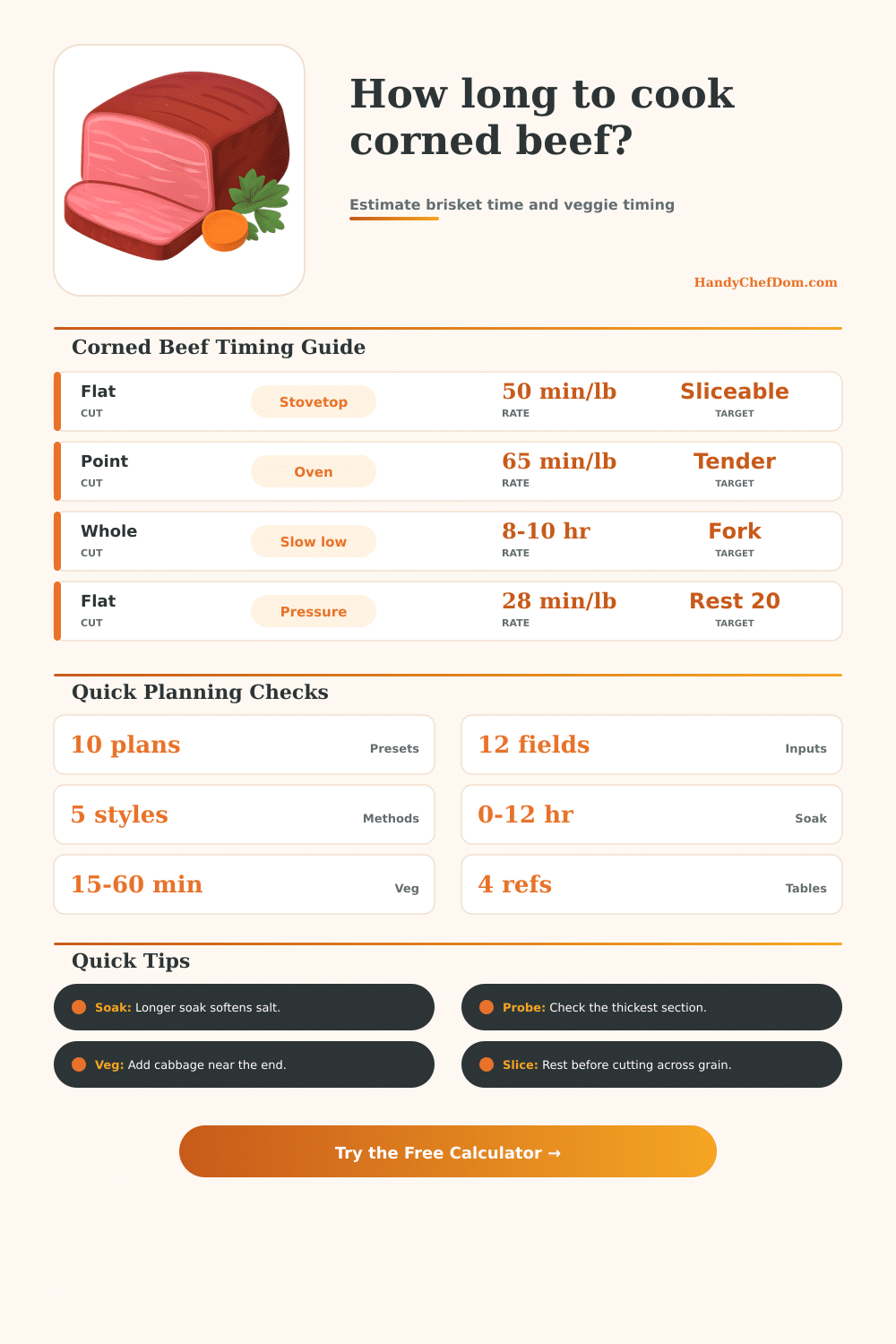
| Stovetop gentle simmer | 45 to 55 min per lb | 52 to 62 min per lb | Check when a fork slides in with light resistance. |
| Oven braise 300 F | 55 to 65 min per lb | 62 to 72 min per lb | Keep covered and check the thickest section first. |
| Slow cooker low | 7 to 9 hr for 3 to 4 lb | 8 to 10 hr for 3 to 4 lb | Begin checking near the final hour. |
| Slow cooker high | 4 to 5.5 hr for 3 to 4 lb | 4.5 to 6.5 hr for 3 to 4 lb | Use earlier checks for small lean flats. |
| Pressure cooker | 24 to 30 min per lb | 28 to 34 min per lb | Include natural release before testing tenderness. |
| Choice | Texture goal | Calculator effect | Serving fit |
|---|---|---|---|
| Flat cut brisket | Neat slices | Baseline timing | Best for dinner plates and sandwich slices. |
| Point cut brisket | Richer, softer bite | Adds about 12% | Good for chunked portions and hearty platters. |
| Whole flat and point | Mixed tenderness | Adds about 8% | Check flat and point separately before slicing. |
| Sliceable tender | Holds together | Baseline target | Rest, then cut across the grain. |
| Pull-apart tender | Very soft texture | Adds about 22% | Better for chunks than clean slices. |
| Vegetable | Stovetop or oven | Slow cooker | Pressure cooker plan |
|---|---|---|---|
| Potatoes, medium chunks | Add 45 to 55 min before finish | Add for final 90 to 120 min | Cook after meat, 4 to 6 min pressure. |
| Carrots, medium chunks | Add 35 to 45 min before finish | Add for final 75 to 100 min | Cook after meat, 3 to 5 min pressure. |
| Cabbage wedges | Add 15 to 22 min before finish | Add for final 45 to 60 min | Steam or pressure 1 to 3 min after meat. |
| Small-cut vegetables | Add 5 to 10 min later | Add 20 min later than medium | Use the shorter pressure range. |
| Large-cut vegetables | Add 8 to 15 min earlier | Add 20 to 30 min earlier | Use the longer pressure range. |
| Planning step | Typical range | Calculator use | Practical cue |
|---|---|---|---|
| Rinse only | 0 min soak | No extra prep time | Use when you like a classic salty profile. |
| Desalting soak | 30 min to 12 hr | Back-scheduled before cooking | Change water once for long soaks. |
| Rest before slicing | 10 to 30 min | Added after meat and vegetables | Rest longer for large or very tender brisket. |
| Cooked yield | 55% to 65% of raw weight | Feeds guest and slice math | Point cuts often yield a little less than flats. |
| Slice thickness | Thin to thick | Changes total slices | Always slice across the grain for cleaner pieces. |
Cooking corned beef require careful attention to teh timing of the cooking process. The timing of the cooking process will determine the texture of the corned beef. Many people makes the mistake of treating corned beef like a simmered recipe for beef.
The weight of the corned beef, the cut of the corned beef, the cooking method for the corned beef, and the resting time for the corned beef can all change the total time that the corned beef need to be cooked. If these different variable are not accounted for, the corned beef may be underdone in the middle of the cut of the meat, or the corned beef may be dry at the edges of the cut of the meat. One of the main variables in the cooking of corned beef is the weight of the corned beef.
How to Cook Corned Beef
A three-pound cut of corned beef will cook faster than a five pound cut of corned beef. Additionally, the cut of the corned beef can change the cooking time for the corned beef. For instance, a cut that contains more fat than another cut will require less cooking time than a cut that contains little fat.
Additionally, cuts that are meant to provide a sliceable texture will require less cooking time than cuts that are meant to provide a pull apart texture. In these cases, a calculator can be used to determine the weight of the corned beef that will be cooked and the desired doneness of the cooked corned beef. Another variable that can change the cooking time for corned beef is the cooking method for the corned beef.
For instance, simmering the corned beef on the stovetop will require more cooking attention than cooking the corned beef in the oven. However, the oven will cook the corned beef more even than on the stovetop. Slow cookers requires little cooking attention but take longer than stovetop cooking.
Pressure cookers take the least amount of time to cook the corned beef but require cooking the vegetables at a different time than the corned beef. Each cooking method will change the time at which the vegetables are added to the pot. Another factor in the preparation of corned beef is the salt level of the corned beef.
Corned beef contains salt in the cure that is added to the meat. As a result, the corned beef will taste very saltily when it is cooked. To reduce the amount of salt in the corned beef, you can rinse the corned beef with water prior to cooking, or soak it in cold water for a longer period of time prior to cooking.
A longer soak in cold water will aid in managing the salt in the corned beef, and the soaking of the corned beef in cold water should be performed prior to beginning to cook the corned beef. The vegetables that are cooked along with the corned beef require different timing to the cooking of the corned beef. For instance, vegetables like potatoes and carrots require more time to simmer in the cooking liquid than vegetables like cabbage require of the corned beef.
The cabbage will become too soft if it simmers in the cooking liquid for too long. Additionally, the size of the vegetables will impact the time required to cook the vegetables. For instance, larger chunks of vegetables require more time to cook than smaller chunks of vegetables.
As a result, the larger chunks of vegetables should be added to the cooking pot at a different time than the smaller chunks of vegetables. In addition to cooking the corned beef, the corned beef should be rested after it has been cooked. A short period of resting is acceptable if the preparation of the meal is rushed, but allowing the corned beef to rest for a longer period of time will allow the fibers of the meat to relax.
When the fibers of the corned beef relax, the corned beef will hold together better when it is sliced against the grain of the meat. This resting period is essential for large briskets to allow for nice, tidy slices of corned beef to be produced. Another factor related to the cooking of corned beef is the yield of the corned beef.
The raw weight of the corned beef will shrink throughout the cooking process. This is due to the fat in the cut of corned beef rendering during the cooking process, as well as due to the loss of moisture from the corned beef during the cooking process. Additionally, cuts of corned beef that contain more fat, such as point cuts of corned beef, will feature less meat once the corned beef is cooked than cuts that contain less fat, such as flat cuts of corned beef.
Flat cuts will retain more of the original weight of the raw corned beef. It is important to know the yield of the corned beef to determine how many guests the corned beef will be able to feed. Many mistake are made when cooking corned beef.
For instance, some cooks may add the vegetables to the pot at the same time as the corned beef is being added to the pot. In this case, the vegetables may become overcooked. Additionally, many cooks may skip the step of rinsing the corned beef to remove the excess salt.
This can make the corned beef too salt to eat. Finally, cooks may also slice the corned beef immediately after it is cooked. In this case, the corned beef may fall apart when sliced.
To avoid making these mistakes, cooks should use reference tables to determine both the timing of the cooking of the corned beef, and the timing of the addition of the vegetables to the cooking pot.