🍖 Roast Pork Bone-In Cooking Time Calculator
Estimate bone-in pork shoulder, loin, and rib roast timing from cut type, bone percentage, oven temperature, target finish, crackling or covered style, rest time, and guest count.
This calculator focuses on bone-in roast pork cuts that are not pork leg: shoulder, picnic shoulder, loin rib roast, rack of pork, and rib-end roasts. Use a thermometer to confirm the final result because oven behavior and roast shape can shift the window.
Best for longer roasting, high targets, shreddable texture, and skin-on crackling plans.
Often has more bone and skin, so the calculator gives it more time and lower edible yield.
Works well at moderate oven heat with lower target temperatures and a shorter rest.
Ribs raise bone share, so guest coverage depends on edible cooked meat, not raw weight.
Adds a short high-heat stage before the steady roast and slightly trims the main cook.
Covered roasting can speed the main stage, then uncovering adds active finishing minutes.
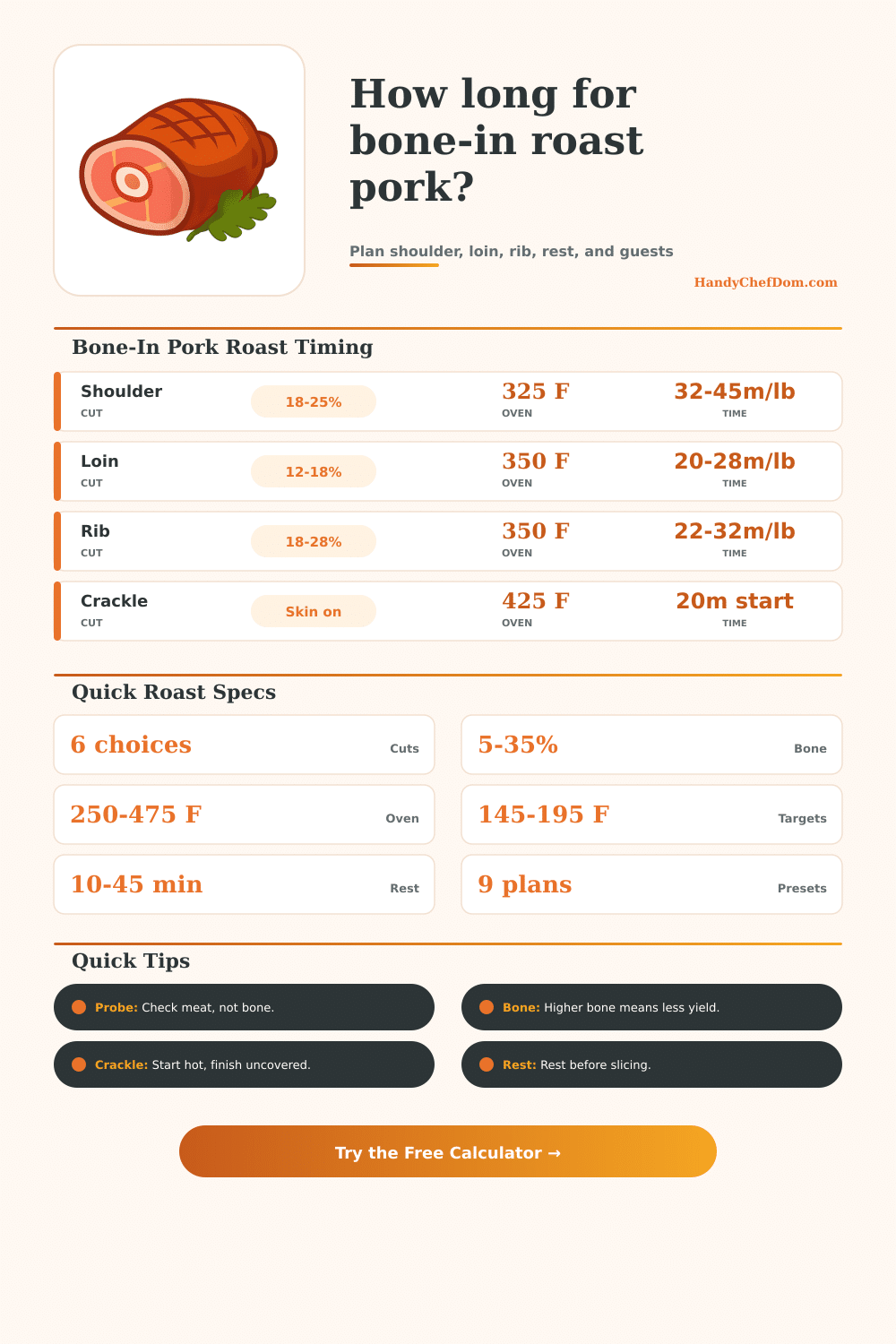
| Bone-in pork cut | Typical bone share | Common oven range | Sliceable timing | Higher target timing |
|---|---|---|---|---|
| Shoulder blade roast | 18 to 25 percent | 300 to 350 F | 30 to 38 minutes per lb | 38 to 52 minutes per lb |
| Picnic shoulder roast | 20 to 30 percent | 300 to 350 F | 34 to 42 minutes per lb | 44 to 58 minutes per lb |
| Center loin rib roast | 12 to 18 percent | 325 to 375 F | 20 to 28 minutes per lb | Not usually targeted high |
| Rack of pork or crown rack | 20 to 30 percent | 325 to 375 F | 22 to 32 minutes per lb | Not usually targeted high |
| Rib-end pork roast | 18 to 26 percent | 325 to 375 F | 24 to 34 minutes per lb | 32 to 42 minutes per lb |
| Country-style rib roast | 10 to 20 percent | 300 to 350 F | 28 to 36 minutes per lb | 36 to 48 minutes per lb |
| Bone percentage | What it usually means | Timing adjustment | Yield adjustment | Best calculator use |
|---|---|---|---|---|
| 5 to 10 percent | Small bone or trimmed rib end | Little added time | High edible share | Country-style or lightly boned roast |
| 11 to 18 percent | Typical loin rib roast | Small to moderate added time | Good slice yield | Sunday loin and rib roasts |
| 19 to 25 percent | Shoulder blade or rack | Moderate added time | Less edible meat per raw lb | Shoulder and rack planning |
| 26 to 35 percent | Heavy rack or picnic bone | Higher timing cushion | Plan more raw weight | Large bones and showpiece racks |
| 36 percent plus | Very bony or skin-heavy roast | Use wide time window | Lowest edible share | Check early, then extend as needed |
| Style setting | Main effect | Active step | Main cook change | Use when |
|---|---|---|---|---|
| Uncovered roast | Standard dry roasting | None | Baseline | Loin, rib, and moderate shoulder roasts |
| Hot crackling start | Begins with high surface heat | 15 to 25 minutes | Slightly shorter main cook | Skin-on shoulder or rack with crackling |
| Crackling finish | Crisps after steady roasting | 8 to 15 minutes | Baseline main cook | Roasts that brown late |
| Covered then open | Moist heat first, browning late | 10 to 18 minutes uncovered | Slightly faster main cook | Shoulder roasts that need tenderness |
| Mostly covered moist roast | Steadier humid heat | Optional 5 to 10 minutes | Faster but less crisp | Picnic shoulder and tender slicing |
| Guests | Light buffet raw roast | Standard dinner raw roast | Hearty raw roast | Cut note |
|---|---|---|---|---|
| 4 guests | 2.5 to 3.25 lb | 3.25 to 4.25 lb | 4.5 to 5.5 lb | Small loin rib roast works well |
| 6 guests | 3.75 to 4.75 lb | 5 to 6.25 lb | 6.5 to 8 lb | Rack or shoulder blade roast |
| 8 guests | 5 to 6.25 lb | 6.5 to 8.25 lb | 8.5 to 10.5 lb | Choose lower bone share for more slices |
| 12 guests | 7.5 to 9.5 lb | 10 to 12.5 lb | 13 to 16 lb | Large rack or two shoulder roasts |
| 18 guests | 11 to 14 lb | 15 to 18 lb | 19 to 23 lb | Two roasts are easier to time evenly |
Timing estimates are planning windows for bone-in roast pork. Always confirm the final result with a thermometer placed in the thickest meat away from bone.
Because pork roast with the bone in the roast cooks different than pork roast without the bone in the roast, the weight of the roast will not necesary equal the weight of the edible meat. The bone in the pork roast will actualy slow the transfer of heats to the roast, and the bone will help to keep the roast juicy. However, you must account for the weight of the bone in the roast and the weight of the skin on the roast; both of these components of the roast are not edible meat.
If the pork roast has a high percentage of bone, more raw weight of roast must be purchased to account for the weight of the bone and to ensure that there is enough edible meat to serve each guests. Pork roast shoulder roasts will contain a higher percentage of bone than loin roasts. The temperature to which you set the oven will impact both the rate at which the roast cooks, as well as the length of time that the roast need to reach the target internal temperature.
How to Cook and Serve a Pork Roast
If you set the oven to a lower temperature, the heat will move more slow within the roast; this slow rate of heat transfer will help to prevent the roast from drying out. A low oven temperature is especially helpful for shoulder roasts. Alternatively, if the cook cooks the roast at a higher temperature, the heat will move more quickly within the roast.
Higher temperatures is useful for loin roasts. However, higher temperatures can be a risk factor for overcooking the roast if the cook places it in a colder part of the oven. The target internal temperature will differ for each cut of pork roast.
For instance, loin roasts or rib roasts should be removed from the oven at a lower internal temperature than shoulder roasts because the loin and rib roasts can become dry if cooked to an overly high internal temperature. Shoulder roasts contain more connective tissue than loin roasts; that connective tissue will become soft when cooked to a higher internal temperature. Regardless of the type of pork roast that is to be cooked, the roast should be removed from the oven a few degree before it reaches the target internal temperature; the roast will continue to cook after it is removed from the oven.
This process is referred to as carryover cooking. The skin on the pork roast will alter the method in which the roast is cooked. If the skin is left on the roast, the roast will need to reach high temperatures to create crackling on the roast.
Achieving crackling require more time to reach high temperatures. If the cook roasts the roast under a cover, the cover will trap the moisture of the roast, and the roast will require less time to cook. The decision of whether to include crackling on the roast will impact the cooking process; crackling will require a change in the use of the oven.
The shape of the roast and the starting temperature of the roast will impact the length of time for which the roast needs to cook. A thick roast will require more time to fully cook than a roast with a longer, narrower shape. Additionally, a roast that starts at a temperature of 40°F will require more time to cook than a roast that has been allowed to sit out until it reaches the internal temperature of 70°F. These factors will impact the length of time that the roast needs to reach the target internal temperature; they will not impact the target internal temperature.
After the roast has been cooked, it must be rested. Resting the roast allows the muscle fiber within the roast to relax. This relaxation of the muscles within the roast allows the juices that are contained within the roast to redistribute throughout the roast.
If the roast is not rested, the juices will exit the roast when it is carved. Shoulder roasts contain more protein than loin roasts; because of the higher protein content, a shoulder roast will require a longer resting time. This resting time should of been accounted for within the meal timeline.
The number of guest that will eat the roast and the appetite of those guests will determine the amount of edible meat that is required. If the meal includes a buffet with many side dishes, less meat will be required per person than if the roast is the main course of the meal. The edible yield will account for the weight of the bone and the shrinkage of the roast.
If the calculation of the edible yield of the roast indicates that there will be extra servings of roast, there will be extra roast meat that can be served as leftovers. If there are too few servings of roast calculated, it will be known prior to cooking that more roast meat will need to be purchased. Regardless of the recipe that is used to calculate the edible meat yield of the pork roast, the internal temperature of the roast should always be checked in the thickest part of the meat to ensure it is cooked to the desired doneness.