🥐 Laminated Dough Calculator
Plan croissant, Danish, puff pastry, and rough puff dough by flour weight or target batch weight, then size the butter block, folds, layers, sheet, pieces, hydration, and trim loss.
Enter flour or target laminated dough weight, choose a pastry profile, and set the fold plan. The calculator treats butter as a lock-in percentage of flour and calculates layers from half, single, and book folds.
Always 100%.
0% hydration.
0% of flour.
0% of flour.
0% of flour.
0% of flour.
0% of flour.
0% of flour.
Classic croissant structure with open honeycomb potential.
Compact Danish or croissant-style schedule with defined layers.
Finer layers for Danish sheets and laminated pastries.
Classic puff pastry count for very fine lift and flake.
| Preset style | Hydration | Butter percent | Typical fold plan | Best planning use |
|---|---|---|---|---|
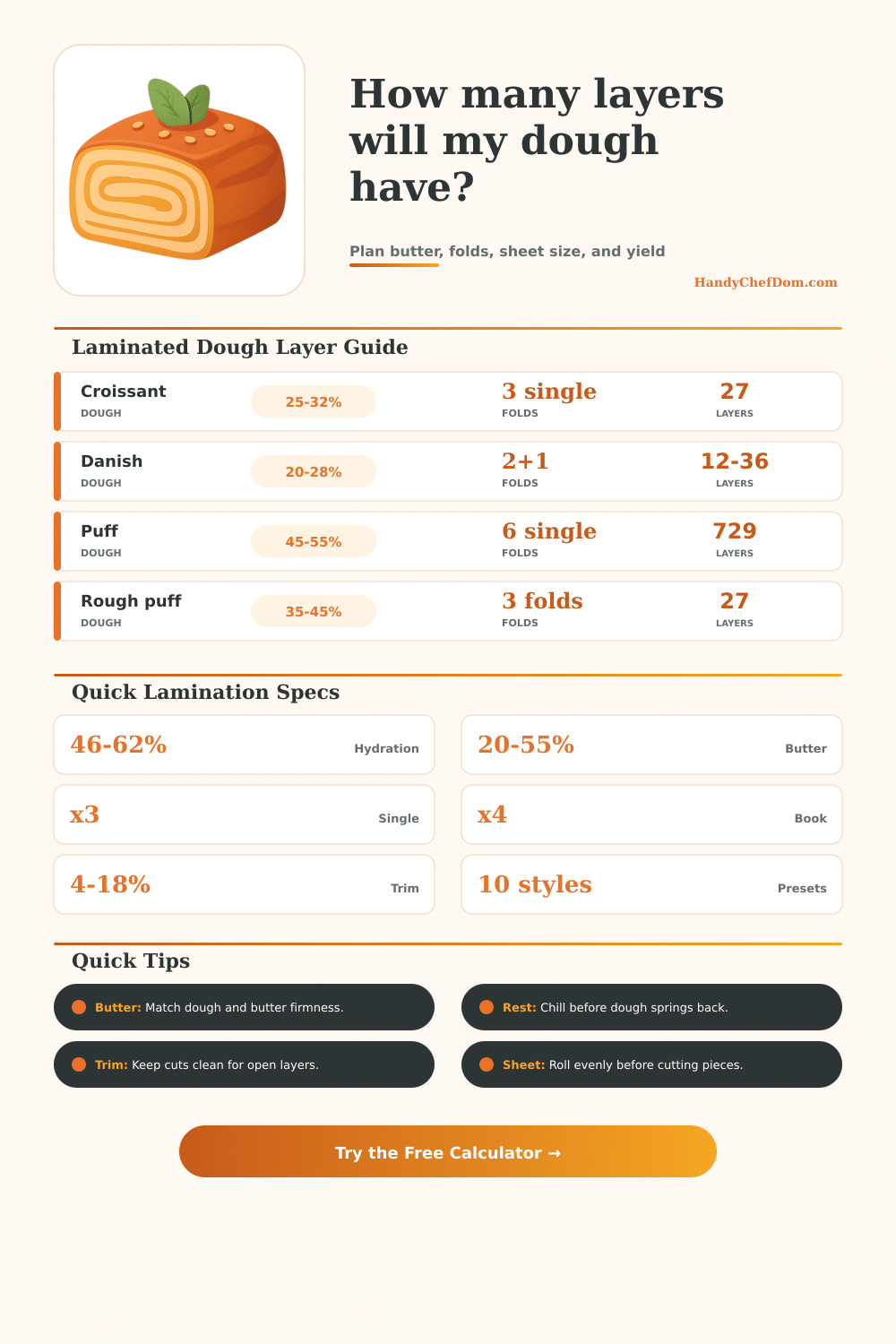
| Classic croissant | 52 to 58% | 25 to 32% | 3 single folds | Balanced lift, rollability, and open layers |
| Danish dough | 50 to 60% | 20 to 30% | 1 book plus 1 to 2 singles | Richer dough that still sheets cleanly |
| Classic puff pastry | 45 to 52% | 45 to 55% | 5 to 6 single folds | High butter, high layer count, no yeast |
| Rough puff | 45 to 55% | 35 to 45% | 3 to 4 rough folds | Faster flaky sheets with less precision |
| Kouign-style dough | 48 to 56% | 28 to 38% | 3 single folds | Richer laminated base before sugaring |
| Variable | Low range | Middle range | High range | Calculator cue |
|---|---|---|---|---|
| Butter percent of flour | 20 to 25% | 26 to 35% | 45 to 55% | More butter increases total batch weight and sheet fragility |
| Butter coverage of block | 50 to 60% | 62 to 70% | 75 to 85% | Coverage estimates block width and length before lock-in |
| Hydration | 45 to 50% | 52 to 58% | 60 to 65% | Higher hydration feels extensible but can squeeze butter |
| Trim loss | 4 to 6% | 8 to 12% | 14 to 18% | More shaped pastries and triangles need more trim buffer |
| Final thickness | 2 to 3 mm | 3.5 to 5 mm | 6 to 8 mm | Thin sheets need more area for the same dough weight |
| Fold type | Layer multiplier | Example schedule | Butter layer result | Use case |
|---|---|---|---|---|
| Half fold | 2x | 1 half fold | 2 butter layers | Useful after lock-in or for rough puff starts |
| Single fold | 3x | 3 single folds | 27 butter layers | Standard croissant lamination |
| Book fold | 4x | 2 book folds | 16 butter layers | Fast layer building with fewer turns |
| Mixed fold plan | Multiplied together | 1 book plus 2 singles | 36 butter layers | Danish or hybrid schedules |
| Puff pastry plan | High multiplier | 6 single folds | 729 butter layers | Very fine laminated flake |
| Pastry cut | Common sheet thickness | Example piece size | Trim allowance | Planning note |
|---|---|---|---|---|
| Croissant triangles | 3 to 4 mm | 10 x 25 cm triangle blanks | 8 to 12% | Long triangles need a larger sheet than square pieces |
| Pain au chocolat | 3.5 to 4.5 mm | 8 x 15 cm rectangles | 6 to 10% | Rectangles waste less dough than triangles |
| Danish squares | 4 to 5 mm | 10 x 10 cm squares | 5 to 9% | Good yield because cuts tile cleanly |
| Puff pastry lids | 2 to 3 mm | 12 x 12 cm squares | 8 to 14% | Thin sheets cover more area but tear easily |
| Turnover squares | 3 to 4 mm | 12 x 12 cm squares | 7 to 12% | Leave enough area for sealing and folding |
This calculator plans laminated dough by weight and geometry. Actual sheet behavior changes with flour strength, butter plasticity, dough temperature, rolling pressure, and rest time.
Laminated dough is used to make croissants, Danish pastries, and puff pastry. The quality of the laminated dough relies on the mathematical proportion of the ingredients. You need to know the weight of the flour, the amount of liquid in the dough, and the amount of butter that youll use in the dough.
Furthermore, you need to understand how the fold of the dough will multiply the number of layers of laminated dough that each fold will create. The sheet of laminated dough will need to be large enough to allow for the desired number of piece of pastry to be cut out of the sheet. The laminated dough calculator allow you to input the different numbers associated with the dough recipe.
Using a Laminated Dough Calculator
For example, you can input the weight of the flour or the target batch size for the dough. You can adjust the hydration, the butter percentage, and the fold plan for the dough in the calculator. For instance, croissant dough is different than puff pastry dough.
You can also use the calculator to input the amount of sugar, salt, yeast, egg, and milk powder needed for your recipe. The calculator will automatically calculate the total number of layers that will result from the fold plan that you program into the calculator. Furthermore, the calculator will provide you with the size of the butter block, the dimension of the dough block, and the amount of usable dough once you trim the dough sheet to remove the edges.
The butter percentage for your recipe is one of the primary factor that will impact your laminated dough. A lower percentage of butter will make the dough more easy to handle due to the increased extensibility of the dough with a lower butter percentage. A higher butter percentage will produce more lift and shattering of the laminated pastry once baked.
Furthermore, the butter percentage will impact the doughs texture once you roll it with a rolling pin. You will need to adjust how many time you rest the dough according to the butter percentage. If the butter is too soft, it will squeeze out of the edges of the dough.
If the butter is too firm, it will crack when you roll the dough. You need to ensure that the firmness of the butter match that of the dough. The calculator will allow you to maintain the correct percentage of ingredients to ensure that this matching of dough and butter occurs.
Another important factor in laminated dough is the hydration. The hydration level is the amount of water and milk in the dough. Doughs with 55% hydration will stretch easy when you roll the dough with a rolling pin.
Doughs with high hydration will require more time in the refrigerator to allow the gluten in the dough to relax. Dough with high hydration is more delicate and may be more difficult for bakers who have to cut many shape of pastry out of the sheet. The laminated dough calculator will keep the hydration percentage visible on the screen so that bakers can monitor this factor.
The number of fold that are used will determine the number of layers in the laminated dough. Using a fold will multiply the number of butter layer by three. Using a book fold will multiply the number of butter layers by four.
The number of layers in the laminated dough will determine whether the dough will be used to make croissants or puff pastry. The calculator will allow you to program the fold plan for your recipe. The calculator will automatically calculate the number of layers that your fold plan will make.
This will allow you to decide how many layers you would like in your dough. Avoid over-folding the laminated dough. Over-folding will compress the dough and cause the layers to fuse together.
Another factor to consider with laminated dough is the trim loss. Trim loss is the portion of dough that will be lost when you cut shapes out of the sheet of laminated dough. When cutting shapes like triangles or rectangles, the scraps of dough will be trim loss.
You will need to account for trim loss so that you dont find yourself out of dough before you have finished cutting all of the desired shapes. The laminated dough calculator will allow you to input a percentage to account for trim loss. The amount of usable dough after trimming the edges of the sheet will be calculated.
The size of the piece of pastry that you will cut from the sheet of laminated dough must be accounted for in relation to the size of the sheet of dough. While the sheet of laminated dough may appear to be a large size, it may not have enough area to provide the amount of pastry pieces that you desire. The calculator will allow you to compare the area of the sheet of rolled dough to the area of the pastry shapes.
Furthermore, the calculator will calculate the thickness of the layers of laminated dough. The thickness of the laminated layers will determine whether the pastry should be substantial or delicate when it is baked. Although the laminated dough calculator does not include factors for the dough temperature or the baking time, these factor will affect the results of the calculations of the recipe for laminated dough.
For example, if the butter becomes too warm while rolling the dough, the butter will absorb into the dough. If you roll the dough too aggressively with a rolling pin, the sheets of butter will tear. It is important to allow the dough to rest between rolling the dough to allow the gluten to relax.
One of the easiest ways for bakers to adjust the recipe is to adjust only one variable at a time. For instance, the butter percentage will change the richness of the dough without having to change the fold plan. Increasing the hydration and decreasing the percentage of butter will increase the ease with which bakers can handle the dough.
The laminated dough calculator will help bakers to see the effect that these adjustment will have on the recipe. Using the laminated dough calculator will transform the process of baking laminated dough into a repeatable process. Once you understand how the percentages and folds will create the desired amount of laminated dough, you can scale up or down the amount of dough that you require.
For instance, the dough block will always be the correct size for the butter block. The sheet will contain enough dough for the amount of pastry pieces that you need, and there will be an expected trim loss. Using the calculator will allow you to successfully repeat the process each time you attempt to make laminated dough.