🍕 Pizza Size Calculator
Compare pizza diameter, square area, slices, serving demand, appetite, crust style, and topping coverage so you can choose the right size and estimate dough, sauce, and cheese for the whole group.
Start with a common pizza size or party scenario, then adjust diameter, slice count, guests, appetite, style, and topping coverage.
Small pizza for one or two light eaters.
A flexible medium size for small groups.
Common large size with strong sharing value.
More area than two 11 inch pizzas.
| Diameter | Area | Common cut | Typical serving | Size note |
|---|---|---|---|---|
| 8 inches | 50 sq in | 4 slices | 1 person | Personal pizza or kids meal. |
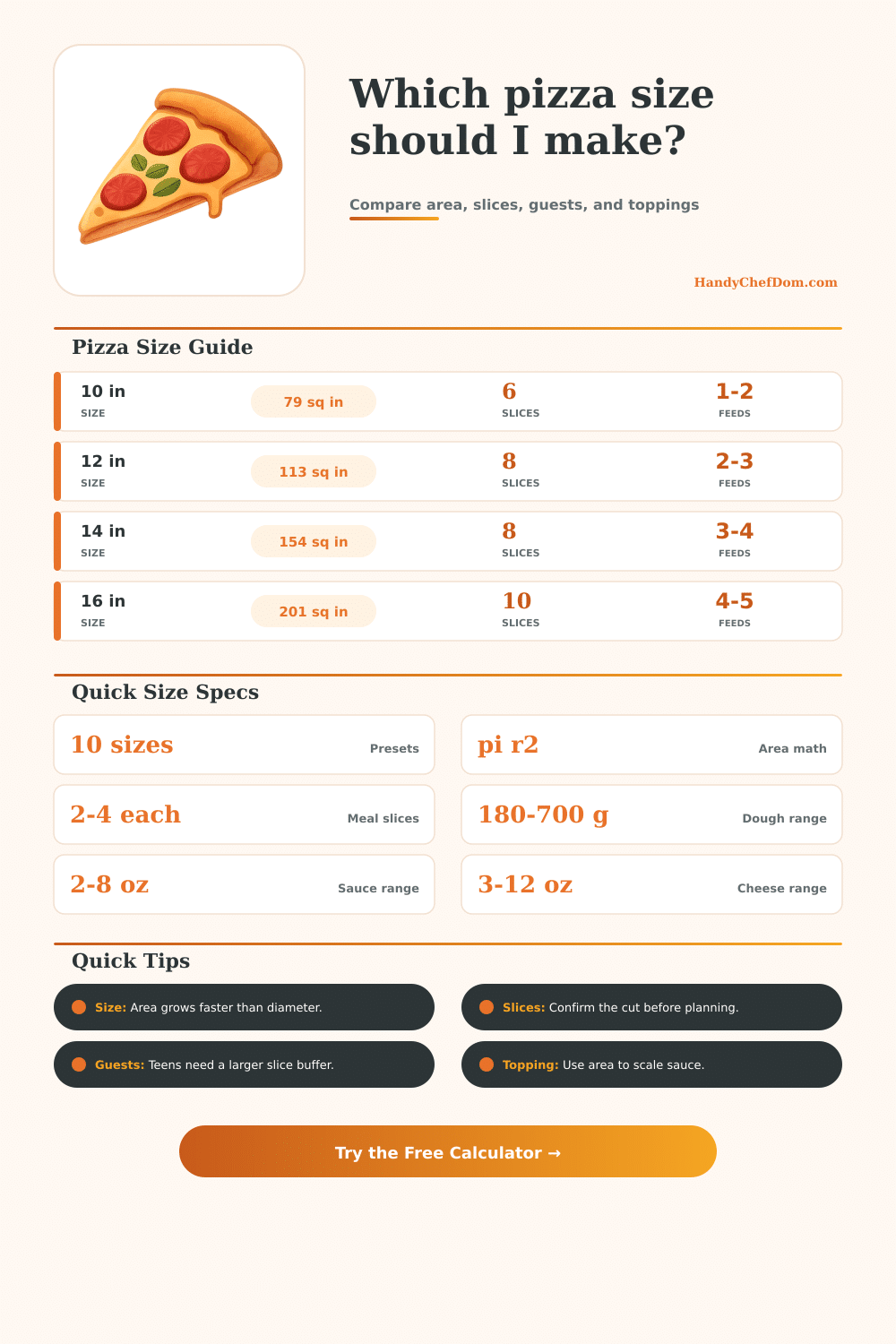
| 10 inches | 79 sq in | 6 slices | 1 to 2 people | Good small pizza for light appetites. |
| 12 inches | 113 sq in | 8 slices | 2 to 3 people | Medium size for family variety. |
| 14 inches | 154 sq in | 8 slices | 3 to 4 people | Default large delivery-style size. |
| 16 inches | 201 sq in | 10 slices | 4 to 5 people | Large area jump from 14 inches. |
| 18 inches | 254 sq in | 12 slices | 5 to 6 people | Best when table space can handle it. |
| Guest type | Snack pizza | Main meal | Only food | Planning note |
|---|---|---|---|---|
| Young kids | 1 slice | 1.5 slices | 2 slices | Smaller slices can reduce waste. |
| Adults | 1.5 slices | 2.7 slices | 3.2 slices | Use sides to fine tune demand. |
| Teens | 2 slices | 3.5 slices | 4.2 slices | Add buffer for sports or late nights. |
| Mixed group | 1.4 slices | 2.5 slices | 3 slices | Weighted demand beats a flat average. |
| Late-night crowd | 2 slices | 3.2 slices | 4 slices | Grazing events need backup slices. |
| Pizza style | Dough density | Sauce guide | Cheese guide | Fullness effect |
|---|---|---|---|---|
| Thin crust | 1.9 g per sq in | 0.28 oz per 10 sq in | 0.65 oz per 10 sq in | Guests may eat more slices. |
| Classic hand tossed | 2.7 g per sq in | 0.33 oz per 10 sq in | 0.78 oz per 10 sq in | Balanced serving baseline. |
| New York style | 2.5 g per sq in | 0.31 oz per 10 sq in | 0.82 oz per 10 sq in | Large slices feel moderate. |
| Pan pizza | 3.8 g per sq in | 0.36 oz per 10 sq in | 0.88 oz per 10 sq in | More filling per slice. |
| Deep dish | 4.6 g per sq in | 0.42 oz per 10 sq in | 1.05 oz per 10 sq in | Fewer slices satisfy most guests. |
| Comparison | Area change | Equivalent count | Slices if cut | What it means |
|---|---|---|---|---|
| 10 to 12 inch | 44% more | 1.44 small | 6 to 8 | Medium adds a meaningful second serving. |
| 12 to 14 inch | 36% more | 1.36 medium | 8 to 8 | Same slice count can hide more food. |
| 14 to 16 inch | 31% more | 1.31 large | 8 to 10 | Extra-large is a big area jump. |
| 16 to 18 inch | 27% more | 1.27 XL | 10 to 12 | Useful when one large pie replaces two small. |
| 12 to 16 inch | 78% more | 1.78 medium | 8 to 10 | Diameter changes compound quickly. |
When ordering pizza for a group of peoples, there are a variety of factors that will determine the amount of pizza that is necesary to feed the group. Many peoples tend to make mistake in the ordering of pizza, whether it is too little for everyone to eat, or there is too much pizza that results in leftovers that the individual in the group dont want. You can perform the determination of the amount of pizza that is necesary by considering the area of the pizza, the style of crust for the pizza, and the appetite of the individuals who will be eating.
The area of the pizza is one of the main factors in determining the amount of pizza that should be order for a group. The area of a pizza increases much more rapid than the diameter of the pizza. For instance, increasing the diameter of a pizza from 14 inches to 16 inches will more than double the area of the pizza, the amount of dough that is provided, the amount of sauce, and the amount of cheese that will be on the pizza.
How to Decide How Much Pizza to Order
As such, pizzas of a larger diameter will feed more people then pizzas of smaller diameters. You can use a calculator to compute the area of the pizza to determine how much food will be provided to the guest. The style of crust for the pizza will also affect the amount of pizza that is consume by each individual.
Thin crust pizzas will allow each individual to consume more slice of pizza before feeling full. Deep dish or pan style pizzas will allow each individual to feel full more quickly due to the increased amount of dough and topping that is provided with each slice. A deep dish crust is beneficial if the pizza is to be the only food that is served to the guests, but thin crust pizzas may be better if the pizza is to last the guests for a longer period.
The appetite of the guests should be considered when planning the pizza. For instance, children will tend to eat less pizza than adults, but teenagers or athletes will eat more slices of pizza than the average adult. You should adjust the number of slices of pizza that is ordered according to the age of the guests, whether they are children, adults, or athletes.
Additionally, the side dish that are to be served can also reduce the amount of pizza that the guests eats. A buffer for pizza is an extra order of pizza that can be prepared in case that some of the guests are late or additional guest show up. A buffer should be ordered in the preparation of pizza for a group of individual in case the headcounts are not accurate.
A buffer accounts for late guests or guests who come later then planned. A buffer should be ordered in the preparation of pizza, but not in such a way that there will be too much pizza leftover, too much pizza will result in waste of resources. The amount of sauce and cheese that is used on the pizza should also be considered.
If the pizza features a larger surface area, it will require more sauce and cheese to fully coat the pizza. The amount of sauce and cheese will impact the cost of the pizza. If you would like less cheese or sauce on the pizza, you must account for how this will alter the amount of filling that the pizza will be to each of the guests.
By measuring the diameter of the pizza, the style of crust, and the appetite of the guests, you can create a meal plan that will provide enough pizza for all of the guests without waste.