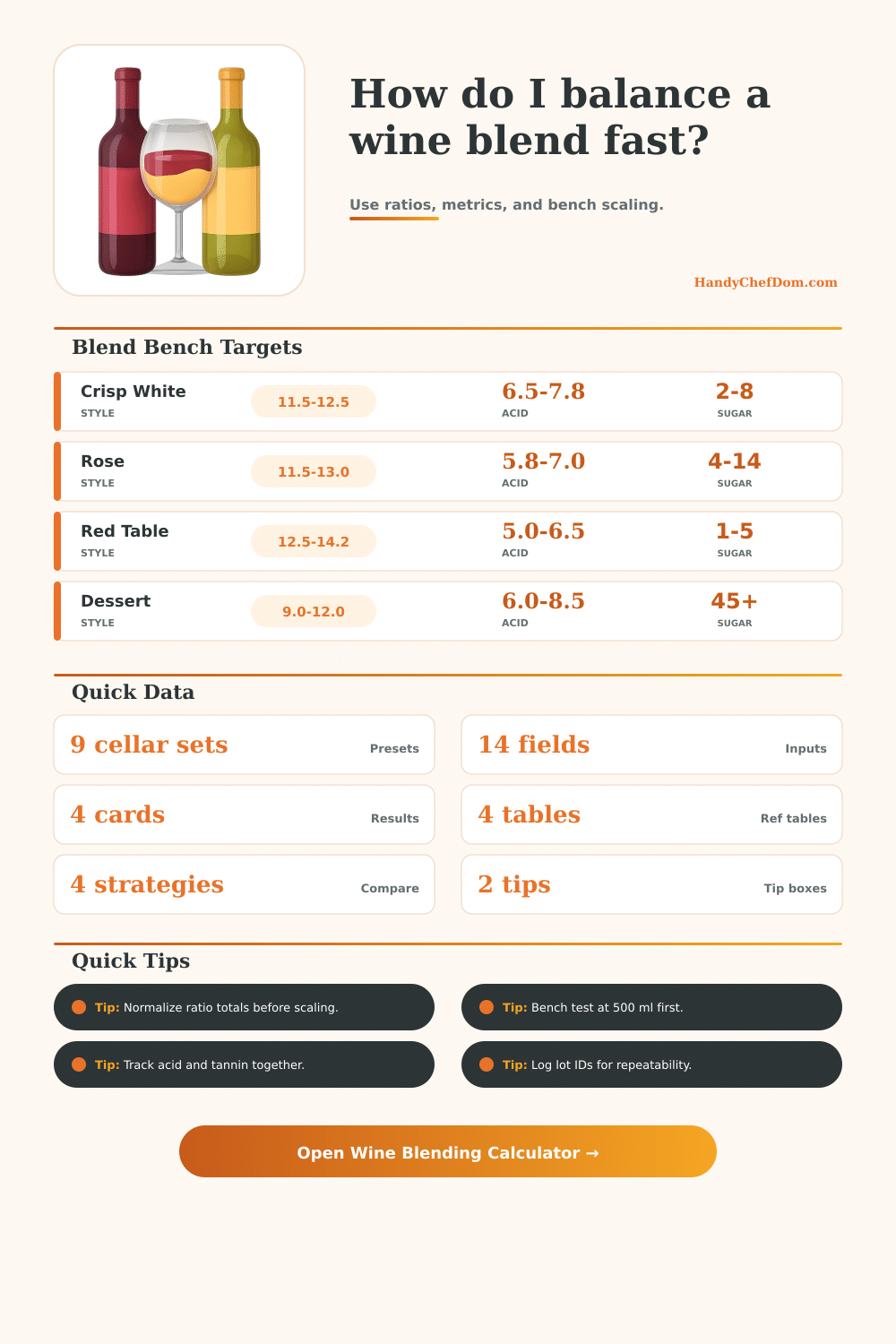
🍷 Wine Blending Calculator
Blend up to three wine lots with weighted chemistry and cost outputs so your bench trial ratios can scale cleanly to production volume.
Blend Presets
Topic Labels
Blend Inputs
Formula: Each metric is volume-weighted by lot share. Ratio entries are normalized, then scaled to target blend volume for lab and cellar runs.
Blend Breakdown
Blend Strategy Comparison Grid
Reference Tables
| Style | ABV % | Acid g/L | Tannin 0-10 |
|---|---|---|---|
| Crisp white | 11.5-12.5 | 6.5-7.8 | 0.8-2.0 |
| Aromatic rose | 11.5-13.0 | 5.8-7.0 | 1.2-2.8 |
| Silky red | 12.8-13.8 | 5.2-6.2 | 4.5-6.0 |
| Structured red | 13.5-14.8 | 5.0-6.0 | 6.0-8.5 |
| Dessert | 9.0-12.0 | 6.0-8.5 | 1.0-3.0 |
| Component role | Typical lot | Main gain | Main caution |
|---|---|---|---|
| Base body | Merlot or Grenache | Round palate | Can mute aroma |
| Structure spine | Cabernet or Syrah | Tannin length | Dry finish risk |
| Aromatic lift | Cab Franc or Viognier | Nose detail | Overpowers quickly |
| Freshness line | High-acid lot | Brighter finish | Sharp edge if high |
| Sweet balance | Off-dry lot | Mid-palate weight | Sugar creep |
| Bench size | Lot A ml | Lot B ml | Lot C ml |
|---|---|---|---|
| 250 ml | 138 | 75 | 37 |
| 500 ml | 275 | 150 | 75 |
| 750 ml | 413 | 225 | 112 |
| 1000 ml | 550 | 300 | 150 |
| 2000 ml | 1100 | 600 | 300 |
| If this is high | Check first | Adjust with | Retest after |
|---|---|---|---|
| ABV too hot | Ratio math | Lower ABV lot | 24 h |
| Acid too sharp | TA reading | Round base lot | 24 h |
| Tannin too hard | Seed extraction lot | Softer lot share | 48 h |
| Sugar too high | RS lab data | Drier lot share | 24 h |
| Cost too high | Lot pricing | Cost-balanced lot | Immediate |
A blending calculator are a tool that help a winemaker to determine the correct ratio for each individual wine lot. A winemaker may have several different lots of wine that taste good individually but dont create a balanced wine when blended. A blending calculator turns the guessing factor of create teh perfect ratio to a measurable process that assists a winemaker in achieving the desired style of wine without having to taste numerous blends of wine.
Before using a blending calculator, a winemaker must determine the characteristics of each individual lot of wine. Characteristics of wine includes alcohol percentage, acidity, tannin, residual sugar, and the cost per volume of each wine lot. Each of these characteristic must be weighted according to the volume share of each wine lot because a winemaker can account for the flavor of each wine lot, but it is impossible to taste every drop of every lot of wine.
How to Use a Blending Calculator for Wine
A winemaker must also decide on the volume of wine that the winemaker intends to blend. This particular volume of wine are the risk that a winemaker take in the winemaking process. A winemaker can perform small bench trials of wine to determine the perfect ratio of each wine lot to test with a smaller volume of wine, such as five hundred milliliter of wine.
The success of this small batch of wine can be easily replicated in larger batches of wine. A loss percentage of wine during the racking and filtration processes must also be accounted for. Loss percentages of two or three percent may seem small, but these percentage can represent an entire pallet of wine to be lost during the winemaking process.
The importance of ratios ensures that the final blend of wine will possess the same style of wine that the winemaker desires. For instance, if the winemaker intends to create a wine that contains high level of tannins, that particular lot of wine will have a high ratio in the blend of wine. However, the ratio of that lot cannot be so high that the final product will contain an overwhelming amount of tannins for the winemaker’s wine.
For wines with high levels of tannins, the ratio of that wine should be below twenty percent of the total blend. A blending calculator will allow the winemaker to set these parameter for each wine lot. A blending calculator can assist a winemaker with the cost of each bottle of wine.
By determining the cost of each bottle according to the blend of wine lots, the winemaker can decide whether an expensive lot of wine will improve the characteristics of the blend to warrant the price of that wine lot. In some instance, the expensive lot of wine may be worth the cost to the winery. In other instances, the cheaper lot of wine may be able to provide the same characteristics at a lower cost.
Winemakers often make mistake with the characteristics of wine lots. Winemakers may become focused on just one parameter for the wine lots while ignoring other characteristics that may impact the flavor of the wine. For instance, a lot of wine that has a lower percentage of alcohol may have a higher percentage of sugar, which can impact the taste of the wine.
Another common mistake is treating tannin and acidity as if they is the same. Tannin and acidity can both provide structure to wines, but the two components interact differently when tasted on the palate and when stored in different winemaking tanks. Reference tables can inform a winemaker of the characteristics of wine.
These characteristics can help a winemaker decide whether a calculated acidity percentage of six point two grams per liter is an appropriate acidity level for the wine that will be blended. These reference tables can help winemakers to understand whether the ratio calculation for wine lots fall within the normal parameters of wines of this particular style. If the ratios of wine lots fall outside of the normal parameters of wine characteristics, the winemaker can adjust the ratios of each wine lot before blending the wines together.
There are various factor in the winemaking process that a blending calculator cannot measure. Factors such as the amount of oxygen that interact with the wine during blending, the temperature of the wine during the winemaking process, and the shape of the winemaking tank can all have an impact on the blend of wine lots that are produced. Despite the ratios calculated by the blending calculator, the winemaker must taste the wine after twenty-four hours and forty-eight hours of blending to ensure that the wine maintains the correct flavor and characteristics.
Winemakers should also create a system to repeat the blend of wine lots once they have found the perfect ratio of each lot of wine. Winemakers can record the code for each lot of wine and the ratio of each lot of wine in the blend. This information can be used to quickly create another batch of wine with the same flavor and characteristics.
By learning the winemaking process and creating a system for winemakers to repeat the winemaking process, the role of a blending calculator becomes more importantly and visible to the winemaker. A blending calculator makes the change that are invisible to the winemaker visible to the winemaker. It does not make the winemaking decisions for winemakers but ensures that winemakers dont have to rely solely on there memories or there hopes to produce wine with the desired characteristics.