🍞 Bread Baking Time Calculator
Estimate bread bake time from loaf weight, shape, pan or freeform setup, oven temperature, steam, dough hydration, lean or enriched formula, internal temperature, and crust color.
Enter divided dough weight per loaf or piece. The calculator estimates a check window and a finish window, then uses internal temperature and crust color as the final decision points.
Moderate oven heat protects a tall pan loaf while the center reaches target.
High heat and early steam build oven spring before the crust sets.
An oval loaf bakes slightly faster than a same-weight boule.
Small diameter loaves finish fast and depend on color cues.
Higher hydration and bran usually add a few minutes to the bake.
Dense rye loaves need a firm internal target and a patient finish.
Sugar and butter brown early, so use lower heat and a lower target temp.
A shallow slab reaches temperature quickly but may need color time.
| Bread shape | Dough weight each | Typical oven | Start checking | Finish range |
|---|---|---|---|---|
| Small rolls | 60 to 100 g | 375 to 425 F | 12 to 16 min | 15 to 22 min |
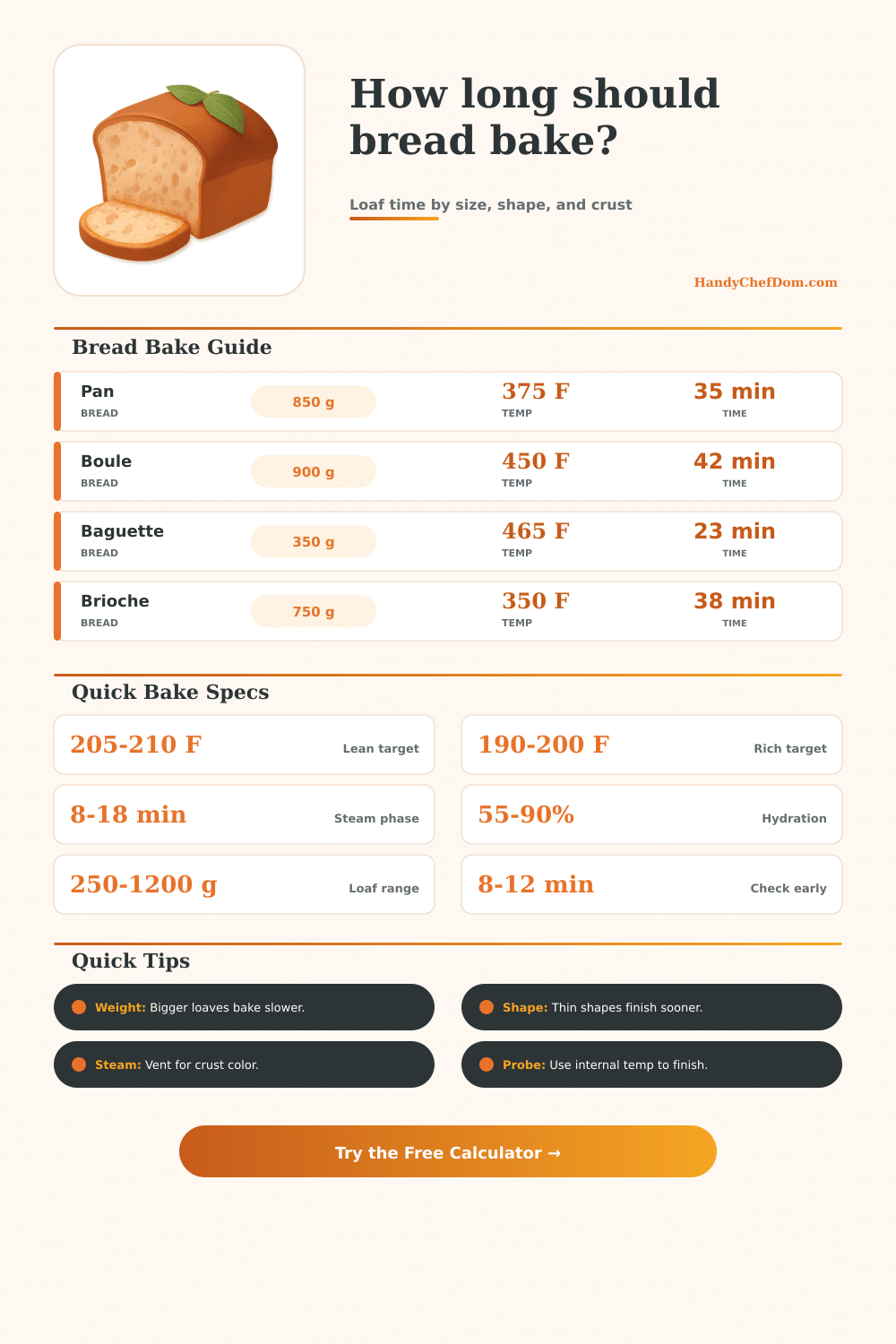
| Baguette | 300 to 380 g | 450 to 480 F | 18 to 21 min | 22 to 28 min |
| Standard pan loaf | 750 to 900 g | 350 to 390 F | 28 to 34 min | 34 to 44 min |
| Country boule | 800 to 1000 g | 430 to 475 F | 32 to 38 min | 38 to 50 min |
| Large miche | 1100 to 1600 g | 400 to 450 F | 45 to 55 min | 55 to 75 min |
| Bread type | Oven set point | Internal target | Color cue | Timing note |
|---|---|---|---|---|
| Lean hearth bread | 430 to 475 F | 205 to 210 F | Deep golden | Steam first, then vent |
| Sandwich bread | 350 to 390 F | 195 to 205 F | Golden brown | Pan slows the center |
| Whole wheat loaf | 375 to 425 F | 200 to 208 F | Brown top | Hydration adds time |
| Rye blend loaf | 375 to 430 F | 200 to 208 F | Firm crust | Dense crumb needs rest |
| Rich brioche | 325 to 375 F | 190 to 200 F | Amber brown | Cover if browning early |
| Steam method | Steam phase | Time effect | Crust result | Best fit |
|---|---|---|---|---|
| No steam | 0 min | Fast color | Softer crust | Pan loaves and enriched bread |
| Light steam tray | 6 to 10 min | Slightly longer | Better shine | Small hearth loaves |
| Standard steam | 10 to 15 min | Adds 1 to 3 min | Thin crisp crust | Batards and boules |
| Dutch oven | 18 to 25 min | Covered start | Bold blistered crust | Sourdough boules |
| Steam oven | 12 to 20 min | Delays browning | Even expansion | Lean artisan loaves |
| Formula cue | Hydration range | Likely adjustment | Target temp | Watch point |
|---|---|---|---|---|
| Firm enriched | 50 to 60% | Lower heat, steady time | 190 to 200 F | Early browning |
| Standard pan | 60 to 68% | Baseline timing | 195 to 205 F | Center dome |
| Open crumb lean | 70 to 80% | Add 2 to 5 min | 205 to 210 F | Vent after steam |
| Whole grain | 75 to 90% | Add 4 to 8 min | 200 to 208 F | Moist center |
| Flat focaccia | 75 to 90% | Fast center, color finish | 200 to 210 F | Bottom browning |
Bread baking times are estimates because oven calibration, pan color, stone thickness, dough temperature, and proof level all change the finish window. Start checking early and finish by temperature and crust cues.
To bake breads, you must understands how the different variable influence the amount of time that the bread spends in an oven. Bake time will change based off the weight of the dough, the shape of the dough, the temperature of the oven, and the amount of steam in the oven. Understanding how each of these variable relate to the baking process will allow you to understand when the bread is baked correct.
One that is neither underbaked nor overbaked. One of the primary factor to consider in the bake time calculation is the weight of the dough. Dough of a greater weight will take longer to evenly cook to the center of the loaf than dough that has less weight.
What Affects Bread Baking Time
For instance, a 900 gram boule will take longer to cook than a 350 gram baguette due to the increased mass of doughs that must cook to the center of the boule. The weight of the dough is, therefore, a critical factor in calculating the bake time. The second primary factor in bake time is the shape of the dough.
Dough that has a greater distance between the crust and the center of the dough will take longer to bake than dough that has less distance between those two elements. For instance, a tall pan loaf will require more time to bake than a thin baguette, or a round boule will require more time to bake than a thin baguette due to the thicker portion of dough that must cook. The shape of the dough, therefore, is another critical factor in bake time that any bake time calculator should accounts for.
The third variable that will impact bake time is the temperature in the oven. Higher temperature in the oven will cause the crust of the bread to cook more fast, but the high temperature may cause the crust to brown prior to the center of the bread baking. Lower temperatures in the oven allow for the center of the bread to cook, and bakers often use these temperatures in enriched bread recipes like brioche.
Bake time will be shorter at higher temperatures in the oven than it will be at lower temperatures. The fourth variable that will impact the bake time is the amount of steam in the oven. Steam will delay the setting of the crust of the bread.
This allows the bread to expand during baking. If you introduce steam into the oven (such as by using a Dutch oven), the crust will take longer to set than in an oven that dont contain steam. The presence of steam in the oven, therefore, must be accounted for in the bake time.
The hydration and enrichment of the dough will also impact the bake time. Doughs that contain high amount of hydration will hold more moisture. Doughs that contain more moisture will require more time to cook and bake.
Enriched doughs (those that contain ingredients like butter, eggs, or sugar) will brown more fast on the crust of the bread than lean bread recipes. Therefore, enriched doughs may appear baked while the center of the bread isnt yet cooked. The most reliable method of determining whether the bread has baked is to measure the internal temperature of the bread.
Lean hearth bread recipes will bake when the internal temperature of the bread reaches between 205 and 210 degrees. Enriched breads will reach the same internal temperature at a lower degree as the fat and sugar in the enriched bread will keep the crumb tenderly. You can measure the internal temperature of the bread with a thermometer to determine whether the center of the bread has reached the required temperature.
Finally, the calculated bake time should be treated as a window of time rather than a specific minute that the bread should exit the oven. The bread should be checked at the beginning of the calculated bake time window, and you should ensure the bread exits the oven at the end of the calculated time window. If the internal temperature of the bread is too low, it will take longer to reach the proper temperature; if the internal temperature is correct, but the crust is pale in color, it will take a few extra minutes to bake to achieve the proper color.