Pizza Dough Ball Weight Calculator
Plan dough ball weight from pizza size, crust style, hydration, and fermentation, then scale a full batch with baker percentages and a practical production buffer.
Choose sizing mode first. In diameter mode, the calculator estimates per-ball dough from pan area. In target-ball mode, it estimates finished diameter and scales total batch from the exact ball weight you want.
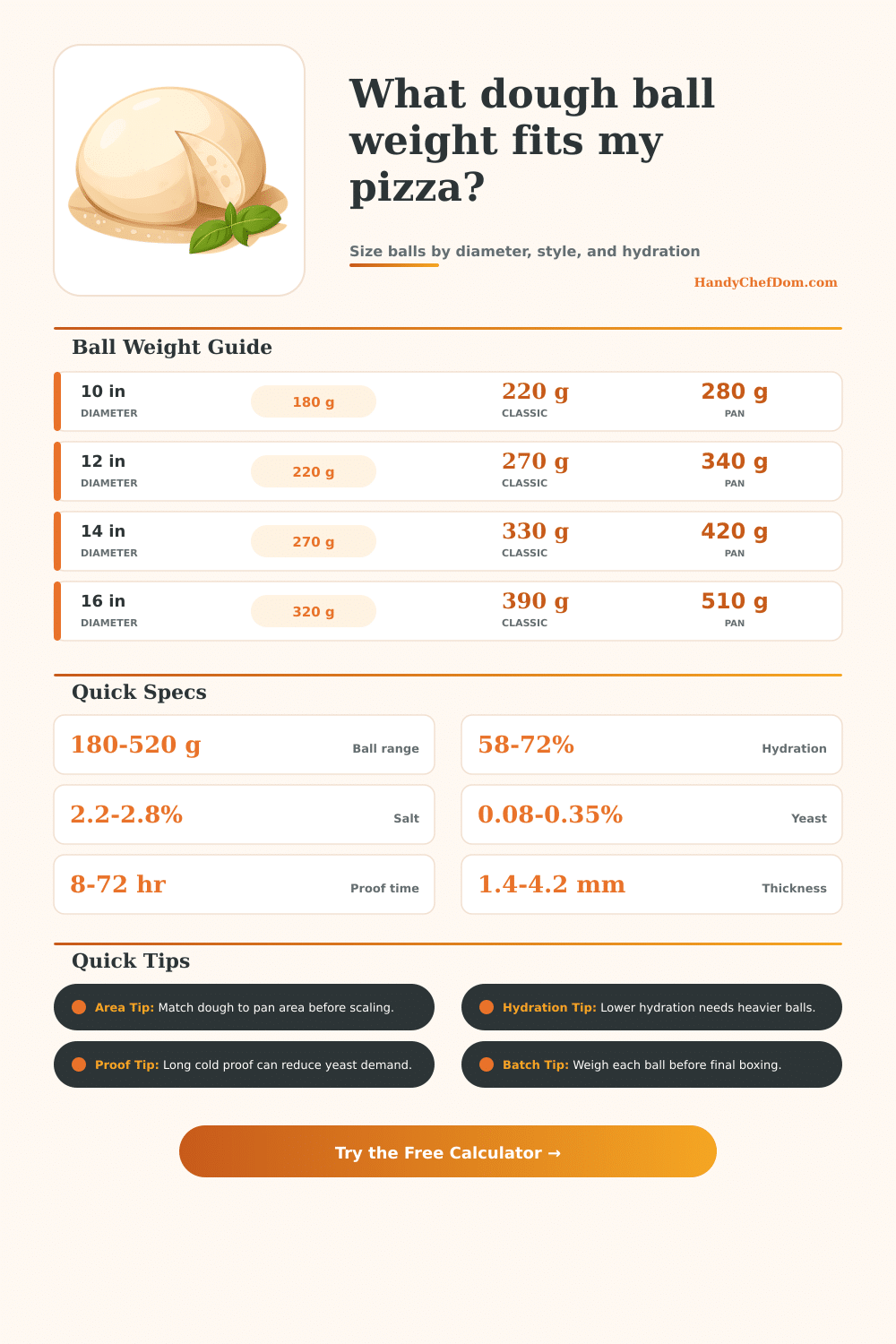
| Diameter | Thin | Classic | Pan |
|---|---|---|---|
| 10 in | 180-200 g | 215-235 g | 260-300 g |
| 12 in | 220-245 g | 260-290 g | 320-360 g |
| 14 in | 270-305 g | 320-355 g | 390-450 g |
| 16 in | 320-360 g | 380-430 g | 470-540 g |
| Hydration | Feel | Handling | Weight impact |
|---|---|---|---|
| 58-60% | Firm | Easy bench | Use +3% ball mass |
| 61-64% | Balanced | Most forgiving | Baseline mass |
| 65-68% | Open crumb | Stickier dough | Use -2% ball mass |
| 69-72% | Very airy | Advanced handling | Use -4% ball mass |
| Proof plan | Yeast % | Temp | Result |
|---|---|---|---|
| Same day 6-8 hr | 0.30-0.35% | 72-76F | Fast rise, mild |
| Room 12-18 hr | 0.20-0.25% | 66-72F | Balanced flavor |
| Cold 24-48 hr | 0.10-0.18% | 36-40F | Deep aroma |
| Cold 48-72 hr | 0.08-0.12% | 35-38F | High extensibility |
| Style | Base g/in2 | Thickness | Use case |
|---|---|---|---|
| Neapolitan | 2.80 | 1.8-2.7 mm | Leopard crust |
| New York | 3.20 | 2.2-3.2 mm | Foldable slice |
| Thin crisp | 2.55 | 1.4-2.2 mm | Cracker base |
| Pan or Detroit | 3.95 | 3.0-4.2 mm | Soft interior |
Getting the dough ball weight right is critical in determining whether the pizza will stretch or collapse during the baking process. Many people will find it easier to use a size of dough ball that they like rather than calculating the correct weight of each dough ball. However, if you change the style of the pizza or the proofing time of the dough, the weights of the dough balls will not be consistenly.
Thus, using the incorrect weight of dough balls will make each batch of pizza not repeatably made. The calculator will do the math for you once you have entered the target diameter for your pizza or the weight of the dough ball that you would like to use for each pizza. You must also enter your pizza style, the hydration level of your dough, the thickness of your pizza, and your proofing plan because these will also impact the amount of dough that is necessary to create your desired pizza.
Choose the right dough ball weight for consistent pizzas
The diameter of each pizza will impact the area of each pizza. Additionally, the style of pizza will contain a certain number of grams of dough per square inch. Higher hydration level will require more mass of dough to be added to ensure that the pizza spreads even during the baking process.
Finally, the thickness and proofing time will impact the density of the pizza; the longer proofed the dough is, the less the mass of each pizza will need to be to cover the same amount of surface area. The weight of each dough ball will change depending on the style of the pizza that you are creating. For instance, an Neapolitan style of pizza will require a different amount of dough then a pan pizza; the pan pizza will require more dough balls to even cover the pan while the Neapolitan style will not require as much dough due to its thickness.
Additionally, the proofing time will also change the amount of dough balls that is required for each pizza. If you lengthen the proofing time, the amount of dough balls will have to be adjusted to allow for the extensibility of the dough after it has been proofed for a longer period. The calculator includes these adjustments to allow for the recipe to be made without guessing the proper amount of dough for each ball.
Many people make the mistake of using a fixed weight for each ball of dough; however, the results of each batch of pizza will not be the same due to the changes in the hydration levels of the dough and proofing times. For instance, using sixty-three percent hydration for your pizza dough will result in a different outcome then using seventy percent hydration. Thus, it is best to hold the percentages of salt, yeast, and oil to keep the flavors of each batch of pizza the same.
In addition to accounting for the proofing time, you must also account for process loss when calculating the weight of each dough ball. Process loss can occur when kneading and shaping the dough; it is likely to stick to your hands and countertops. Thus, if you dont account for this in your recipe, the last batch of balls of dough may be smaller than the others.
To account for this, the recipe includes a dough ball weight buffer so that you may ensure that you have the number of balls of dough that you have accounted for in your recipe. The reference tables include typical weights for different styles of pizza with different hydration levels. These tables can help you to determine your variables before you begin to make your pizzas.
These tables will help you to understand how different hydration level will impact the weight of each ball of dough. Additionally, these tables will provide proofing plans and the amount of yeast to use so that you may progress from your same-day recipe to your cold fermented recipe. Once you have the weight for one ball of dough, the calculator will allow you to scale the recipe for your batch.
This will tell you how much flour and water is required and how many balls of dough you can make with the amount of available flour. Knowing how many balls of dough you can make will allow you to decide whether you want to make fewer large pizzas or more small pizzas of the same weight. The value of using this calculator will allow you to have repeatability in your recipe.
You can change one variable and see how this changes the other variables in your recipe. For instance, you can adjust the diameter of your pizza and see how this changes the hydration or proofing time. Additionally, you can adjust the weight of each ball of dough and see the diameter that this will make with the dough balls of this weight.
You should always weigh each ball of dough instead of measuring it by volume. The volume of the balls of dough may change due to the hydration levels or the temperature of the balls of dough; however, the weight will remain the same. If you weigh each ball of dough, each batch will contain the same amount of dough and the pizzas will be consistent in there composition.
Thus, the consistency in the pizzas comes from weighing the balls of dough rather than guessing at the volume of each ball. This calculator is a tool for managing the variables of the pizza recipe. You can use it to decide what variables you would like to remain the same and which that you would like to change to achieve the desired result.