🍞 Aliquot Method Sourdough Calculator
Estimate aliquot jar rise, current bulk progress, target height, remaining time, dough temperature effect, sample fit, jar volume, and readiness for shaping from simple height marks.
Pack a small piece of mixed dough into a straight-sided jar, mark the settled starting height, keep it near the main dough, and update the current height as bulk fermentation progresses.
Starting dough height compared with usable jar height.
Estimated space occupied before expansion.
Observed expansion rate from your elapsed time.
Suggested height to watch at the next check.
A narrow, straight wall makes height changes easier to read and compare.
Tap the jar lightly, wait a minute, then mark the true starting height.
Take the sample after mixing or first fold so it represents the main dough.
Keep the aliquot jar beside or on top of the main bulk container.
Ignore large isolated bubbles and use the average dough level.
Enough dough to read clearly without stealing much from the final loaf.
A 60% target means starting height multiplied by 1.60.
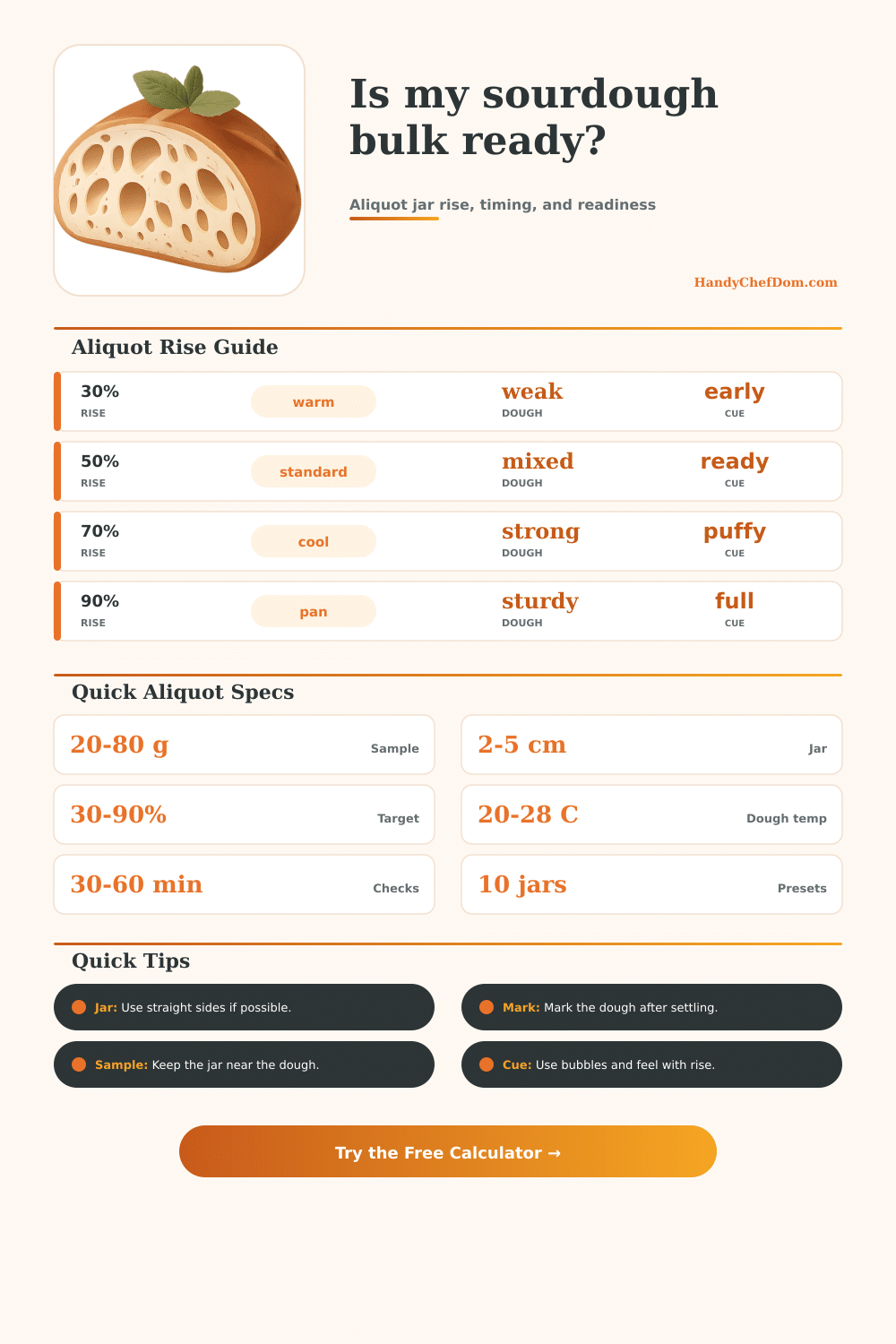
Shape when jar rise agrees with bubbles, jiggle, and dough strength.
| Target rise | Best fit | Dough strength | Typical cue | Planning note |
|---|---|---|---|---|
| 25 to 35% | Warm dough, rye blend, weak gluten | Low tolerance | Early bubbles and slight dome | Shape before dough becomes fragile |
| 40 to 55% | Most country sourdough loaves | Moderate | Rounded edge, bubbles, gentle jiggle | Common balanced target for beginners |
| 60 to 75% | Cool room or strong dough | Good tolerance | Clear rise, puffy mass, elastic feel | Use if dough still holds shape well |
| 80 to 100% | Pan loaf or very strong dough | Supported or sturdy | Very airy and expanded | High risk for free-form loaves |
| 100% plus | Special pan formulas | Very supported | Full jar and strong gas build | Usually too much for hearth sourdough |
| Jar diameter | Sample size | Good start height | Pros | Watch out |
|---|---|---|---|---|
| 2.0 to 2.5 cm | 10 to 25 g | 2 to 5 cm | Very clear rise movement | Narrow jars exaggerate trapped bubbles |
| 3.0 to 4.0 cm | 25 to 60 g | 2.5 to 6 cm | Best everyday aliquot size | Needs straight sides for clean marks |
| 4.5 to 6.0 cm | 60 to 120 g | 2 to 5 cm | Stable and easy to pack | Rise looks smaller in a wide jar |
| Tapered jar | Any sample | Lower third only | Convenient if it is all you have | Height percent becomes less exact |
| Container wall mark | Main dough | Whole batch | No separate sample needed | Folds and dough shape distort volume |
| Dough temp | Bulk speed | 20% starter guide | Aliquot behavior | Adjustment |
|---|---|---|---|---|
| 18 to 20 C / 64 to 68 F | Slow | 7 to 10 hours | Rise may lag for several hours | Check every 60 minutes |
| 21 to 23 C / 70 to 73 F | Steady | 5.5 to 7.5 hours | Gradual rise with clearer bubbles | Use normal target range |
| 24 to 25 C / 75 to 77 F | Active | 4 to 6 hours | Rise accelerates after folds | Check every 30 minutes late bulk |
| 26 to 28 C / 79 to 82 F | Fast | 3 to 4.5 hours | Jar can jump quickly near the end | Lower rise target if dough is weak |
| 29 C plus / 84 F plus | Very fast | Often under 3.5 hours | Gas and acid build quickly | Use short checks and cool next batch |
| Aliquot status | Main dough cue | Shape decision | Risk | Next step |
|---|---|---|---|---|
| Under 35% of target | Tight dough, few bubbles | Keep bulking | Under-bulked crumb | Check again later |
| 35 to 70% of target | Edges rounding, bubbles increasing | Prepare workspace | Still early for many loaves | Shorten check interval |
| 70 to 95% of target | Puffy, jiggly, elastic | Shape soon | May pass quickly when warm | Watch every 15 to 30 minutes |
| 95 to 110% of target | Full rise and active bubbles | Ready if dough has strength | Weak dough can spread | Preshape or shape now |
| Over 110% of target | Foamy, fragile, very sticky | Handle gently | Over-bulk possible | Use pan support if needed |
Aliquot calculations estimate volume rise from height in a small sample. Jar shape, trapped bubbles, folds, dough temperature drift, starter strength, and flour blend can shift real bulk timing.
The aliquot method is a means of measuring the progress of the dough during bulk fermentation. Bulk fermentation is the phase of bread making in which the dough perform its rise. Many baker find it difficult to determine when bulk fermentation is complete.
This can result in flat loaves of bread or dough that is stickily to the touch. The aliquot method aim to solve these issues by taking a sample of the dough and placing that portion into a separate jar to observe its rise. The height of the dough in the jar is a means of determining the fermentation of the bulk of the dough.
How to use the aliquot method to know when dough is ready
The aliquot method require bakers to take a portion of the dough after they have mixed the dough or after the first fold of the dough. The portion of dough will experience the same temperature as the bulk of the dough. A jar with straight sides will make it more easy for the baker to measure the change in height of the dough in the jar.
Using a marker, the baker can make a starting mark on the jar once the portion of the dough has settle in the jar for a minute or two. The baker must place the jar near the main batch of dough so that the temperature within the jar remains constant. With these measurements taken, the baker can input them into a calculator to find the percentage of the dough that has risen.
Temperature is an essential component of bulk fermentation. Changes in temperature alter the rate at which the dough ferments. If the dough is allowed to reach 24 C, it will ferment at a steady rate.
If the temperature increases by a few degrees, however, the dough will ferment at a faster rate. Bulk fermentation can be reduced by nearly an hour if the dough is allowed to warm to a higher temperature. The time calculator takes into account the temperature of the dough in the main container.
In addition to the effect of temperature, the hydration levels of the dough will alter the fermentation rate. The percentage of the dough that contains the starter will affect the rate at which the dough ferments. Both of these variable are accounted for in the time calculator.
The time that the calculator estimates is a general window of time, rather than an exact time when the dough will be ready for shaping. The strength of the dough will affect the rate at which the dough rises during bulk fermentation. A slack batch of dough will reach the rise percentage that indicates it is ready for shaping at a lower percentage then a strong batch of dough.
Strong dough can hold more gas and can rise to a higher percentage before it reaches the point at which the dough must be shaped. The rise percentage calculator incorporates the strength of the dough into its calculation to ensure that the percentage provided to the baker is accurate. If dough strength is ignored in the calculation, the dough may be shaped either too soon (if the dough is weak) or too late (if the dough is strong).
There are reference tables included with the aliquot method that indicate the percentage of rise that is appropriate for different types of dough. These percentages are suggested starting points for bakers to use as a means of understanding the rise percentage that the aliquot sample of dough is indicating. For instance, a rise percentage of 50% may be appropriate for a country loaf, but may be insufficient for a cool dough that contains a high amount of protein.
These tables allow bakers to understand the rise indicated by the aliquot sample without having to memorize the rise percentages for each type of dough. There are a few technique that bakers can use to improve the results of the aliquot method. One is to make the starting mark for the portion of dough after it has settled into the jar for a minute or two.
If the mark is made immediately after the dough is placed into the jar, the measurements will be incorrect. Bakers are also encouraged to use the average dough line as an indicator for the rise of the dough rather than reading the height of the tallest bubble that form within the jar. Bubbles can make the dough appear to have risen to a higher percentage than the dough actually is rising to; reading the average line avoids this inaccuracy.
By following these suggestions, bakers will obtain the most accurate measurements with the aliquot method. The aliquot method calculator can provide the baker with several different measurement of the dough bulk fermentation process. One calculation will be the percentage of rise that the dough has experienced.
In addition to the rise percentage, the calculator can also determine how much longer it will take for the dough to reach the rise percentage require for shaping. Finally, the tool provides the baker with a label that indicates when the dough should be shaped. The label includes terms like “keep bulking” or “shape soon.” This information is helpful for bakers, but it should not be the only information that bakers rely upon to determine when to shape the dough.
Additional information that bakers should know is the physical appearance of the bulk of the dough. Dough that is ready for shaping will have rounded edges, bubbles, and exhibit a gentle jiggle when shake. Considering the information from both the aliquot method and the bulk of the dough allows bakers to make an informed decision about when to shape the dough.
Many bakers make errors with the aliquot method. For example, if the aliquot method indicates that the percentage of rise required to reach the target rise for that batch of dough has been achieved, the baker may still feel a need to wait until the bulk of the dough reaches that same percentage; it may feel too tight or too cool to shape. The aliquot method provides a means of measuring and forecasting the bulk fermentation process; however, the tool is unable to observe all of the dough.
Additional time with this technique will allow bakers to gain an intuition for the bulk fermentation process. After employing the aliquot method for several batches of dough, bakers will begin to recognize the physical characteristics of dough that indicates a specific rise percentage. When the rise percentage calculated by the tool and those identified by the baker match, the resulting loaf of bread will be able to hold its shape and contain an even crumb pattern.
The aliquot method is helpful in that it allows the baker to monitor bulk fermentation even in cases in which the environment for that dough changes. If the room temperature change suddenly, or if the strength of the starter changes, the aliquot method will reflect those changes. It is still up to the baker to make the final decision regarding the bulk fermentation of the dough.
However, knowing the rise of the aliquot portion of the batch will eliminate one variable in the recipe. Thus, using the aliquot method, the baker can make the bulk fermentation process into a repeatable process with every batch of dough.