🍞 Bread Hydration Calculator
Calculate exact hydration percentage using baker's percentages — includes starter & add-ins
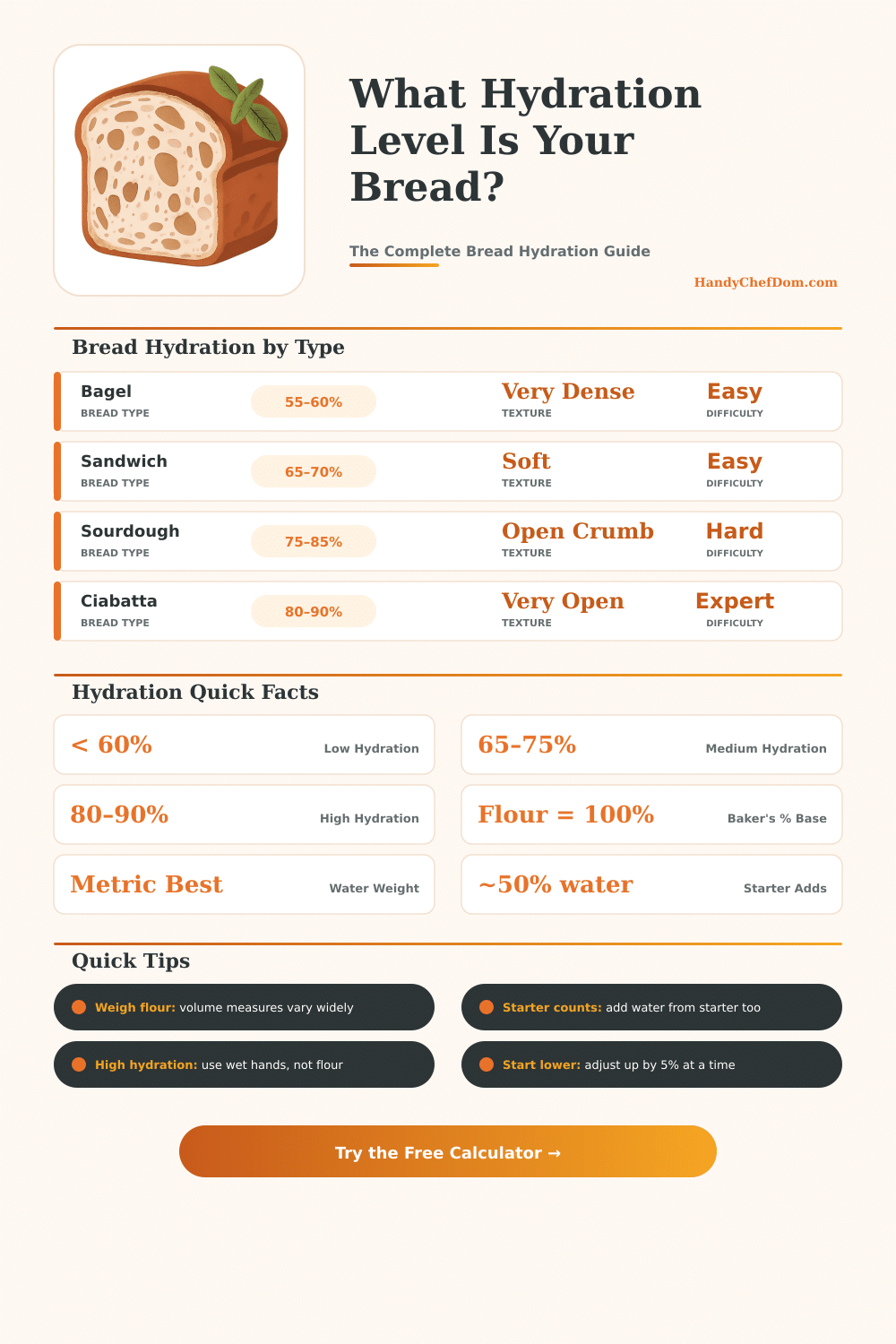
| Bread Type | Hydration % | Crumb Texture | Dough Feel | Difficulty |
|---|---|---|---|---|
| Bagel | 55–60% | Dense, chewy | Stiff, firm | ⭐ Easy |
| Soft Dinner Roll | 58–63% | Soft, pillowy | Slightly tacky | ⭐ Easy |
| Pizza Dough | 60–65% | Chewy, stretchy | Smooth, pliable | ⭐⭐ Medium |
| Brioche | 60–65% | Rich, tender | Enriched, soft | ⭐⭐ Medium |
| Sandwich Loaf | 65–70% | Soft, fine crumb | Smooth, workable | ⭐ Easy |
| Baguette | 70–75% | Open, crispy crust | Slightly sticky | ⭐⭐ Medium |
| Sourdough Loaf | 75–80% | Open, irregular | Wet, extensible | ⭐⭐⭐ Hard |
| Focaccia | 78–85% | Airy, open holes | Very wet/slack | ⭐⭐ Medium |
| Ciabatta | 80–90% | Large open holes | Batter-like | ⭐⭐⭐ Expert |
| Dark Rye | 80–90% | Dense, moist | Sticky paste | ⭐⭐⭐ Hard |
| Ingredient | Typical Baker's % | 500g Flour (g) | 1000g Flour (g) | Role |
|---|---|---|---|---|
| Flour (base) | 100% | 500g | 1000g | Structure |
| Water | 60–85% | 300–425g | 600–850g | Hydration |
| Salt | 1.8–2.2% | 9–11g | 18–22g | Flavor, gluten |
| Yeast (instant) | 0.5–1% | 2.5–5g | 5–10g | Leavening |
| Oil/Fat | 2–10% | 10–50g | 20–100g | Tenderness |
| Sugar/Honey | 1–8% | 5–40g | 10–80g | Color, flavor |
| Sourdough Starter | 10–30% | 50–150g | 100–300g | Leavening, flavor |
| Ingredient | 1 Cup (US) | 1 Tbsp | 1 tsp | Note |
|---|---|---|---|---|
| All-purpose flour | 120–130g (4.3oz) | 8g | 2.6g | Spooned & leveled |
| Bread flour | 127–136g (4.5oz) | 8.5g | 2.8g | Higher protein |
| Whole wheat flour | 120–128g (4.3oz) | 8g | 2.7g | Denser grind |
| Rye flour | 102–115g (3.7oz) | 7g | 2.3g | Lighter than AP |
| Water | 237ml / 237g (8.3oz) | 14.8g | 4.9g | Exact by ml |
| Salt (fine) | — | 18g | 6g | Always weigh salt |
In bread, it is made up of simple elements like water, flour and commonly yeast, that is baked together. Noticeably that modest mix grew to basic food through many cultures, especially in Europe and the Middle East. For thousands of years folks prepare it, and it stays popular because it simply works well.
Especially wheat and rye kinds of bread turn plain grains into something more easily eaten and practically portable. After baking, one receives food, that lasts well and needs almost no extra preparation.
Bread Basics: What It Is, Types and How to Make It
The range of breads is truly amazing. One finds the classic rolls with yeast and sourdough breads, of course, but also baguettes, ciabattas, focaccias, bagels and warm cross buns. Later one enters into more sweet areas, like blueberry slices with honey or cinnamon rolls.
Some favour fast breads, others those with rising. There are also handy ways to use stale bread, for instance in French toast or as croutons from baguette.
One mix, that won big attention, is the sourdough croissant bread. It combines two loved baked goods: the crisp, buttery layers of croissants with the bitter, chewy quality of sourdough bread. The result gives golden, flaky layers with a tired bitter hint from the yeast, what creates something rich and actually delicious.
Another style, the Struan bread, harvest roll with roots in many traditions, counts among the best breads four toast.
Here the main spot: homemade crusty artisan bread surprisingly works for beginners. You need only four ingredients, without need of fancy tools or a stand mixer. It is not kneading or final form, about that care, almost the whole process is simply waiting.
The same goes with basic white bread. Truly, a stand mixer eases the work, but really a mixing bowl and wooden spoon are enough for the task. Kneading by hand works entirely well.
The proofing matters more, than one thinks. It is the stage, when the dough rises before the baking, usually for at least one hour in a warm place. Skipping that can cause trouble.
Too proofed dough will not rise a lot in the oven, and under proofed dough also will not. Uneven density during the second kneading and shaping can affect badly the final rolls.
The taste of bread and its texture changes based on that, what one adds. In savory direction, nuts, vegetables, cured meats and cheese all work perfectly. Wants one something sweeter?
Add fruits, purees or chocolate. Toasted wheat crumbs and any addition changes the texture up. Pineapple in banana bread adds surprising tang and helps it stay moist and soft.
Some European breads have different forms or thicknesses, and those usually need two slices to serve. Indeed, because of that nutrition labels commonly point two slices as one serving, because that is, what many folks eat as a snack or part of ameal.
Although bread enjoys big popularity, it commonly is criticised. Folks say, that it is unhealthy, dangerous, fattening. But here something important is missing: there exist thousands of kinds, and each tells about history, culture and human creativity.
All of them deserve to be tried.