🥚 Calories in Eggs Calculator
Build an egg plate by size, count, yolk and white mix, cooking fat, preparation style, add-ins, servings, and calorie target.
Use whole eggs, extra whites, and extra yolks together. Nutrition is estimated from standard USDA-style raw egg values, then adjusted for measured cooking fat and selected add-ins.
| Egg size | Edible weight | Calories | Protein | Fat | Carbs |
|---|---|---|---|---|---|
| Peewee | 35 g / 1.2 oz | 50 cal | 4.4 g | 3.3 g | 0.3 g |
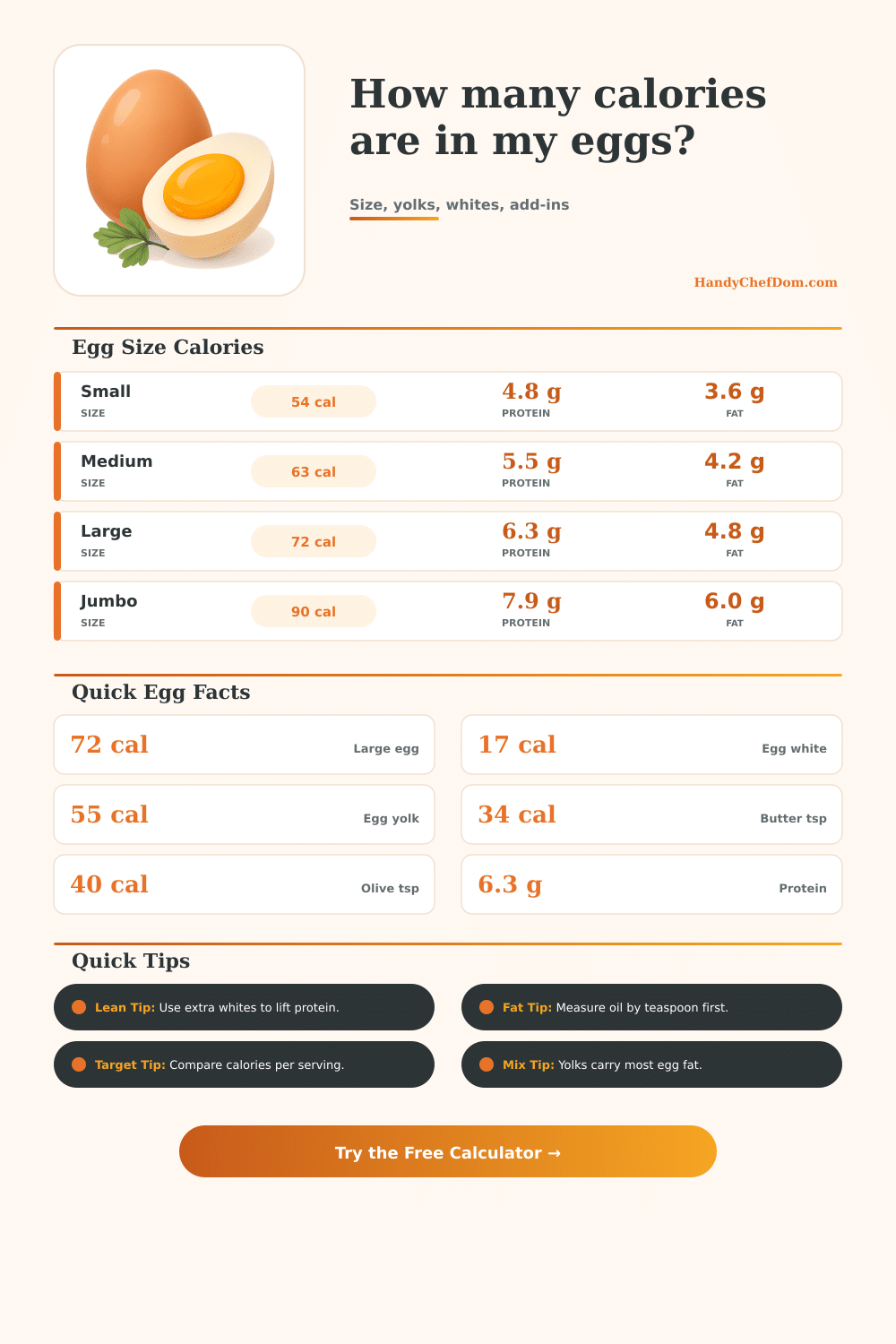
| Small | 38 g / 1.3 oz | 54 cal | 4.8 g | 3.6 g | 0.3 g |
| Medium | 44 g / 1.6 oz | 63 cal | 5.5 g | 4.2 g | 0.3 g |
| Large | 50 g / 1.8 oz | 72 cal | 6.3 g | 4.8 g | 0.4 g |
| Extra large | 56 g / 2.0 oz | 80 cal | 7.0 g | 5.3 g | 0.4 g |
| Jumbo | 63 g / 2.2 oz | 90 cal | 7.9 g | 6.0 g | 0.5 g |
| Egg component | Large equivalent | Calories | Protein | Fat | Best calculator use |
|---|---|---|---|---|---|
| Whole egg | 1 large, 50 g | 72 cal | 6.3 g | 4.8 g | Default egg count |
| Egg white | 1 large white, 33 g | 17 cal | 3.6 g | 0.1 g | Higher protein, lower calorie plates |
| Egg yolk | 1 large yolk, 17 g | 55 cal | 2.7 g | 4.5 g | Richer egg mixtures |
| Two whole eggs | 100 g edible | 143 cal | 12.6 g | 9.5 g | Common breakfast base |
| Three whites | 99 g edible | 52 cal | 10.8 g | 0.2 g | Lean scramble base |
| One whole plus two whites | 116 g edible | 106 cal | 13.5 g | 5.1 g | Balanced yolk-white mix |
| Cooking fat | Portion basis | Calories | Fat grams | Calculator note |
|---|---|---|---|---|
| Butter | 1 tsp | 34 cal | 3.8 g | Count retained fat after prep style |
| Olive oil | 1 tsp | 40 cal | 4.5 g | High calorie density by spoon |
| Avocado oil | 1 tsp | 40 cal | 4.5 g | Similar calories to olive oil |
| Coconut oil | 1 tsp | 39 cal | 4.5 g | Measured teaspoons matter |
| Oil spray | 1 second spray | 5 cal | 0.5 g | Enter spray seconds as amount |
| Bacon drippings | 1 tsp | 38 cal | 4.2 g | Pan fat changes total fast |
| Add-in | Calculator portion | Calories | Protein | Fat | Carbs |
|---|---|---|---|---|---|
| Spinach | 1/2 cup cooked | 10 cal | 0.9 g | 0.1 g | 1.5 g |
| Cheddar | 1/2 oz | 57 cal | 3.5 g | 4.7 g | 0.4 g |
| Feta | 1/2 oz | 37 cal | 2.0 g | 3.0 g | 0.6 g |
| Mushrooms | 1/2 cup | 8 cal | 1.1 g | 0.1 g | 1.2 g |
| Salsa | 2 tbsp | 10 cal | 0.4 g | 0.0 g | 2.0 g |
| Diced ham | 1 oz | 30 cal | 5.0 g | 1.0 g | 0.5 g |
| Pepper and onion | 1/2 cup | 25 cal | 0.8 g | 0.2 g | 5.5 g |
| Avocado | 1/4 medium | 80 cal | 1.0 g | 7.4 g | 4.3 g |
Eggs are an common food for breakfast because eggs are relatively inexpensive and versatile in the types of meals they can be prepared as. However, the nutritional value of eggs change depending on how the eggs are prepared. For example, a person may desire to increase the protein content of a meal while maintaining the calorie content of that meal.
In this case, increasing the number of egg whites in the meal will accomplish this goal. However, if a person desire to increase the fat content of a meal, increasing the number of egg yolks or the amount of butter added to the eggs will accomplish that goal. Thus, using a calculator to determine the nutritional contents of a meal that contains eggs is beneficial for those that wish to control the nutritional contribution of each variable of the meal.
How to Use an Egg Calculator to Check Calories and Protein
The size of the eggs is one variable that will alter the nutritional content of the meal. For instance, larger eggs will contain more fat due to the larger amount of yolks that those eggs contain compared to medium sized eggs. Additionally, the increased amount of fat in large eggs will contribute to the total amount of calories from that meal.
Calculators ask for the size of the eggs before the number of egg whites or yolks are selected, thus allowing for the size to be accounted for in the calculation. The amount of cooking fat that is used in preparing the eggs is another variable that will change the nutritional content of the eggs. For instance, using a teaspoon of butter to scramble the eggs will contribute to the total fat content of the meal.
The same is true of using olive oil to cook the eggs. The amount of fat added to the eggs will remain in the eggs after they are cooked. Thus, the recipe can account for the fat content using a calculator.
Calculators allow for users to change the preparation of the eggs to include fat ingredients, and then the calculator will perform those calculations according to the retention rate of the fats; the calculator will recognize that using oil to spray the pan will contribute less fat than using oil to pour into the pan. Additionally, other ingredients that are added to the eggs, such as vegetables or cheese, will change the nutritional content of the eggs. For instance, adding vegetables like mushrooms and spinach will contribute to the nutritional content of the eggs, but not as much as adding ingredients like cheese or avocado.
Thus, calculators allow users to compare the nutritional contribution of adding other ingredients to the eggs. Such a comparison will allow the user to determine how closely the meal can come to the nutritional goal of the meal. Another main reason why individuals use egg calculators is in the tracking of protein content of the meal.
Protein content is important to many individuals, and the whites of the eggs contain protein, while contributing almost no fat to the body. Thus, using whites instead of whole eggs allows the protein content to be increased without increasing the fat content of the meal. Additionally, because egg whites contain very few calories, replacing one egg with two egg whites will not increase the calorie content of the meal.
These variables the calculator accounts for; it will display the protein and calorie content of the meal after the user enters the recipe numbers. The same variables applies to recipes that use large batches of eggs. For instance, if a batch of eight egg is prepared, those eggs can be divided into a varying number of servings.
Calculators will display the number of calories per serving, which can be compared to the total number of calories of the meal. By understanding how many calories will be contained in each serving, the cook can determine whether additional vegetable should be added to the eggs, or if the cook should reduce the amount of cooking fat that is used to prepare the eggs. Finally, the numbers that are displayed on the calculator are only information.
They provide the cook with an understanding of the nutritional content that the recipe that is created with the eggs will contribute; however, the calculator will not provide information regarding the taste of the eggs, or how full the cook will feel after eating the eggs. Thus, the cook should use the information from the calculator to prepare the eggs, and should adjust the recipe according to the information that the calculator provides. Thus, over time, using an egg calculator will allow cooks to prepare meals with nutritional content that match the nutritional goals that they have established for themselves.