🍜 Salt in Ramen Noodles Calculator
Estimate sodium and salt equivalent from ramen packs, seasoning packet use, noodle sodium, leftover broth, servings, toppings, and low-sodium swaps.
Use the label on your package when available. This calculator is informational only and is not medical advice.
| Ramen style | Seasoning sodium | Noodle sodium | Typical full pack |
|---|---|---|---|
| Shoyu instant pack | 1500 mg | 180 mg | 1680 mg |
| Miso instant pack | 1700 mg | 180 mg | 1880 mg |
| Tonkotsu-style pack | 1600 mg | 220 mg | 1820 mg |
| Spicy Korean-style pack | 1850 mg | 200 mg | 2050 mg |
| Cup noodle bowl | 1300 mg | 250 mg | 1550 mg |
| Fresh noodle kit | 1150 mg | 170 mg | 1320 mg |
| Vegetable low-sodium pack | 750 mg | 150 mg | 900 mg |
| Plain noodles plus seasoning | 0 mg | 320 mg | 320 mg plus toppings |
| Seasoning packet used | 1500 mg packet contributes | Best for | Calculator entry |
|---|---|---|---|
| Full packet | 1500 mg before broth leftover | Classic instant ramen flavor | 100% |
| Three-quarter packet | 1125 mg before broth leftover | Strong broth with a small cut | 75% |
| Half packet | 750 mg before broth leftover | Noticeable sodium reduction | 50% |
| Quarter packet | 375 mg before broth leftover | Light broth or heavy toppings | 25% |
| No packet | 0 mg from soup base | Custom seasonings only | 0% |
| Broth left in bowl | Seasoning sodium eaten | Seasoning sodium left | How it changes the bowl |
|---|---|---|---|
| 0% left | 100% of dissolved seasoning | 0% | All broth is consumed |
| 10% left | 90% of dissolved seasoning | 10% | Small sip left behind |
| 25% left | 75% of dissolved seasoning | 25% | Common partly finished bowl |
| 50% left | 50% of dissolved seasoning | 50% | Noodles eaten, much soup remains |
| 75% left | 25% of dissolved seasoning | 75% | Mostly drained or not sipped |
| Topping or add-in | Typical sodium | Serving example | Input note |
|---|---|---|---|
| Soy sauce | 900 mg | 1 tablespoon | Add to toppings or sauce sodium |
| Kimchi | 250 mg | 1/4 cup | Varies by brand and brine |
| Chashu pork | 300 mg | 2 slices | Marinade can raise sodium |
| Soft egg | 70 mg | 1 large egg | Egg alone is modest |
| American cheese | 250 mg | 1 slice | Common spicy ramen add-in |
| Fish cake | 200 mg | 3 slices | Processed toppings add quickly |
| Seaweed sheet | 10 mg | 1 sheet | Usually very low sodium |
| Green onion | 5 mg | 2 tablespoons | Good flavor with little sodium |
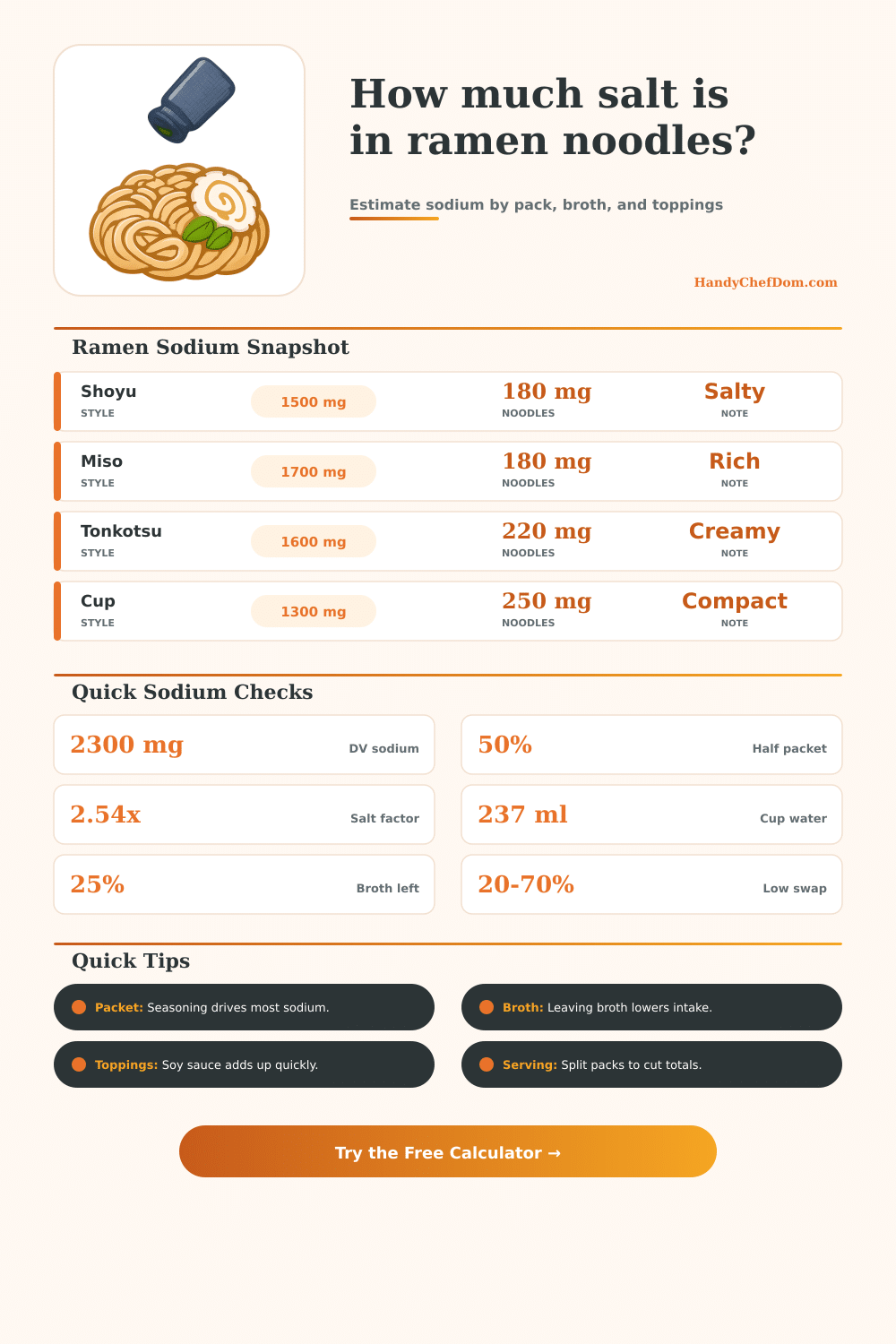
Ramen noodle soups contains sodium, and a variety of different factor can influence the amounts of sodium contained in a bowl of ramen. For example, the amount of sodium that is contained within one pack of ramen is often more greater than the amount of sodium that most people are supposed to consume each entire day. However, the amount of broth that an individual drinks from the pack influences the actual amount of sodium that is consumed by an individual who consume a pack of ramen.
More specific, the seasoning packet that is included with a pack of ramen is the primary source of sodium in the ramen, and contribute more sodium to the ramen than the ramen noodle themselves. Thus, one can alter the amount of sodium that is consumed with ramen by altering the amount of seasoning packet that is used with the ramen noodles, or by rinsing the ramen noodles in water after boil the noodles. The amount of broth that an individual drinks from the ramen pack will affect the amount of sodium that are consumed.
How Much Sodium Is in a Pack of Ramen?
By leaving some of the broth behind in the bowl, an individual will leave some of the sodium behind with the broth, and will consequently consume less sodium than if all of the broth had been drunk. For example, if an individual leaves one-quarter of the broth in the bowl, then the individual will leave behind one-quarter of the sodium that were released from the seasoning packet. Additionally, the amount of water that is added to the pack of ramen will affect the amount of sodium that is consumed.
Adding more water to the pack will make the sodium more diluted, but the total amount of sodium will remain the same unless the individual changes the amount of seasoning packet. Ramen packs often contains toppings that add additional sodium to the soup. For instance, adding soy sauce or meat to the ramen will increase the sodium content of the ramen.
Though these toppings are separate from the seasoning packet that is included with the pack, these toppings will contribute to the total amount of sodium that is consumed with the ramen. One can enter the sodium content of these toppings into a calculator to determine how the toppings influences the total amount of sodium that is consumed with the ramen. Ramen can be prepared in a variety of ways to reduce the amount of sodium that is consumed with the noodle soup.
For instance, individuals may use a reduced-sodium seasoning packet, rinse the ramen noodles to remove some of the sodium from the noodles, use only part of the seasoning packet, or use herbs and chili to flavor the ramen broth instead of using the seasoning packet altogether. Each of these method will reduce the amount of sodium that is contained in the ramen that is consumed, yet does not require any alteration to the recipe for the ramen. It is helpful to compare the sodium content of ramen to the daily limit for sodium that should be consumed by an individual.
The daily limit for sodium for most individuals is around 2300mg of sodium. By entering the total number of milligrams of sodium into the calculator for ramen, it is possible to determine what percentage of an individual’s daily sodium limit one pack of ramen will consume. This percentage can help an individual to decide if the ramen is suitable to that individual’s dietary need, or if it is necessary for them to consume food that contain less sodium for the remainder of that day.
Thus, the calculator helps an individual to understand how much sodium will be consumed with one pack of ramen, and allows that individual to make informed dietary choice.