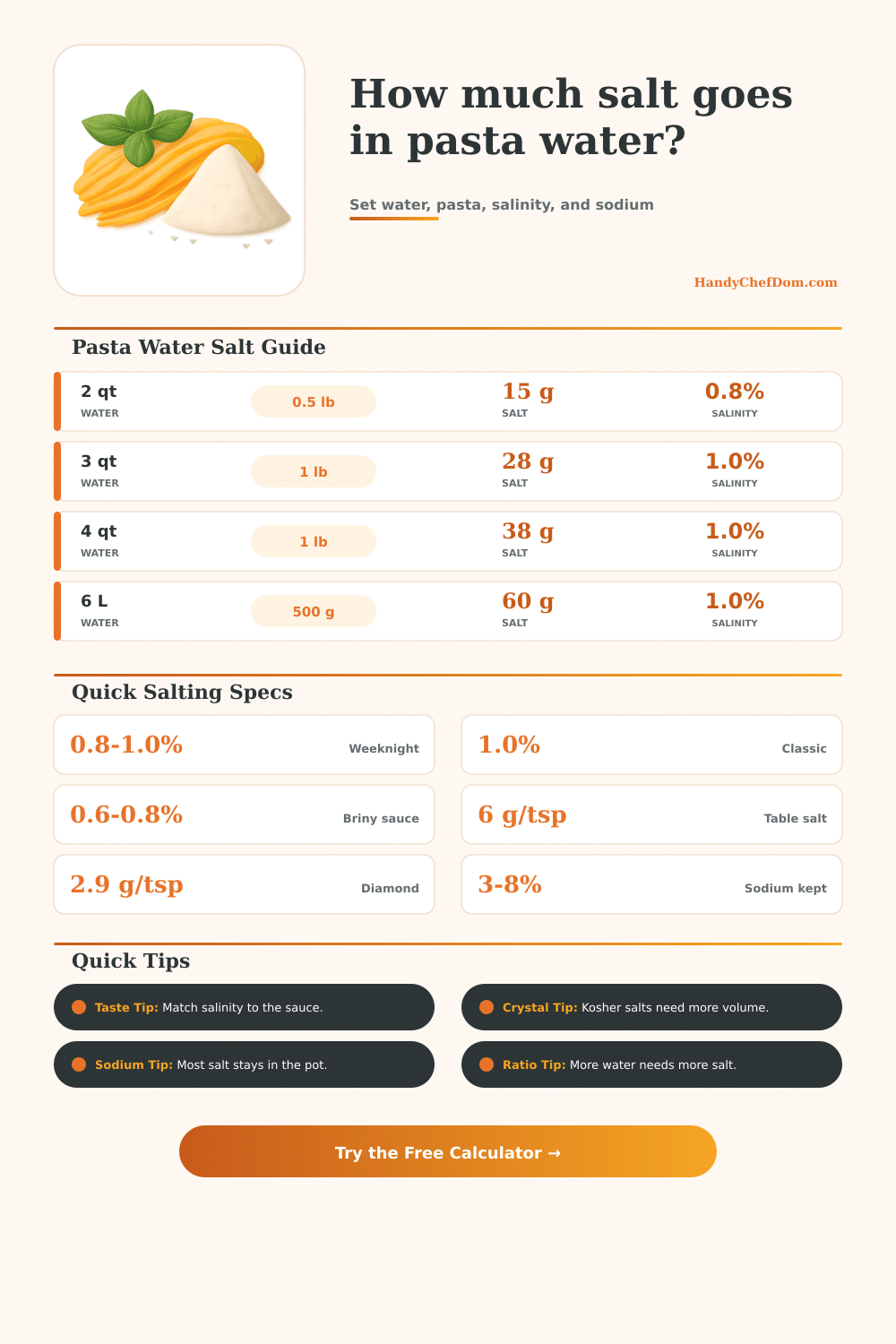
🍝 Salt To Add To Pasta Water Calculator
Set pasta-water salinity by water mass, choose the salt crystal size, adjust for salty sauces, and estimate retained sodium per serving.
Enter the water in quarts or liters and dry pasta in pounds or grams. The calculator converts salt by mass, then translates that amount into the spoon volume for your chosen salt type.
| Salinity Target | How It Tastes | Best Pasta Night | Salt Per Liter |
|---|---|---|---|
| 0.5% | Gentle and low | Very salty sauce or sodium watch | 5 g |
| 0.8% | Lightly seasoned | Balanced tomato sauce or pesto | 8 g |
| 1.0% | Classic savory | Most dried pasta dinners | 10 g |
| 1.2% | Noticeably seasoned | Plain butter, oil, or mild cream sauce | 12 g |
| 1.5% | Very briny | Rare use when sauce is unsalted | 15 g |
| Water Amount | Metric Equivalent | 1.0% Salt | Diamond Kosher Volume |
|---|---|---|---|
| 2 quarts | 1.89 liters | 18.9 g | 6.4 tsp |
| 3 quarts | 2.84 liters | 28.4 g | 9.7 tsp |
| 4 quarts | 3.79 liters | 37.9 g | 12.9 tsp |
| 5 quarts | 4.73 liters | 47.3 g | 16.1 tsp |
| 6 liters | 6.34 quarts | 60.0 g | 20.5 tsp |
| Dry Pasta | Metric Equivalent | Typical Water | Ratio Check |
|---|---|---|---|
| 0.5 pound | 227 g | 2 to 3 qt | Comfortable |
| 1 pound | 454 g | 4 to 5 qt | Classic roomy |
| 1.5 pounds | 680 g | 6 to 7 qt | Large pot |
| 500 grams | 1.10 lb | 4 to 5 L | Metric standard |
| 750 grams | 1.65 lb | 6 to 7 L | Family pot |
| Sauce Saltiness | Calculator Adjustment | Example Sauce | Practical Aim |
|---|---|---|---|
| Unsalted | +0.10% | Plain butter, no-salt tomato | Season the pasta more |
| Light | +0.00% | Fresh tomato or light pesto | Use target as written |
| Balanced | -0.05% | Standard jarred or homemade sauce | Keep pasta savory |
| Salty | -0.15% | Pecorino, pancetta, reduced cream | Leave room for the sauce |
| Briny | -0.25% | Clams, olives, capers, anchovy | Avoid stacking salt |
| Retained Sodium Setting | Meaning | From 40 g Salt Added | For 4 Servings |
|---|---|---|---|
| 3% | Light uptake estimate | 472 mg kept | 118 mg each |
| 5% | Middle home estimate | 787 mg kept | 197 mg each |
| 8% | Higher uptake estimate | 1,259 mg kept | 315 mg each |
| 12% | Conservative high estimate | 1,888 mg kept | 472 mg each |
Salinity are a measure of the amount of salt that is dissolve in water. Salinity is one of the factor that determines the taste of pasta. You must manage the salinity of the pasta water that you boil because the salinity of the pasta water will affect the flavor of the meal that you create with the pasta.
If the salinity level in the pasta water is to low, the pasta will taste flat even after you add sauce to it. If the salinity level in the pasta water is too high, the pasta will taste briny. Salinity isnt just the number of spoonfuls of salt that you add to the water, but the percentage of salt by weight in the water.
How Much Salt to Add to Pasta Water
The amount of salt that you add to the pasta water depend on the volume of the water, the weight of the pasta, and the type of sauce that you will use for your pasta. For example, if the sauce that you are using is already salty (like clam sauce), you will need to add fewer salt to the pasta water than if you were making pasta with a sauce that was not salty (like butter sauce). You can use a calculator to determine the amount of salt that is needed to prepare your pasta; the calculator takes into account the volume of the water, the weight of the pasta, and the type of sauce that will be used.
Additionally, the calculator provides the amount of salt in spoon volumes so that it can be easy added to the pasta water with different types of salt (table salt, kosher salt). The majority of the salt that you add to the pasta water remain in the pot of boiling water. Only a small amount of salt remains on the drained pasta.
The amount of salt that remains on the pasta is important for those who must limit its sodium (salt) intake; the amount of salt that remains on pasta can vary with the shape of the pasta. For example, pasta with ridges or hollow center will tend to hold more of the seasoned water than pasta of smooth shapes. Additionally, the amount of salt that pasta absorbs also varies with the type of pasta.
Fresh pasta will absorb less salt than dried pasta because fresh pasta cooks for a shorter period of time. The salinity of the water can change due to the process of evaporation. As water evaporate from the pot of boiling water, the volume of the water decreases.
As the volume of the water decreases, the salinity of the water increase. You can enter the percentage of the water that has boiled off into the calculator, as this percentage allow for the increase in salinity caused by evaporation to be accounted for. Accounting for the amount of water that has boiled off will ensure that you dont add to much salt to the pasta water.
The type of salt that you use will also affect the salinity of the water. For example, kosher salt tend to be fluffier than table salt so that one tablespoon of kosher salt will not contain the same weight of salt as one tablespoon of table salt. Therefore, if you are preparing pasta using the calculator, you can use a scale to measure out the salt, or you can use the spoon measurement that are provided in the calculation.
The calculator will provide both the amount of salt in grams and spoon volumes so that you can measure the salt in either variable. To prepare pasta correctly, you must decide on the target salinity of the water. Based off the target salinity, the volume of the pasta water, and the weight of the pasta, you can calculate the amount of salt that will require for the pasta water.
If you change any of the variables other than the amount of salt, you will have to change the amount of salt that is required. For example, if you increase the amount of pasta, you will have to increase the amount of salt. This calculator will help to remove the mental arithmetic that is required for preparing pasta with the proper salinity.
You should of used this sooner to recieve better results.