🥚 Cholesterol in Egg White Calculator
Estimate cholesterol for clean egg whites, liquid whites, and optional yolk traces, then compare against yolks, whole eggs, and a daily value reference.
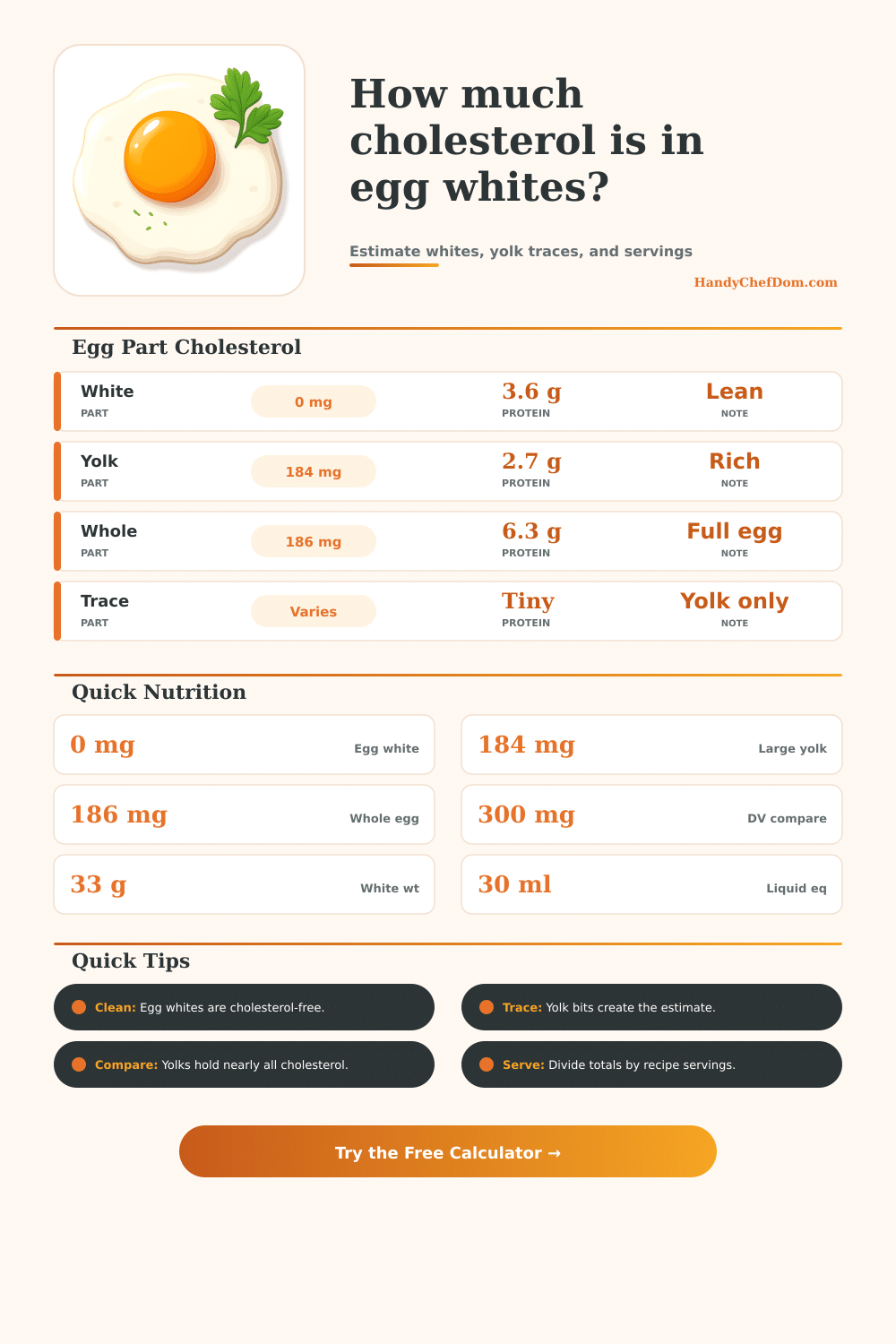
Clean egg whites are calculated as 0 mg cholesterol. The cholesterol estimate only rises when you add a yolk contamination percentage.
| Egg Size | White Weight | Liquid Equivalent | Clean Cholesterol |
|---|---|---|---|
| Small | 26 g | 25 ml | 0 mg |
| Medium | 30 g | 29 ml | 0 mg |
| Large | 33 g | 30 ml | 0 mg |
| Extra-large | 37 g | 36 ml | 0 mg |
| Jumbo | 42 g | 41 ml | 0 mg |
| Egg Part | Typical Large Egg Amount | Cholesterol | What It Means |
|---|---|---|---|
| Egg white only | 33 g white | 0 mg | Cholesterol-free base |
| Egg yolk only | 17 g yolk | 184 mg | Main cholesterol source |
| Whole large egg | 50 g edible egg | 186 mg | White plus yolk |
| 1% yolk trace in one white | 0.33 g yolk trace | 3.6 mg | Small estimate only |
| 5% yolk trace in one white | 1.65 g yolk trace | 17.9 mg | Visible yolk streak |
| Recipe Use | Typical Whites | Liquid Whites | Clean Cholesterol |
|---|---|---|---|
| Omelet or scramble | 3 to 5 whites | 90 to 150 ml | 0 mg |
| Meringue topping | 3 whites | 90 ml | 0 mg |
| Angel food cake | 10 to 12 whites | 300 to 360 ml | 0 mg |
| Macarons | 3 to 4 whites | 90 to 120 ml | 0 mg |
| Cocktail foam | 0.5 to 1 white | 15 to 30 ml | 0 mg |
| Baking binder | 1 to 2 whites | 30 to 60 ml | 0 mg |
| Cholesterol Total | 300 mg DV Comparison | Common Egg Example | Kitchen Note |
|---|---|---|---|
| 0 mg | 0% | Clean egg whites | No yolk included |
| 25 mg | 8% | Several trace streaks | Estimate from yolk only |
| 93 mg | 31% | About half a large egg yolk | Not from whites |
| 184 mg | 61% | One large yolk | Yolk cholesterol |
| 186 mg | 62% | One whole large egg | Yolk plus white |
| 300 mg | 100% | Daily comparison reference | Not a medical target |
Since egg whites does not contain cholesterol, and since egg whites contain almost no fat, egg whites are a way for an individual to consume the benefits of egg products without consuming the cholesterol that is contained within the egg yolk. Because egg whites dont contain cholesterol, recipes often use egg whites as a means of reducing the amount of cholesterol that an individual who eats that recipe consumes. In accounting for egg whites, it is necesary to account for the different size of the eggs.
A large egg white contain a different amount of protein than a small egg white. Additionally, the amount of egg whites that are liquid and contained within a carton are measured by volume or weight, not by the numbers of individual eggs. In the case of recipes that are to be divided among a number of individuals, it is important to calculate the total amount of egg whites that the recipe will use.
Measuring Egg Whites and Their Nutrition
This allows for the recipe to be divided in a way that each serving will contains the same amount of protein and the same amount of cholesterol. Another factor to consider in the calculation of the amount of cholesterol that will be contained within recipes that use egg whites is the possibility of the introduction of yolk into the mixture. The amount of cholesterol that is contained within the yolk are very high.
Even a small amount of the yolk can introduce cholesterol into the recipe. Accounting for this small amount through the use of a trace percentage field will allow cooks to account for this introduced cholesterol into the recipe, without overestimating the amount of cholesterol that the egg whites contain. If the egg whites are clear and do not contain any yolk, the amount of cholesterol will be zero.
Because egg whites are high in protein and have a neutral flavor, recipes use egg whites to provide structure to the recipe, such as angel food cake or meringues. Additionally, egg whites tend to behave differently within a pan or an mixer than whole eggs do. This difference is due to the fact that egg whites contain almost no fat.
As a result, recipes that use egg whites requires different cooking techniques different than those recipes that use whole eggs. One of the primary sources of the protein in a cooked recipe is the protein that is contained within egg whites. One large egg white contains approximately three and a half gram of protein.
Additionally, the protein that is contained within egg whites contains almost no fat or carbohydrate. As a result, recipes that use egg whites will contain a significant amount of protein if many egg whites is used in the recipe. Furthermore, the calculator can easily calculate the protein content and the cholesterol content of recipes that use egg whites at the same time.
The nutrition information for egg whites can be compared to the daily value targets that is recommended for each individual. The daily value targets can be different according to the country from which the individual derives there recipe or the health guidelines that they follow. By viewing the amount of egg whites as a percentage of the daily target for each type of nutrient, cooks can easily understand in what way the egg whites will fit into the diet of the individual.
Furthermore, the comparison of the nutrition facts of egg whites to daily value targets indicates that egg whites contain very little cholesterol for the amount of protein that they contributes to a recipe. Some of the most common mistakes made in the use of egg whites is the assuming that all egg products contain cholesterol, or the assumption that all eggs are of the same size. The jumbo size of an egg white contain more protein than the small size of an egg white.
Additionally, the amount of liquid egg whites that are contained within the carton may differ from recipe to recipe. Therefore, the amount of liquid egg whites should of be entered by weight or by volume. The specific purpose of the calculator is to eliminate the need of individuals to perform mental arithmetic.
The mental arithmetic that cooks should perform with the knowledge of the amount of cholesterol, the amount of protein, and the amount of that protein and cholesterol per serving will allow cooks to make decisions regarding their recipe. Therefore, the knowledge of these figures will allow cooks to treat egg whites as a specific ingredient in their recipe.