Lentils Iron Calculator
Estimate lentil iron from dry cups, cooked cups, dry grams, cooked grams, brown, red, green, or black lentils, cooked yield, servings, daily value percent, vitamin C pairing, and soup, curry, or salad batch scaling.
1Lentils Iron Presets
2Dry, Cooked, Cups, Grams, Type, Yield, and Serving Inputs
Pick the entry mode that matches your recipe. Dry modes estimate cooked output using the selected lentil yield; cooked modes use the edible cooked amount directly.
Lentils iron estimate
Choose a preset or enter your own lentil amount.
3Four Live Lentil Iron Cards
Current cooked lentil iron density used by the calculator.
Back-calculated dry amount when you enter cooked cups or grams.
Meal pairing note for non-heme iron planning.
Entered lentils compared with the target recipe servings.
4Lentil Type, Cooked Yield, and Iron Grid
| Lentil type | Dry cup weight | Cooked yield | Cooked iron per 100 g | Dry iron per 100 g |
|---|---|---|---|---|
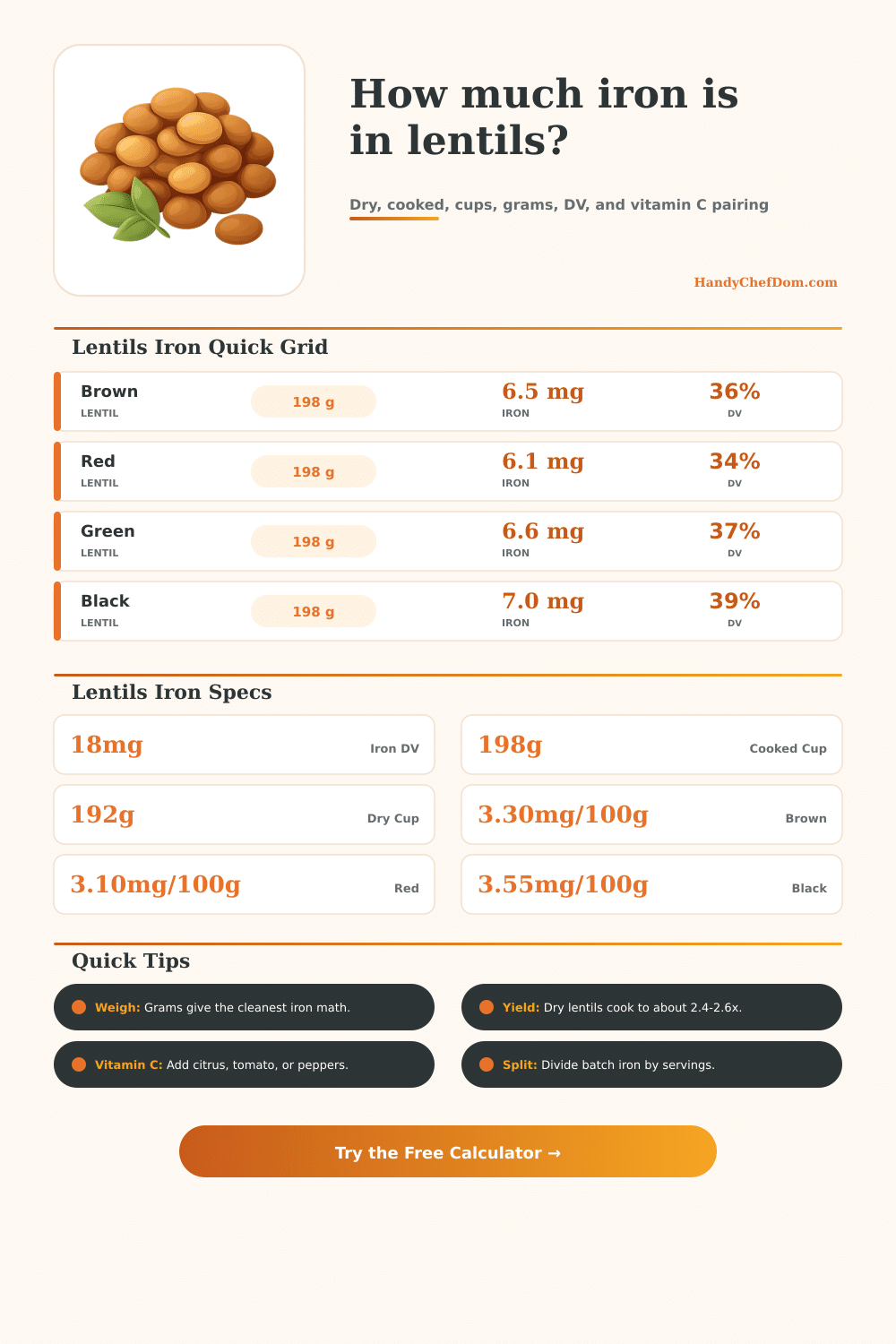
| Brown lentils | 192 g | 2.50x | 3.30 mg | 6.50 mg |
| Red or split red lentils | 190 g | 2.40x | 3.10 mg | 7.40 mg |
| Green or French lentils | 190 g | 2.60x | 3.35 mg | 6.20 mg |
| Black beluga lentils | 185 g | 2.45x | 3.55 mg | 7.00 mg |
| Canned drained lentils | n/a | already cooked | 2.10 mg | n/a |
| Sprouted cooked lentils | 160 g | 2.20x | 2.85 mg | 5.70 mg |
| Mixed lentil blend | 190 g | 2.50x | 3.25 mg | 6.70 mg |
5Dry and Cooked Lentils Iron Conversion Table
| Measure | Brown lentil equivalent | Cooked grams | Iron estimate | Best calculator mode |
|---|---|---|---|---|
| 1/4 cup dry | 48 g dry | 120 g cooked | 4.0 mg | Dry cups |
| 1/2 cup dry | 96 g dry | 240 g cooked | 7.9 mg | Dry cups |
| 1 cup dry | 192 g dry | 480 g cooked | 15.8 mg | Dry cups |
| 1/2 cup cooked | about 99 g cooked | 99 g cooked | 3.3 mg | Cooked cups |
| 1 cup cooked | about 198 g cooked | 198 g cooked | 6.5 mg | Cooked cups |
| 250 g cooked | about 100 g dry | 250 g cooked | 8.3 mg | Cooked grams |
6Soup, Curry, Salad, and Bowl Scaling Table
| Recipe style | Cooked lentils per serving | Iron per serving with brown lentils | Vitamin C pairing | Calculator note |
|---|---|---|---|---|
| Brothy lentil soup | 110 g | 3.6 mg | Tomato, lemon, parsley | Use soupy cup if broth fills the cup. |
| Thick dal or curry | 150 g | 5.0 mg | Tomato, chile, lime | Use retention 1.03x or 1.05x if reduced. |
| Cold lentil salad | 170 g | 5.6 mg | Bell pepper, citrus vinaigrette | Use salad cup or cooked grams. |
| Grain bowl base | 160 g | 5.3 mg | Pickled cabbage or salsa | Set target grams per serving to 160 g. |
| Taco filling | 120 g | 4.0 mg | Salsa, lime, slaw | Set recipe style to taco or filling batch. |
| Meal prep container | 180 g | 5.9 mg | Roasted peppers or broccoli | Divide the cooked batch by box count. |
7Daily Value and Non-Heme Iron Context Table
| Serving scenario | Cooked lentils | Iron | DV at 18 mg | Non-heme context |
|---|---|---|---|---|
| Small side | 75 g | 2.5 mg | 14% | Plant iron; pair with vitamin C for a supportive meal. |
| Half cup cooked | 99 g | 3.3 mg | 18% | Good side portion for rice, bowls, or soups. |
| One cup cooked | 198 g | 6.5 mg | 36% | Large serving with substantial non-heme iron. |
| Soup bowl | 130 g | 4.3 mg | 24% | Tomato broth can add vitamin C support. |
| Dal dinner | 180 g | 5.9 mg | 33% | Serve with lemon, tomato, or chile. |
| High-lentil prep | 250 g | 8.3 mg | 46% | Use cooked grams for best accuracy. |
8Two Practical Lentils Iron Tips
Recipes call for cups, which is how most people measure their lentil. But mass matter for iron. Small amounts of dry black beluga lentils, which are also tiny, may contain even more iron than a cup of larger brown ones. That’s why you can’t guess at your nutrient uptake if you only know the volume in cups.
Once you know your actual measurement, our calculator figures out the rest. No need to waste time wondering about conversions and coefficients: it does that for you. And it converts abstract volume into something concrete… A precise number of milligrams… So you can actualy see what you’re getting.
Why Measuring Matters for Iron Intake
The first true barrier, though, is getting a grip on how much cooked versus dry lentils weigh. When you cook lentil, those little guys soak up water, increase their weight and volume but don’t change the amount of iron contained inside their seed. When you cook lentils, they absorbs water so that a 100-gram portion of cooked lentils is now half water, which dilutes the iron content. That dilutes the iron content, which is why you’ll have less iron in your 100-gram bowl of cooked-up lentils compared than 100 grams of dry ones.
To accurately portray the amount of iron you’re consuming, then, you must consider the yield multiplier, the amount of cooked lentil product you end up with from a given amount of dry stuff. To do that, simply enter either the cooked amount or original dry one into the tool. Depending on which side of the equation you choose, it will adjust density to match and represent the actual edible item sitting on your plate.
It turns out that kind of lentil makes a bigger difference than most people expect. In general, black beluga and green French varieties contains more iron by weight (per gram) than red split ones do. Red lentils also break down completely into a mushy mass upon cooking, so they’ll affect the consistency of whatever you’re cooking, and therefore how you serve that dish. A thicker lentil stew means denser mouthfuls, versus a lighter dal you’ll want to serve with a soup spoon instead.
Choosing the right option in the interface will ensure that amount of iron per bite matches the variety you have on hand. It is a small point, but it could of avoid big math errors over time. Your starting ingredient matters too: Where did you get your lentils from? Canned lentil are convenient, but they tend to have slightly less iron per cooked gram. This is because they are already hydrated and may have been rinsed, which washes some of the easily-dissolved nutrients into the canning water.
Then there’s sprouted lentils, which add another nutritionally different picture to the mix since their germination process impacts nutrient availability. Because general dry-to-cooked multipliers don’t hold true equally among all varieties, the calculator allows you to choose between them, so if you use the canned lentil option and plug-in a dry lentil multiplier, your numbers will be completely wrong. They’ll be puffed-up way past how much iron there actualy is in this particular lot.
But beyond this, there’s another wrinkle we don’t get through pure numbers: the way things are digested, or how much they’re absorbed. Non-heme iron, the type found in plants, isn’t absorbed so well by our bodies as heme iron (the kind from animals). But the tool knows about this. It tells you that if you eat your lentils with some food high in vitamin C, you’ll be dramatically increasing the amount of iron your body absorbs.
This could be a salad with lemon juice squeezed onto it, some tomatoes thrown into your curry, or a few bell peppers on the side. This doesn’t affect amount of iron in the food at all, of course; it affects how much your body can use. It’s great to know you’ve got six milligrams of iron, but it’s even better to know if you might actualy be able to use half of it.
Meal prepping also adds its own variable: Scaling up to batch-cook can affect nutrients. A big pot of lentils will divide evenly among eight servings, so divide by eight to get an estimate of iron in each serving. But what about a concentrated curry versus a brothy one? The latter has more liquid and therefore fewer solids, which may have become more concentrated as the liquid boiled down. Cooking style factors helps bring your nutrition plan in line with reality. It makes vague dietary targets tangible actions within the kitchen. No more wondering if that side dish qualifies as part of your daily quota; instead you know exactly where it slots into the picture.
Lentils are inexpensive. They don’t require a doctor’s visit or a supplement regimen, and they can help with common iron-deficiency issues. The more you learn about them; how certain varieties differ, their nutritional value, the impact of pairing with vitamin-C-rich foods, and how cooking changes their weight. The more effective this humble pantry item will be as a weapon in your collection of nutritious eats.
A little knowledge goes a long way when it comes to food; it doesn’t take a PhD in nutritional sciences to prepare healthy meals. Just learn to measure, and let the numbers work for you. What once was a mere cup of lentils is now a measured component of your day-to-day fuel.