🧀 Ricotta Cheese for Lasagna Calculator
Estimate ricotta for lasagna by pan size, layer count, servings, filling style, moisture, and cheese blend.
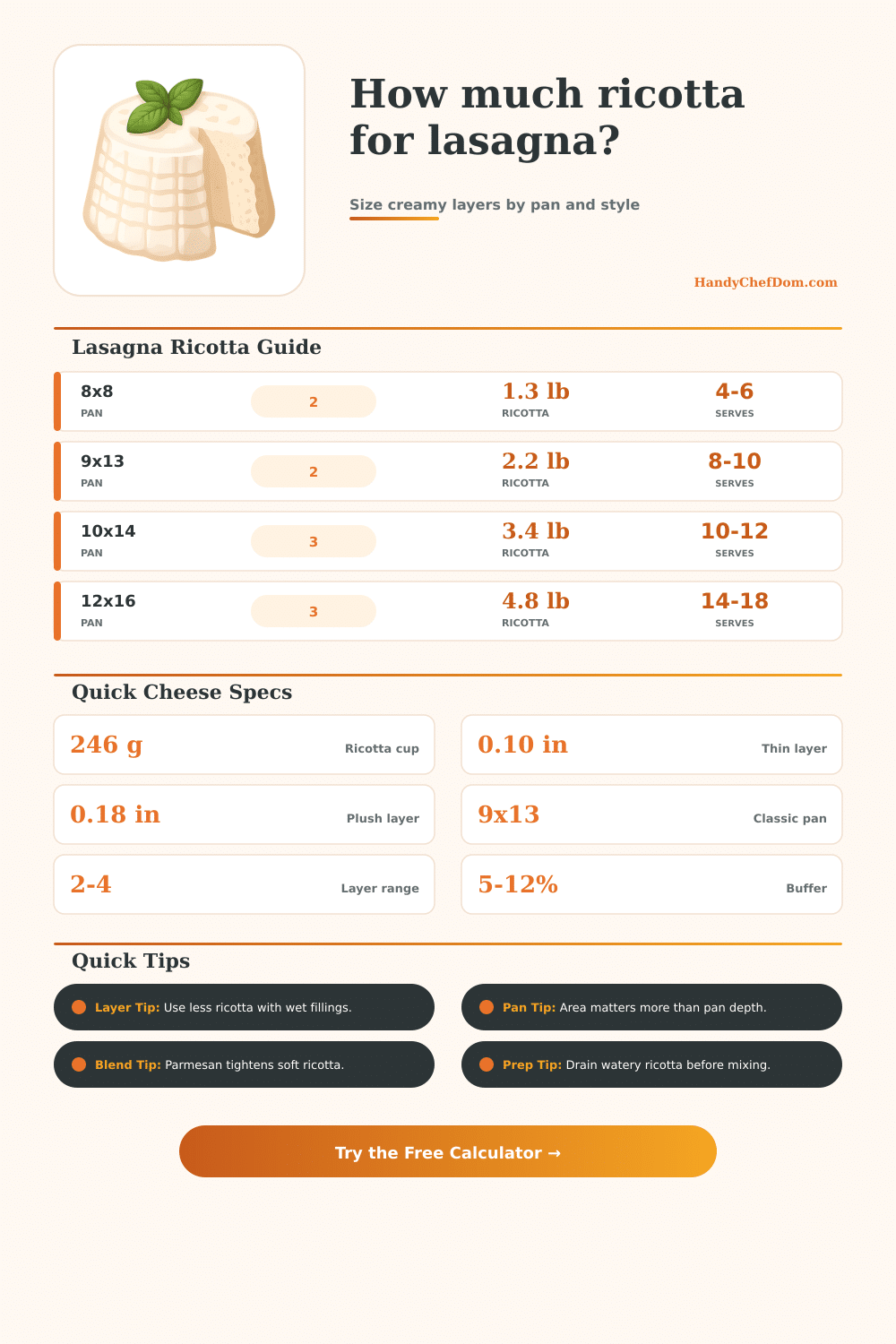
Choose the pan footprint and the ricotta layer style. The calculator converts pan area into ricotta volume, then adjusts for moisture, filling style, blend, and a small spreading buffer.
| Ricotta Layer Style | Thickness Target | Best Use | Ricotta Feel |
|---|---|---|---|
| Skim coat | 0.10 in | Meat-heavy pans | Light and tidy |
| Classic creamy | 0.14 in | Family lasagna | Balanced cheese layer |
| Plush cheese-forward | 0.18 in | Holiday pans | Rich and visible |
| Stuffed bakery-style | 0.22 in | Deep lasagna | Thick ricotta band |
| Pan Size | Area | Classic 2-Layer Ricotta | Typical Servings |
|---|---|---|---|
| 8 x 8 square | 64 sq in | 1.2 to 1.5 lb | 4 to 6 |
| 9 x 9 square | 81 sq in | 1.5 to 1.8 lb | 6 to 8 |
| 9 x 13 family | 117 sq in | 2.1 to 2.6 lb | 8 to 10 |
| 10 x 14 deep | 140 sq in | 2.6 to 3.1 lb | 10 to 12 |
| 11 x 15 party | 165 sq in | 3.0 to 3.7 lb | 12 to 15 |
| 12 x 16 tray | 192 sq in | 3.5 to 4.3 lb | 14 to 18 |
| Lasagna Style | Ricotta Adjustment | Moisture Note | Cheese Balance |
|---|---|---|---|
| Meat sauce classic | 0.96x | Meat sauce fills gaps | Moderate ricotta |
| Sausage heavy | 0.92x | Richer filling | Use a thinner layer |
| Roasted vegetable | 1.08x | Vegetables need coverage | Ricotta softens texture |
| Spinach ricotta | 1.12x | Spinach blends into cheese | More ricotta base |
| White sauce cheese | 1.06x | Sauce is already creamy | Keep layers smooth |
| Lean weeknight | 0.88x | Cleaner slice profile | Smaller cheese ribbon |
| Cheese Blend | Ricotta Share | Add-In Guide | Texture Result |
|---|---|---|---|
| Classic ricotta parmesan | 100% | 0.18 lb parmesan per lb ricotta | Balanced and creamy |
| Extra mozzarella | 95% | 0.30 lb mozzarella per lb ricotta | Stretchier layer |
| Three-cheese blend | 92% | 0.40 lb mixed cheese per lb ricotta | Rich and fuller |
| Spinach parmesan | 100% | 0.12 lb parmesan per lb ricotta | Firm green filling |
| Lighter blend | 86% | 0.10 lb parmesan per lb ricotta | Thinner cheese band |
| Ricotta cottage blend | 70% | 0.45 lb cottage per lb ricotta | Soft and spoonable |
| Kitchen Conversion | Imperial | Metric | Calculator Use |
|---|---|---|---|
| Ricotta density | 1 cup | 246 g | Turns spread volume into weight |
| Standard tub | 15 oz | 425 g | Container planning estimate |
| Large tub | 32 oz | 907 g | Good for bigger pans |
| Pan area | 1 sq in | 6.45 sq cm | Scales each ricotta layer |
| Volume | 1 cup | 237 ml | Shows mixing bowl volume |
| Weight | 1 lb | 454 g | Switches result units |
To prepare your lasagna correctly, you must understand how the ricotta cheese interact with the other ingredients in the lasagna pan. The amount of ricotta cheese that you need to use will depend on the size of your lasagna pan, the number of layers that you will make, and the type of filling that you will use in your lasagna along with the ricotta cheese. Using too little ricotta cheese will make the lasagna dry between the lasagna noodles.
Using too much ricotta cheese will cause the lasagna to become a loose mess when you cut into it. Many people will attempt to guess how much ricotta cheese is needed for the lasagna. However, by considering the dimensions of the lasagna pan and the style of the lasagna that you are preparing, you can more accurately determine the amount of ricotta cheese that you will need.
How Much Ricotta Cheese to Use in Lasagna
The surface area of the lasagna pan will influence how much ricotta cheese is needed. If you are using an 8 by 8 inch lasagna pan, you are using roughly half the surface area of a 9 by 13 inch lasagna pan. Therefore, you will need noticeably less ricotta cheese in an 8 by 8 inch lasagna pan.
To determine the amount of ricotta cheese needed for the pan, determine the surface area of the pan. Once you have determined the surface area of the pan, decide on the thickness of the ricotta cheese layer. Depending on the number of lasagna noodles that you are using, a thin layer of ricotta cheese will bind the lasagna noodles together.
A thicker layer of ricotta cheese will make the ricotta cheese the main component of the lasagna. The thickness of the ricotta cheese layer can be important when preparing lasagna for a small number of peoples or for a large number of people. A third ingredient that will influence the amount of ricotta cheese you need is the moisture of the lasagna filling.
If you are using a meat sauce that has been cooked down, you can use a richer layer of ricotta cheese since the meat sauce will not make the lasagna too soupily. If you are using alot of vegetable fillings that will release some of the water in the lasagna when you bake it, you will want to use a thinner layer of ricotta cheese. This will prevent the vegetables from ruining the lasagna when it is cooked.
If you are using a white sauce, like béchamel, to prepare the lasagna, the béchamel sauce will provide creaminess for the lasagna, so the ricotta cheese will mainly provide the body to the lasagna. Therefore, you will need to adjust the amount of ricotta cheese based on the moisture content of the lasagna fillings. The type of cheeses that you will mix with the ricotta cheese will influence the total amount of ricotta cheese that will be needed.
Using parmesan cheese in the lasagna will help to tighten the ricotta cheese and will make the lasagna easy to slice. Using extra mozzarella cheese will stretch the ricotta cheese layer. However, extra mozzarella cheese will also make the lasagna heavier.
Using cottage cheese in the lasagna will lighten the lasagna in terms of protein but will also change the texture of the lasagna. These cheeses are not right or wrong. However, the type of cheeses that are used will influence the amount of ricotta cheese that must be used before you add the other cheeses to the lasagna bowl.
The texture of the ricotta cheese that is straight from the container is one more factor that will influence the total amount of ricotta cheese for the lasagna. If the ricotta cheese is wet and loose, it will spread easily on the lasagna pan. However, wet ricotta cheese will add more water to the lasagna.
Using drained ricotta cheese or basket-style ricotta cheese will help the ricotta cheese hold its shape when it is on the lasagna pan. Also, drained ricotta cheese will require less of the cheese by weight. The difference in ricotta cheese water content is minor when using one lasagna pan but will become significantly when baking lasagna for holidays or preparing multiple lasagna meals.
To find the correct amount of ricotta cheese for your lasagna, you can measure your lasagna pan to determine the size of the lasagna. You can also use this measurement to decide on the number of layers that will be in the lasagna. Additionally, the moisture of the lasagna fillings will help to dictate the amount of ricotta cheese to be used.
The type of cheeses to be used in the lasagna will also help to dictate the amount of ricotta cheese that is to be used. By performing these steps, you will have a target weight of ricotta cheese that will be needed for your lasagna. With the target weight of ricotta cheese that you have calculated, you can shop for the correct number of ricotta cheese tub that you will need to purchase.
Additionally, you can also determine the amount of parmesan or mozzarella cheese that will be needed based on the type of lasagna that you would like to prepare. Many people will overcorrect the amount of ricotta cheese that they use to make their lasagna. They will either use too little ricotta cheese the first time they make lasagna or they will have too much ricotta cheese leftover.
To avoid these issues, use the surface area of the lasagna pan and the moisture of the lasagna filling to calculate the amount of ricotta cheese that will be needed to prepare the lasagna. By using these measurements to calculate the amount of ricotta cheese for your lasagna, you can count on the lasagna to slice clean and hold together on the plate when served to your family and friends.