🌶 Tomato Paste for Chili Calculator
Size tomato paste for chili by batch volume, meat, beans, tomatoes, style, simmer reduction, package size, servings, and thickness goal.
Enter the starting pot volume and flavor builders. The calculator estimates finished volume after simmering, then uses chili style, tomato intensity, and thickness target to size paste.
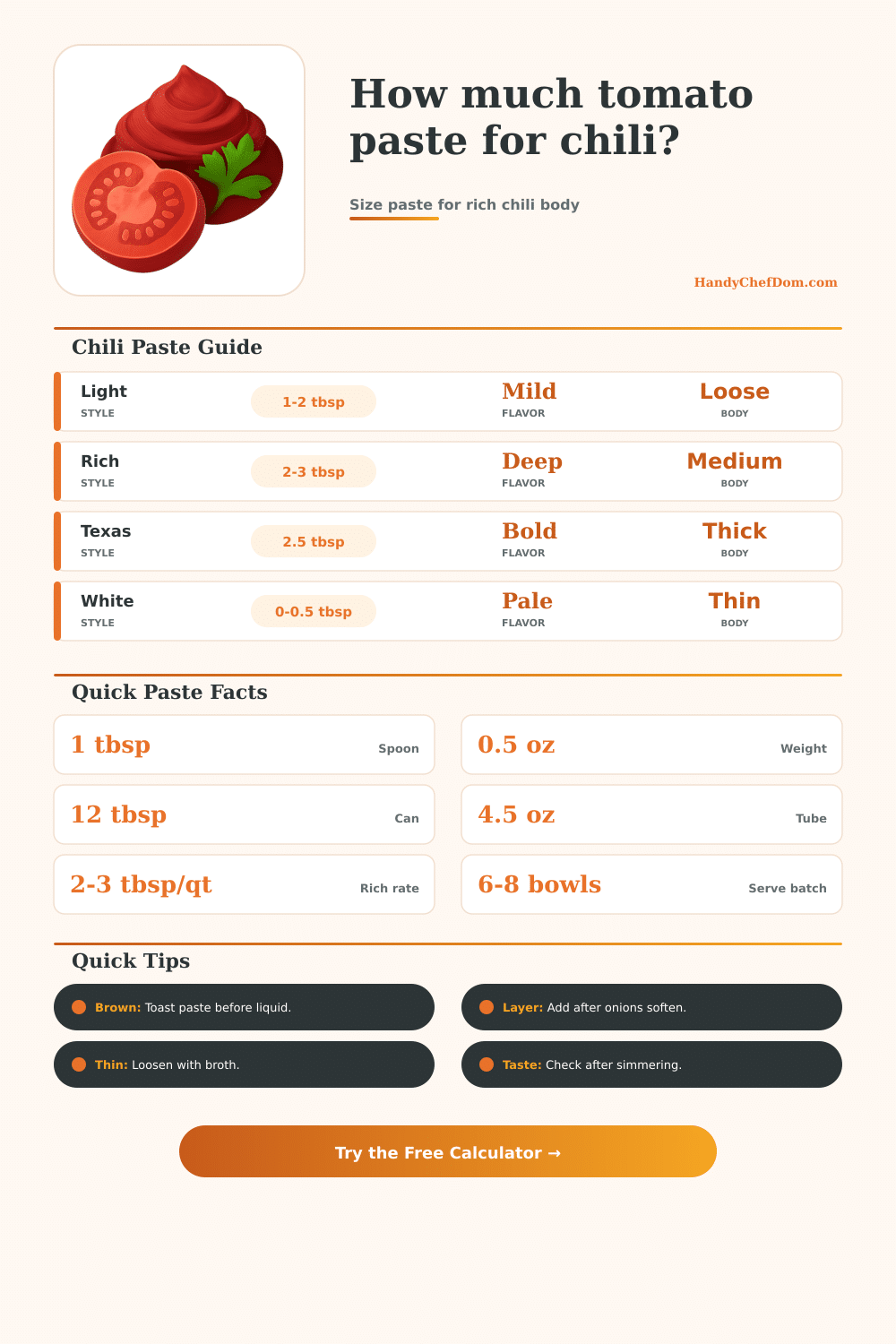
| Tomato Intensity | Starting Rate | Best Chili Use | Flavor Result |
|---|---|---|---|
| Very light | 0.4-0.8 tbsp/qt | White or green chile pots | Subtle body without red flavor |
| Light body | 1-2 tbsp/qt | Weeknight chili with diced tomatoes | Mild tomato roundness |
| Balanced red | 1.8-2.3 tbsp/qt | Beef and bean chili | Classic red chili backbone |
| Rich backbone | 2.4-3 tbsp/qt | Texas red or turkey chili | Deep tomato and thicker sauce |
| Competition deep | 3-3.6 tbsp/qt | Small batches with strong chile powder | Dense red color and firm body |
| Package | Usable Paste | Tablespoons | Kitchen Equivalent |
|---|---|---|---|
| 6 oz can | 6 oz | About 12 tbsp | Good for 4-6 qt rich chili |
| 4.5 oz tube | 4.5 oz | About 9 tbsp | Flexible for staged tasting |
| 3 oz half can | 3 oz | About 6 tbsp | Good for 2-3 qt classic chili |
| 1 tablespoon | 0.5 oz | 1 tbsp | About 14-16 g paste |
| 1 teaspoon | 0.17 oz | 0.33 tbsp | Small final correction |
| Chili Style | Paste Factor | Texture Target | Important Note |
|---|---|---|---|
| Texas red | 1.15x | Glossy, brick red gravy | Paste supports chile puree and beef |
| Beef and bean | 1.00x | Classic spoonable bowl | Beans thicken as they simmer |
| Turkey chili | 1.05x | Lean but rounded | Paste replaces some missing fat body |
| Vegetable chili | 1.12x | Thick vegetable stew | Extra paste anchors watery vegetables |
| White chicken | 0.22x | Pale, broth-forward chili | Use tiny amounts only if wanted |
| Smoky brisket | 1.20x | Bold and dark | Smoked chile can handle more paste |
| Slow cooker | 0.92x | Soft and saucy | Low evaporation means less paste |
| Competition red | 1.25x | Dense and clingy | Best added in staged portions |
| Batch Build | Paste Impact | Reduction Impact | Calculator Treatment |
|---|---|---|---|
| Each lb beef or pork | Adds richness need | Releases juices early | Small paste boost per pound |
| Each 15 oz bean can | Needs red sauce coating | Thickens final pot | Minor boost, then body credit |
| Each cup diced tomato | Adds tomato flavor | Adds water | Offsets some paste, not all |
| Open simmer | Concentrates paste fast | Higher evaporation | Lower final volume, higher body |
| Slow cooker | Mellower tomato flavor | Low evaporation | Less paste than stovetop |
Tomato paste is an ingredient that is necesary in chili because tomato paste provide flavor to the chili, tomato paste provide thickness to the chili, and tomato paste provides color to the chili. If you use too little tomato paste, the chili will taste thin and it will lack flavor. If you use too much tomato paste, the chili will taste heavy and may have a metallic taste.
Because tomato paste is used to provide flavor and thickness to the chili, it is important to use the correct amount of tomato paste in order to achieve the desired results from your pot of chili. A given chili recipe requires an amount of tomato paste based off part upon the other ingredient that are used within that recipe. For instance, a chili that contains beans will require less tomato paste than a chili that contains beef, and a white chicken chili will require less tomato paste than a chili that contains tomatoes and red beans.
How Much Tomato Paste to Use in Chili
The amount of tomato paste that a chili recipe requires can change based upon the ingredients that are used within the chili recipe and based upon the amount of liquid that evaporate during the cooking process of the chili. Thus, the chili will need to change the amount of tomato paste that is required according to the amount of liquid that will evaporate during the cooking process of the chili. The tomato paste calculator allow cooks and chili makers to calculate the amount of tomato paste that is required for a pot of chili based upon several different sets of specifications for that chili recipe.
For instance, the calculator will require from the individual that makes the chili the starting volume of chili that will be made, the weight of the meat that will be used, the number of cans of beans that will be used, the amount of tomatoes that is already contained within the chili, the simmer time that the chili will be simmered to, and the lid that will be used to cover the chili pot. Each of these inputs will allow the calculator to determine the amount of tomato paste that should be used within the chili recipe. For instance, if the chili will be simmermed with a cracked lid for long periods of time, the tomato paste calculator will suggest reducing the amount of tomato paste that will be used within the chili because more water will evaporate from the chili during the simmering process.
The style of chili that is to be made will also determine the amount of tomato paste that is to be used within that chili recipe. For instance, Texas red chili will require more tomato paste to provide the necessary body to the chili because Texas red chili recipes do not include beans. Vegetable chili may require extra tomato paste to counterbalance the water that may be released from the vegetables that are used in the chili.
Turkey chili will require a more moderate amount of tomato paste because the tomato paste can replace some of the flavor of ground beef that is typically used in chili recipes. Additionally, chili makers can also use the intensity setting on the calculator to set the chili recipe to be flavored with either a light or deep flavor of tomato paste. The method in which the tomato paste is cooked will change the flavor of chili that results from the chili recipe.
For instance, blooming the tomato paste with onions and fat for one or two minutes will remove the flavor of the tomato paste that is commonly found in store bought canned tomato paste. By blooming the tomato paste, there will be more tomato paste flavor in the chili that is made with that chili recipe. Thus, the tomato paste calculator will suggest using less tomato paste if the blooming method is to be use for the tomato paste.
The calculator also allows for the chili maker to indicate whether or not the blooming process will be skipped or if the recipe will include deep browning of the tomato paste. Additionally, the level of salt and spice that will be used in the chili will also impact the amount of tomato paste that will be used in the chili recipe. When using the tomato paste calculator, there are several pieces of information that will be provided to the chili maker.
For instance, the calculator will indicate the amount of tomato paste that will be needed for the chili, the number of package of tomato paste that will need to be purchased, the amount of tomato paste per serving of chili, and a thickness score for the chili. The thickness score will indicate how thick the chili will be. A high thickness score will create a chili that has a thick texture that will hold its shape with a spoon, while a low thickness score will result in a chili that has a loose texture.
There are also reference tables that the chili maker can utilize to review the results of the tomato paste calculator. These reference tables provide information about different amounts of chili intensity and chili styles. Additionally, the reference tables can provide information about the sizes of packages of tomato paste and the equivalents in the kitchen to different amounts of tomato paste.
Thus, the reference tables allow individual to make a decision between using a six ounce can of tomato paste, for instance, or a tube of tomato paste. The reference tables exist to provide information about the different inputs into the tomato paste calculator and how each individual input may interact with each other. As with any process, there are mistakes that may be made in the attempt to add tomato paste to chili.
For instance, if the cook adds the tomato paste at the end of the cooking of the chili recipe, it will have a raw taste to the chili. If the tomato paste is added too early in the cooking process, before blooming the tomato paste, it will not develop the full flavor of the tomato paste. The chili maker can avoid both of these mistakes by holding back some of the tomato paste until the last thirty minutes of cooking the chili.
In this way, if the chili tastes too thin, the chili maker can add the tomato paste at this last stage of cooking to even out the flavor of the chili. Overall, the tomato paste calculator will provide the chili maker with the best starting point for the amount of tomato paste to use in their chili recipe. This starting point can be adjusted according to the flavor of the remaining ingredients in the chili, as well as according to the taste of the chili that is being made.