🍚 Carbs in Quinoa Calculator
Estimate total carbs, net carbs, serving carbs, and daily target coverage for cooked quinoa, dry quinoa, or batch leftovers.
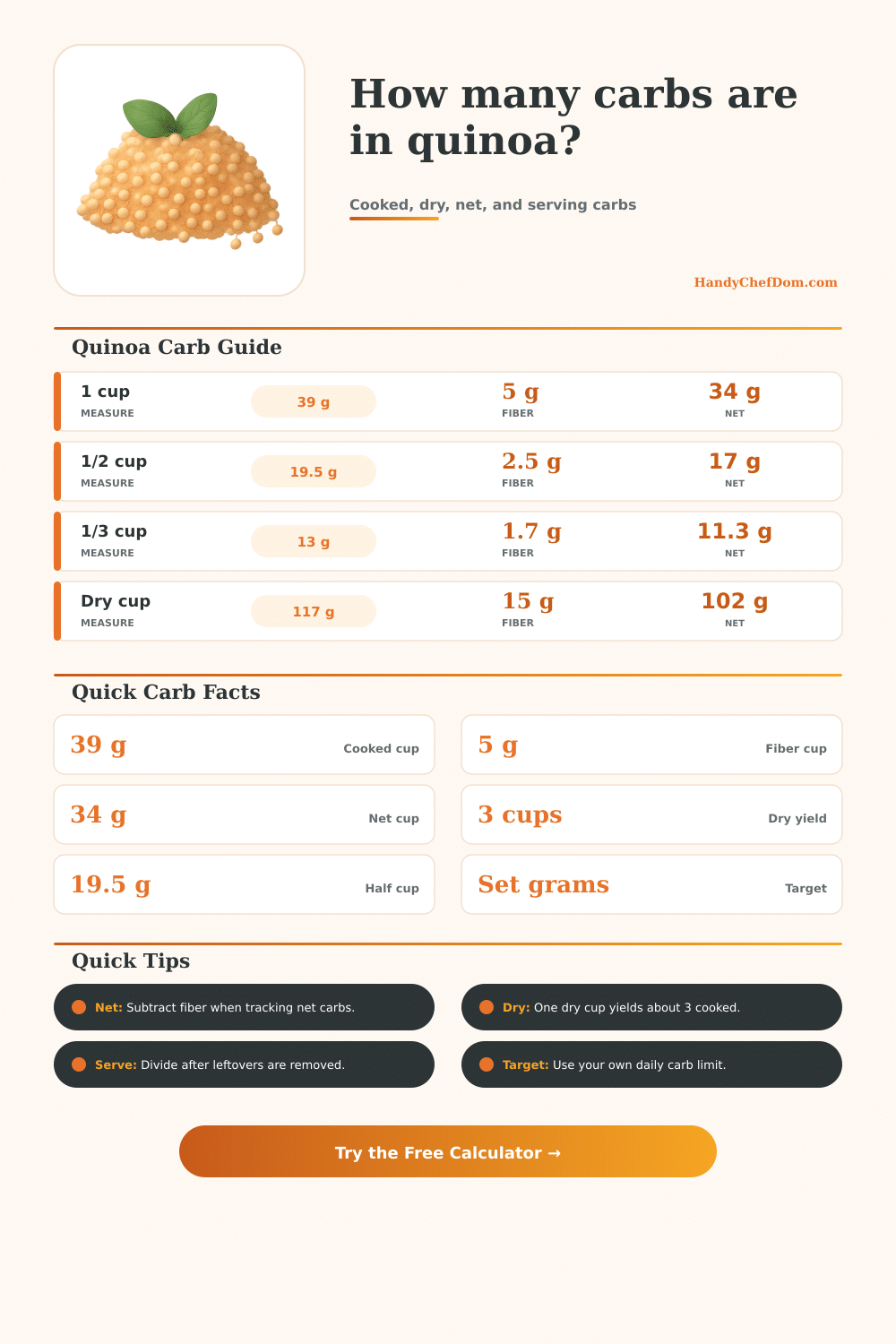
Cooked quinoa is estimated at about 39 g total carbs and 5 g fiber per cooked cup. Dry quinoa is converted through the cooked yield first, with 1 dry cup commonly making about 3 cooked cups.
| Quinoa Type | Total Carbs per Cooked Cup | Fiber per Cooked Cup | Estimated Net Carbs | Best Carb-Planning Note |
|---|---|---|---|---|
| White quinoa | 39.0 g | 5.0 g | 34.0 g | Baseline for most everyday bowls, sides, and batch portions. |
| Red quinoa | 38.5 g | 5.2 g | 33.3 g | Close to white quinoa, often used where firmer grains matter. |
| Black quinoa | 38.2 g | 5.4 g | 32.8 g | Slightly higher fiber estimate creates a lower net-carb result. |
| Tri-color quinoa | 38.8 g | 5.1 g | 33.7 g | Good blended estimate when the exact color mix is unknown. |
| Sprouted quinoa | 37.0 g | 4.8 g | 32.2 g | Use for lighter sprouted batches and quick hydrated portions. |
| Quinoa flakes | 36.0 g | 4.0 g | 32.0 g | Best for breakfast bowls where flakes are measured before serving. |
| Starting Amount | Cooked Yield Estimate | Total Carbs Estimate | Net Carbs Estimate | Planning Use |
|---|---|---|---|---|
| 1/4 cup dry quinoa | About 3/4 cup cooked | About 29 g | About 26 g | Small side batch or two mini portions. |
| 1/3 cup dry quinoa | About 1 cup cooked | About 39 g | About 34 g | One generous bowl base or two small sides. |
| 1/2 cup dry quinoa | About 1 1/2 cups cooked | About 59 g | About 51 g | Two side servings or meal prep filler. |
| 1 cup dry quinoa | About 3 cups cooked | About 117 g | About 102 g | Classic batch for four sides or several bowls. |
| 2 cups dry quinoa | About 6 cups cooked | About 234 g | About 204 g | Larger batch where leftovers should be planned. |
| Cooked Grain | Total Carbs per Cup | Fiber per Cup | Approx Net Carbs | How It Compares |
|---|---|---|---|---|
| Quinoa | 39 g | 5 g | 34 g | Higher fiber than white rice, moderate total carbs. |
| White rice | 45 g | 1 g | 44 g | Usually higher net carbs because fiber is low. |
| Brown rice | 45 g | 3.5 g | 41.5 g | Similar total carbs with less fiber than quinoa. |
| Bulgur | 34 g | 8 g | 26 g | Often lower net carbs per cup due to higher fiber. |
| Farro | 47 g | 8 g | 39 g | Chewier grain with more total carbs per cup. |
| Couscous | 36 g | 2 g | 34 g | Similar net estimate with less fiber density. |
| Cooked Serving Size | Total Carbs | Fiber | Net Carbs | Where It Fits |
|---|---|---|---|---|
| 1/4 cup cooked quinoa | 9.8 g | 1.3 g | 8.5 g | Small garnish or blended salad scoop. |
| 1/3 cup cooked quinoa | 13.0 g | 1.7 g | 11.3 g | Lower-carb plate where quinoa is an accent. |
| 1/2 cup cooked quinoa | 19.5 g | 2.5 g | 17.0 g | Common side portion beside vegetables and protein. |
| 3/4 cup cooked quinoa | 29.3 g | 3.8 g | 25.5 g | Bowl base or filling grain salad portion. |
| 1 cup cooked quinoa | 39.0 g | 5.0 g | 34.0 g | Large bowl base or hearty main-grain serving. |
Quinoa is an grain that is often used in various meal. Quinoa is often used in meals due to the fact that quinoa is easy to cook. However, the carbohydrate count of quinoa can be difficult to track due to the fact that the count of carbohydrates in quinoa change based off the way that the quinoa is measured and the way that the fiber content in that quinoa is calculate.
For instance, one cooked cup of quinoa contain the same amount of carbohydrates then one cooked cup of rice. However, because quinoa contain fiber, the count of net carbohydrates are less than the total carbohydrates in that cooked cup. Although the difference in net carbohydrates is small, the difference is still important for individual who incorporate quinoa into many meals each day.
How to Count Carbs in Cooked Quinoa
Because the volume of quinoa change once it is cooked, the manner in which an individual measure quinoa is critical. When quinoa is dry, it will absorb the water that cooks the quinoa. As a result, the cooked quinoa will contain a much more larger volume than dry quinoa.
If an individual measure dry quinoa, the same amount of dry quinoa will become a much larger volume of cooked quinoa. Therefore, if an individual measures the amount of dry quinoa that they plan to use, but later treats that dry quinoa as if it were cooked quinoa, they will consume more carbohydrate than they planned to consume with that cooked quinoa. Thus, individuals must decide whether they will measure the amount of cooked or dry quinoa that they will use in there recipe.
The fiber content that is contained within quinoa can also impact the way in which an individual calculates the net carbohydrate content of the quinoa. Most individuals calculate the net carbohydrates content of quinoa by subtract the fiber content from the total carbohydrates content of quinoa. However, other methods may be used to calculate the fiber content of quinoa.
Thus, the total carbohydrate count that is calculate for quinoa may change based upon the method that an individual use to calculate the fiber content of that quinoa. Therefore, an individual should use one method to calculate the fiber content of the quinoa, and use that same method each time that they calculate the net carbohydrate content of the cooked quinoa. Potentially next factor in the consideration of the carbohydrate count of quinoa is the portion size of the cooked quinoa that is incorporate into recipes.
A small portion size of cooked quinoa will contain fewer carbohydrates than a large portion size. For instance, a portion size of a quarter cup of cooked quinoa will contain fewer carbohydrates than a cup of cooked quinoa. Many individuals use portion size between these two values, such as a half cup or a three-quarter cup.
Thus, the total amount of carbohydrates that is contained within a portion of cooked quinoa depend upon the portion size of cooked quinoa that an individual chooses to consume. Another factor that an individual should consider when cooking a large batch of quinoa that will be consume over a period of several days is that some of the quinoa will be left over. An individual can set aside a small percentage of the cooked quinoa that they cooked prior to eating it.
This buffer of cooked quinoa will ensure that an individual does not eat more carbohydrate than they calculated that they would consume. Additionally, different types of quinoa may contain different amount of fiber and carbohydrate content. For instance, red and black quinoa may contain more fiber than white quinoa.
Additionally, the carbohydrates content of sprouted quinoa may differ from unsprouted quinoa. Thus, an individual should become aware of the different types of quinoa and the different carbohydrate count of each type. Utilizing the specific type of quinoa in calculating the carbohydrate content will ensure that the count of carbohydrates is accurate.
In order to calculate the carbohydrates that are contained within cooked quinoa, an individual should measure the cooked quinoa correctly, use the same method to calculate the fiber content of the quinoa each time that they calculate the net carbohydrate content of the cooked quinoa, and set a portion size that is appropriate for an individuals diet. By ensuring that each of these factor is considered and accounted for, the individual will have a count of the carbohydrates that are contained within cooked quinoa that they can trust.