Ice Cream Formulation Calculator
Build a balanced ice cream base using target fat, sweetness, milk solids, and overrun. Switch units, compare style profiles, and print a repeatable batch sheet.
Set mix targets, then calculate ingredient masses for cream, milk, sweetener, skim milk powder, and water balance. The model applies style defaults and reports range status.
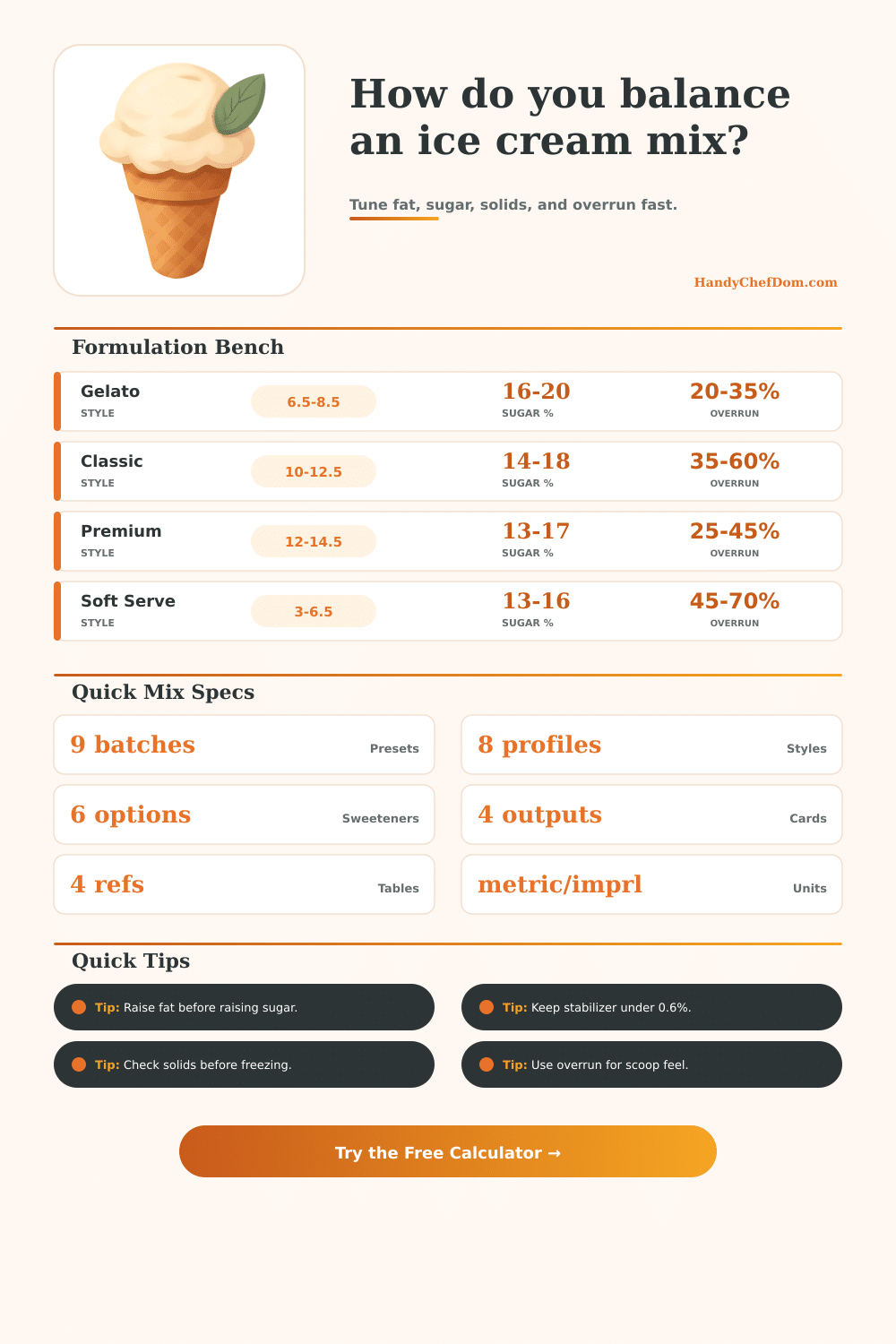
| Style | Fat % | Sugar % | MSNF % |
|---|---|---|---|
| Gelato | 6.5-8.5 | 16-20 | 9-11 |
| Classic ice cream | 10-12.5 | 14-18 | 8.5-10.5 |
| Premium ice cream | 12-14.5 | 13-17 | 8-10 |
| Frozen custard | 10-14 | 14-18 | 8.5-10.5 |
| Soft serve | 3-6.5 | 13-16 | 9-11 |
| Frozen yogurt style | 3-7 | 15-19 | 10-12 |
| Sorbet style | 0-1.5 | 25-31 | 0-1 |
| Kulfi style | 8-12 | 15-19 | 10-12 |
| Dairy Type | Fat % | MSNF % | Density g/ml |
|---|---|---|---|
| Heavy cream 36% | 36.0 | 5.6 | 0.994 |
| Whipping cream 30% | 30.0 | 6.0 | 0.996 |
| Light cream 20% | 20.0 | 7.5 | 1.005 |
| Half and half 12% | 12.0 | 8.5 | 1.015 |
| Whole milk 3.25% | 3.25 | 8.7 | 1.030 |
| Reduced fat milk 2% | 2.0 | 9.0 | 1.033 |
| Skim milk 0.1% | 0.1 | 9.4 | 1.036 |
| Goat milk 4.1% | 4.1 | 8.9 | 1.032 |
| Sweetener | Solids % | Sweetness | PAC Index |
|---|---|---|---|
| Sucrose | 100 | 1.00 | 1.00 |
| Dextrose | 100 | 0.74 | 1.90 |
| Glucose syrup DE42 | 80 | 0.45 | 0.80 |
| Invert syrup | 76 | 1.20 | 1.90 |
| Honey | 82 | 1.15 | 1.70 |
| Allulose blend | 100 | 0.70 | 1.00 |
| Batch | Mix Volume | Approx Mass | Servings 100 ml |
|---|---|---|---|
| Pint | 475 ml | 485 g | 4-5 |
| Quart | 946 ml | 965 g | 9-10 |
| 1 liter | 1000 ml | 1020 g | 10 |
| 2 liters | 2000 ml | 2040 g | 20 |
| 5 liter tub | 5000 ml | 5100 g | 50 |
To make high-quality ice cream, it is important to manage the ingredients carefuly because the texture of the ice cream depend upon the balance of the fat, sugar, and milk solids. If these components are not balanced correctly, the ice cream can be either too icy or too heavy. You must manage these ingredients to maintain the texture of the ice cream both while it is in the freezer and when it is being consumed.
Fat is one of the primary ingredients in the ice cream mix. Fat provides a coating for the tongue and also slow the melting process of the ice cream. The issue with using alot of fat, however, is that the ice cream may end up feeling greasy.
Balance Ingredients for Smooth Ice Cream
If there is too many fats in the mix, stabilizers are required to keep the ingredients suspended. One way of managing the fat content is by using a calculator to set a target fat percentage that will allow for the correct amount of cream and milk to be added to the mix. Sugar perform many roles in the ice cream mix.
One of those roles is to lower the freezing point of the mix. By lowering the freezing point, water will remain in liquid form in the ice cream. This will prevent the formation of large ice crystal.
Different types of sugar will have different effect upon the ice cream mix. For instance, sucrose is a sweetener that will work well in the mix, but dextrose will provide more freezing point depression for the same weight. Glucose syrup will add body to the ice cream but will contain less sweetness than sucrose, so you will need more glucose syrup to reach the desired level of sweetness in the finished product.
A calculator will allow the ice cream maker to account for these different type of sweeteners and avoid the need for mathematical calculations. Milk solids not fat, or MSNF, is another ingredient that are necessary for the texture of the ice cream. MSNF is contained in both milk and milk powder.
This ingredient will bind the water in the ice cream and add flavor. Using too little MSNF will result in the ice cream containing too little flavor. Using too much MSNF will result in the ice cream having a sandier texture due to the crystallization of lactose.
Using a reference table will allow the ice cream maker to decide the appropriate amount of MSNF to include in the ice cream. Overrun refers to the amount of air that must be incorporate into the ice cream. Using a low amount of overrun will result in the ice cream having a dense texture that melt slowly.
Using high amount of overrun will result in a light texture that melts quickly but may contain noticeable foamy textures. Using a calculator will allow the ice cream maker to set a target overrun for the ice cream to determine the final yield of the product. The final yield of the ice cream will tell the ice cream maker how many serving of ice cream will be produced.
Stabilizers and emulsifiers is ingredients that are used in small amount, typically under 1%. Although small in number, these ingredients will determine whether the ice cream remains smooth or separates while setting. Using too much of the stabilizer, however, will result in the ice cream containing a gummy texture.
The minimum amount of stabilizer should of been used to create the desired style of ice cream, and more can be added if need during the testing of the ice cream recipe. Many people tend to make mistake when altering the variables of the recipe. It is important, however, not to change many variables at once.
By changing many variables at once, it is difficult to determine the effect of each individual variable. For example, if the texture of the ice cream is too icy, it may be necessary to increase the amount of fat and sugar. Instead of increasing both of these ingredients at once, only increase one at a time to determine the effect upon the ice cream.
This same principle apply to the amount of MSNF and the amount of overrun. Additionally, it is important to account for process loss, which is the amount of ice cream mix that remain in the bowls and pipes. Using a calculator will allow for the adjustment for process loss as well as environmental condition.