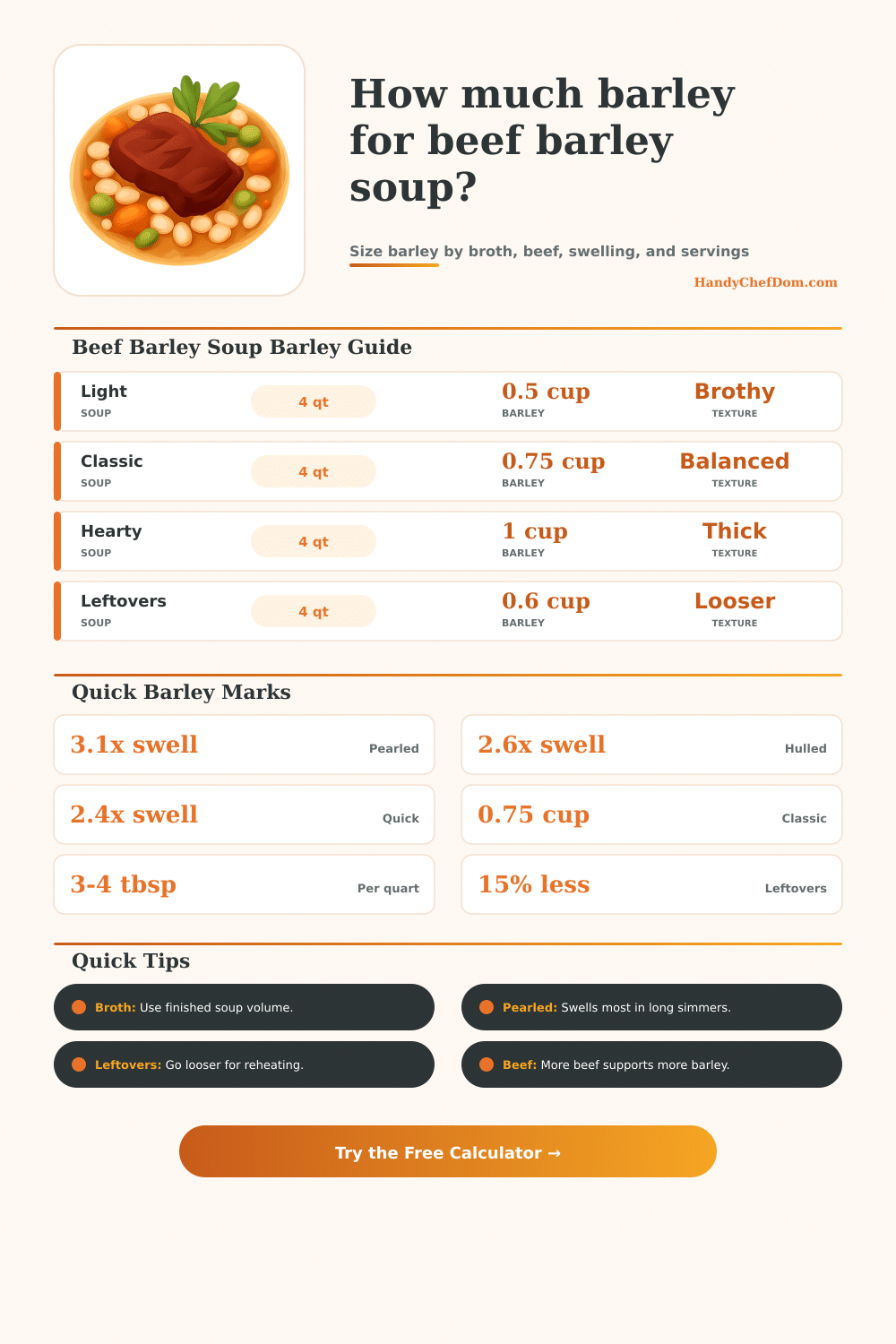
Barley in Beef Barley Soup Calculator
Estimate how much barley belongs in beef barley soup by broth quarts, beef pounds, barley type, dry cups or grams, swelling, vegetables, servings, thickness target, simmer time, and leftover plans.
Barley can turn beef soup from brothy to stew-like as it hydrates. This calculator sizes dry barley, predicts cooked volume, estimates broth absorption, and flags whether your pot will stay spoonable after leftovers.
Barley Plan for This Beef Soup
Your barley result will appear here after calculation.
Barley Type Conversion Table
| Barley type | Dry grams per cup | Typical swelling | Best soup use | Simmer cue |
|---|---|---|---|---|
| Pearled barley | 200 g | 2.8 to 3.3 cups cooked | Classic beef barley soup | 45 to 60 min |
| Quick barley | 180 g | 2.2 to 2.6 cups cooked | Short weeknight simmer | 10 to 20 min |
| Hulled barley | 184 g | 2.4 to 2.8 cups cooked | Chewy rustic soup | 75 to 100 min |
| Scotch or pot barley | 195 g | 2.7 to 3.1 cups cooked | Hearty long simmer | 55 to 75 min |
| Already cooked barley | 155 g per cooked cup | Ready volume | Last-minute soup adjustment | 5 to 10 min |
Broth Size and Barley Amount Table
| Broth base | Brothy amount | Classic amount | Hearty amount | Expected servings |
|---|---|---|---|---|
| 2 quarts | 1/4 to 1/3 cup | 1/3 to 1/2 cup | 1/2 to 2/3 cup | 4 bowls |
| 4 quarts | 1/2 to 2/3 cup | 3/4 to 1 cup | 1 to 1 1/3 cups | 8 bowls |
| 6 quarts | 3/4 to 1 cup | 1 1/8 to 1 1/2 cups | 1 1/2 to 2 cups | 12 bowls |
| 8 quarts | 1 to 1 1/3 cups | 1 1/2 to 2 cups | 2 to 2 2/3 cups | 16 bowls |
| 12 quarts | 1 1/2 to 2 cups | 2 1/4 to 3 cups | 3 to 4 cups | 24 bowls |
Texture and Leftover Planning Table
| Target | Dry cups per quart | Cooked barley share | Leftover adjustment | Texture note |
|---|---|---|---|---|
| Light brothy | 0.12 to 0.15 | Low | Usually stable | Beef broth stays loose |
| Classic balance | 0.18 to 0.23 | Medium | Reduce 5 to 10 percent | Grain in each spoonful |
| Hearty spoonfuls | 0.24 to 0.30 | High | Reduce 10 to 15 percent | Thick but still soup |
| Stew-like bowl | 0.31 to 0.38 | Very high | Serve same day best | Barley-forward texture |
| Meal prep loose | 0.13 to 0.18 | Medium-low | Reduce 15 to 20 percent | Room for reheating |
Beef and Vegetable Balance Table
| Soup build | Beef per quart | Vegetable cups | Barley cue | Best target |
|---|---|---|---|---|
| Lean broth | 0.25 lb | 1/2 cup per qt | Use less barley | Light |
| Classic pot | 0.35 to 0.5 lb | 3/4 cup per qt | Balanced barley | Classic |
| Chuck heavy | 0.55 lb or more | 1 cup per qt | Can take more barley | Hearty |
| Veg packed | 0.3 to 0.45 lb | 1.25 cups per qt | Hold barley moderate | Classic |
| Leftover roast | 0.25 to 0.4 lb | 3/4 cup per qt | Add cooked barley late | Brothy |
For beef barley soup, barley change when cooked. It goes from small and plain to big and puffed-up. It pulls in the broth around it and swell as it heats. This changes not only texture, but overall volume of your meal.
What is the key to the balance? Too little barley make the soup thin, and grain insubstantial; too much, and it’s a thick stew by the time you sit down. Barley asks how many carrot there are. There’s no one answer to this question, which is why there are as many answers to it as people making soup.
How Barley Changes the Soup
First, how much broth are you making? Second, how rich is your beef? (A bit more barley will be necessary for a strong hunk than for a mellow one.) Third, what about vegetables? They’ll contribute moisture and bulk, too, and the length of cooking will affect just how swollen those barley grain become.
Simmer briefly on stovetop or in slow cooker, and they’ll swell modestly; leave them alone long enough and grains will suck up even more broth and thicken it even more. That said, all of the above changes based off what you want to do with leftovers. Once you’ve turned the heat off, the barley keeps soaking up the broth as it sits. What seemed like a well-balanced pot on Day One can thicken up by Day Two (or worse). If you intend to freeze or reheat the soup, account for that change-in-texture now by beginning with a ratio that’s slightly less substantial then what you think you’ll end up using.
Fortunately, above calculator takes that into consideration. You input your beef-to-barley ratio ingredients (beef weight, type of barley, broth volume) and indicate your leftover plans. No guessing is necessary on absorption rate or swelling factor.
The type of barley you use also add flavor: Pearled barley has the tender bite consumers have come to associate with traditional beef barley soup; hulled barley is chewier, cooks longer (requiring slightly less cooked volume than pearled in the same amount by dry measure), and doesn’t absorbs as much liquid. Quick-cooking barley cuts down on cooking time tremendously. But similarly to hulled, resulting dish takes up less room in your bowl at mealtime and absorbs less broth, which changes final dish’s thickness as well.
Ultimately, what do you want the end result be? Do you prefer a brothy, light soup where the meat remains mostly separate, or do you want heartier helpings that can hold up to grains (tougher meats such as shank or chuck)? Do you plan on eating this over multiple days, in which case you’ll want your broth to remain loose so it doesn’t become porridge by day three? Knowing how every ingredient affect the result makes these decisions simpler instead of having to guess from memory.
You should of known that. It’s very rare for the soup to come out exactly as it was while simmering on the stove top. Before serving, give it a stir and a taste test. If the barley soaked up some extra broth, add a little more to maintain the balance you wanted so that bowl do not become too thick. You will recieve better results.
Actually, the textures is always different than expected. It would of been easier if the grains was more consistent.