🥔 Heavy Cream for Mashed Potatoes Calculator
Estimate heavy cream, butter, total dairy, texture balance, serving yield, holding reserve, and richness from potato pounds, potato type, mash style, and service timing.
Enter peeled potato weight, serving plan, potato type, mash texture, butter level, and how long the mash will wait. The calculator estimates warm heavy cream in cups and milliliters, plus how much cream to hold back for final loosening.
| Potato Type | Cream Behavior | Base Cup Per Pound | Texture Note |
|---|---|---|---|
| Russet or Idaho | High starch, absorbs cream quickly | 0.28 to 0.34 cup | Use gentle mixing to avoid gluey mash |
| Yukon Gold | Buttery and naturally dense | 0.24 to 0.30 cup | Needs slightly less cream for a creamy feel |
| Red potatoes | Waxy cells release less starch | 0.20 to 0.27 cup | Works well for rustic or skin-on mash |
| Sweet potatoes | Moist flesh and lower starch | 0.18 to 0.25 cup | Reduce cream if the mash already feels loose |
| Potato-parsnip blend | Parsnip fiber thickens the bowl | 0.26 to 0.33 cup | Use warm cream gradually for a smooth blend |
| Potato-cauliflower blend | Higher water content | 0.16 to 0.23 cup | Drain very well before adding cream |
| Mash Texture | Cream Target | Butter Target | Best Fit |
|---|---|---|---|
| Fluffy spoonable mash | 0.18 to 0.24 cup per lb | 1 to 2 Tbsp per lb | Weeknight sides, gravy, and russet potatoes |
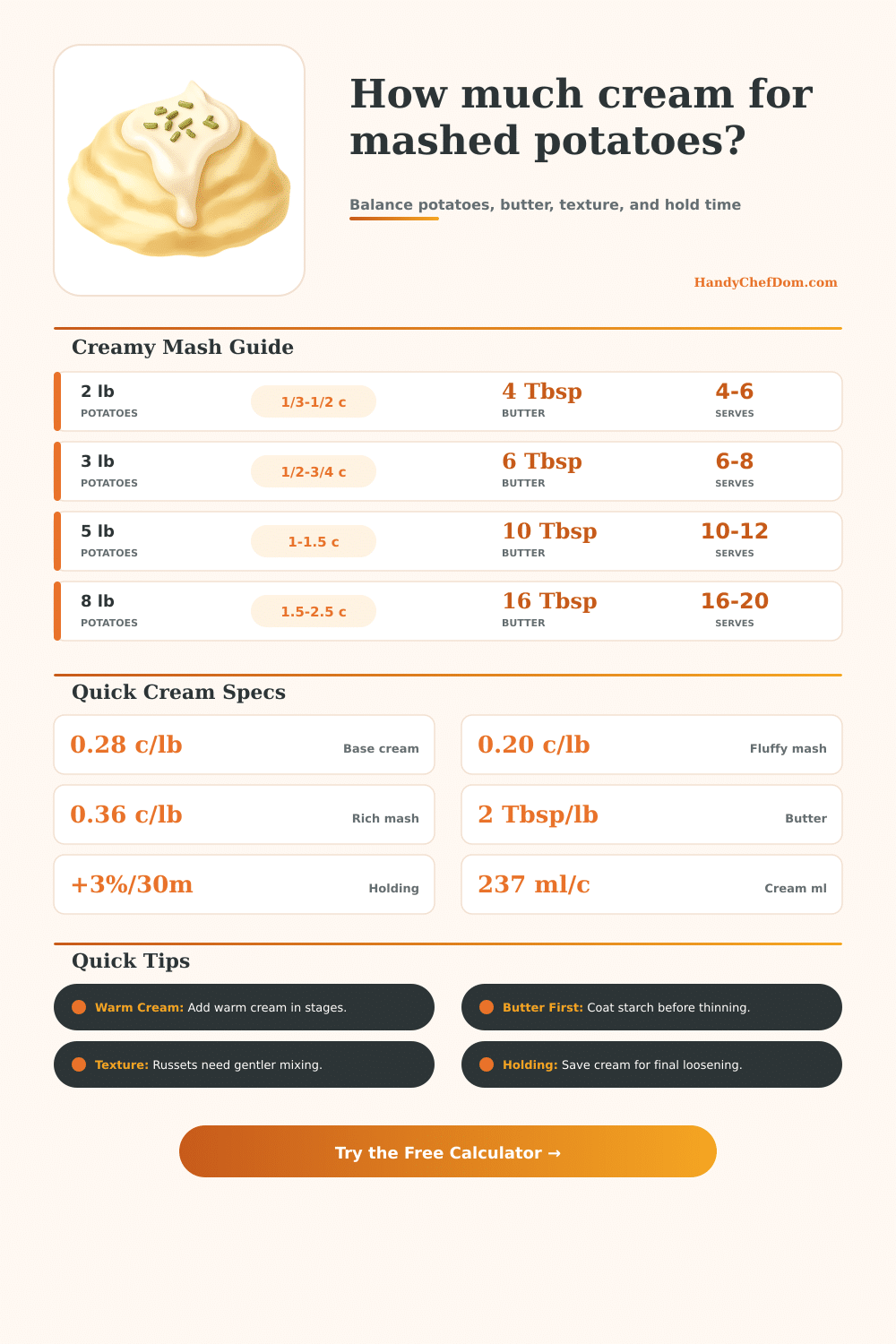
| Classic creamy mash | 0.25 to 0.32 cup per lb | 1.5 to 2.5 Tbsp per lb | Family dinners and holiday bowls |
| Silky restaurant-style | 0.34 to 0.45 cup per lb | 2.5 to 4 Tbsp per lb | Fine mash, ricer, or sieve textures |
| Rustic skin-on mash | 0.18 to 0.27 cup per lb | 1.5 to 2.5 Tbsp per lb | Red potatoes, Yukon, and chunky bowls |
| Pipeable duchess style | 0.12 to 0.20 cup per lb | 2 to 3 Tbsp per lb | Firm mash that must hold shape |
| Loose buffet mash | 0.32 to 0.42 cup per lb | 2 to 3 Tbsp per lb | Steam table or long service windows |
| Batch Size | Potatoes | Classic Cream | Butter Range |
|---|---|---|---|
| Dinner for 4 to 5 | 2 lb peeled | 1/2 to 2/3 cup | 3 to 5 Tbsp |
| Family meal for 8 | 3.5 lb peeled | 3/4 to 1 1/4 cups | 6 to 9 Tbsp |
| Holiday bowl for 12 | 5 lb peeled | 1 1/4 to 1 3/4 cups | 10 to 14 Tbsp |
| Potluck tray for 20 | 8 lb peeled | 2 to 3 cups | 16 to 24 Tbsp |
| Catering pan for 40 | 16 lb peeled | 4 to 6 cups | 32 to 48 Tbsp |
| Small tasting side | 1 lb peeled | 1/4 to 1/3 cup | 1.5 to 3 Tbsp |
| Holding Time | Reserve Cream | Why It Changes | Calculator Treatment |
|---|---|---|---|
| Serve immediately | 0% to 3% | Mash has not tightened yet | Almost all cream can go in now |
| 15 to 30 minutes | 3% to 6% | Steam loss thickens the surface | Small reserve held back |
| 45 to 75 minutes | 8% to 14% | Starch firms as the bowl waits | More cream saved for service |
| Make-ahead reheat | 12% to 22% | Cold starches absorb liquid | Reserve and reheat adjustment added |
| Buffet or steam table | 15% to 25% | Surface drying and repeated stirring | Loose texture target is recommended |
One small decision can change bowl of mashed potatoes: if you use the wrong cream, even perfectly cooked potatoes will feel dry. Get the cream wrong and you end up with a loose, soupy mess that never quite seems to set up on the plate. You have to learn how the time between cooking and eating, the type of potato, and your desired texture all affects one another.
Unlike milk, cream (especially heavy cream) has enough fat in it to coat starch granules during cooling, preventing mash from seizing up on itself into a gluey mess. And that fat will also carry flavors, so a splash or two of cream can enrichen the taste of potatoes without any increase in butter.
How Much Cream You Need
Just input amount of time needed for the mash to be held until service, along with weight of your potatoes and kind you’re planning to use, and the math is handled by calculator above. Keep in mind that not all potatoes soaks up liquids similarly. If you prefer your potatoes dense different than fluffy, use a little more cream for russets (which are high in starch), as they’ll drink it up faster. Similarly, Yukon Golds, because they’re lower in starch and already have more naturaly butter flavor, will require less cream to achieve similar creaminess. Fingerlings and red potatoes is still sturdier when it comes to breaking down, making them more suitable for rustic preparations where you might want some bite left in the bowl.
Potato choice isn’t the only factor; texture target also play in. If you’re aiming for a silky, restaurant-style mash, then you want to add plenty of cream and mix gently to knock out all lumps. For a skin-on or more rustic variety, you can leave it slightly looser with the potato chunks helping to hold things together where the cream won’t do.
The holding time input accounts for the fact that as mashed potatoes sit, their starches keeps absorbing water; therefore, what might be perfectly smooth straight from the masher may firm up during transport to table. The supporting role of butter also impact the amount of cream required: If you add it first, then the fat coats the starch and alters way the liquid spreads out in the bowl. Since butter and cream trade off against each other in the finished texture, the calculator accounts for this by changing its recommended cream depending on your planned butter usage.
How rich? That depends on how else you plan to serve these potatoes. Next to some kind of luxurios main dish or heavy gravy, a leaner mash will do just fine. When there are lots of light sides on holiday table, a little extra cream can push the potatoes into richer territory. The add-in options in the tool reflect that. Cheese, for example, or sour cream or roasted garlic brings some fat and moisture to the equation. Therefore, amount of cream would of need to adjust.
Most folks overlook this step in their mashing-potato math: If any mash sits around longer than a couple minutes, it’ll cool down, lose its steam, and tighten. Keeping a bit of warm cream aside allow you to adjust texture just prior to serving time; adding it all at once would make the entire mass too runny from the start. The reserve is doubly critical if you’re reheating, cold starches soaks up moisture greedily upon warming.
In practice, it’s less about finding one right ratio; it’s more about adjusting the ingredients to match the reality of what you’re making (a big bowlful of potatoes that must stay hot on a steam table versus a quick side dish for a weeknight meal for six). Now that you have a sense of the connection between holding time, desired finished texture, and variety of spud, the amount of cream will cease to be a shot in the dark, and instead become something you feel comfortabley deciding upon.