🥣 Oats Cup Weight Converter
Convert cups of oats into grams, ounces, servings, cooked yield, flour equivalents, and recipe-scaled amounts for breakfast bowls, bakes, and granola mixes.
Choose the oat style and measuring method, then scale by cups, servings, recipe multiplier, and granola mix-ins. The converter uses common culinary cup weights and shows the math in the results.
| Oat style | 1 US cup | 1/2 cup | 1/4 cup | Best use |
|---|---|---|---|---|
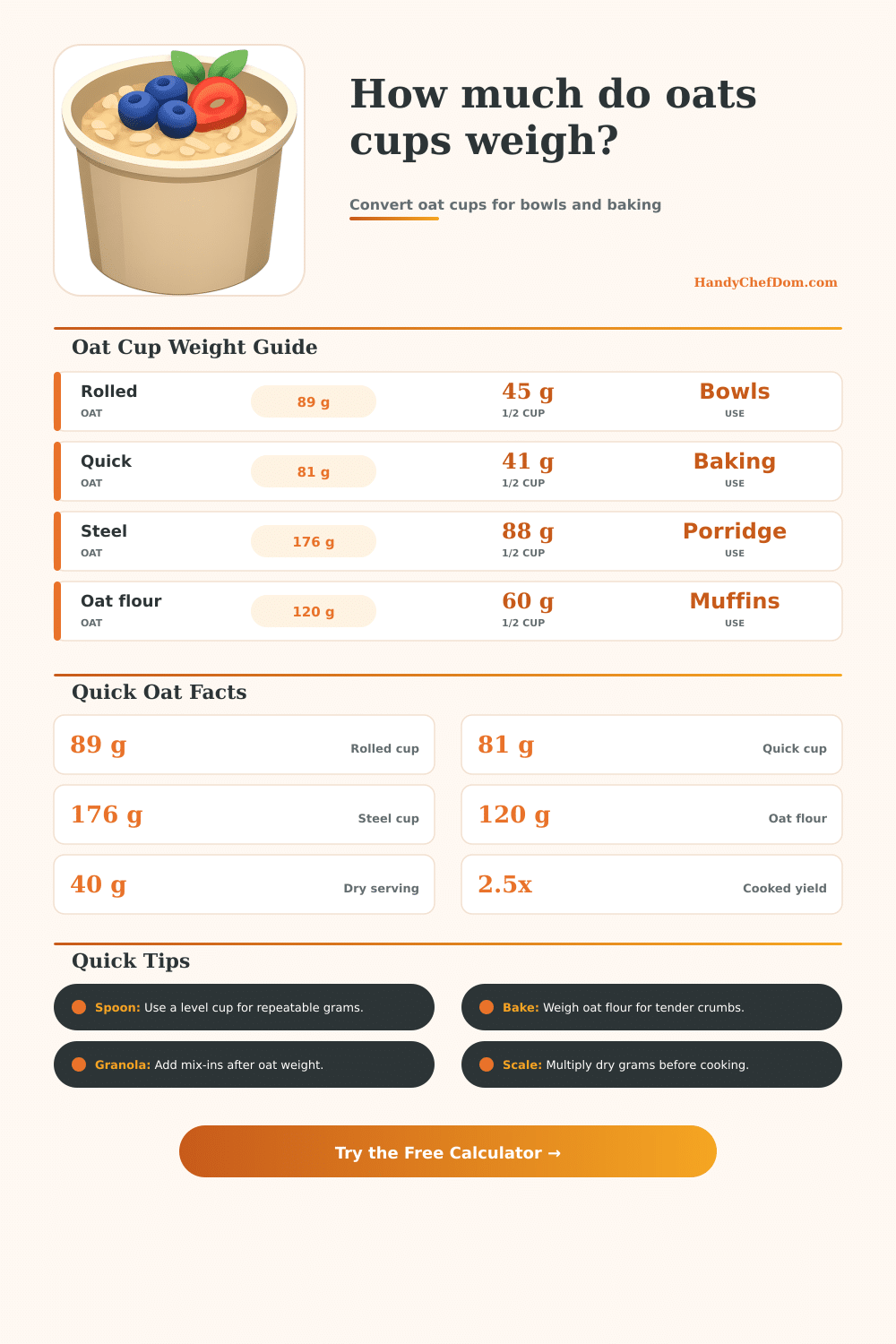
| Old-fashioned rolled oats | 89 g / 3.1 oz | 45 g | 22 g | Bowls, cookies, crisps |
| Thick rolled oats | 96 g / 3.4 oz | 48 g | 24 g | Chewy granola and toppings |
| Quick oats | 81 g / 2.9 oz | 41 g | 20 g | Muffins, meatloaf, fast bowls |
| Instant oats | 80 g / 2.8 oz | 40 g | 20 g | Packets and soft batters |
| Steel-cut oats | 176 g / 6.2 oz | 88 g | 44 g | Meal prep porridge |
| Scottish oatmeal | 150 g / 5.3 oz | 75 g | 38 g | Creamy porridge |
| Oat flour | 120 g / 4.2 oz | 60 g | 30 g | Pancakes, muffins, cakes |
| Oat bran | 94 g / 3.3 oz | 47 g | 24 g | Hot cereal and fiber blends |
| Granola-style oat base | 100 g / 3.5 oz | 50 g | 25 g | Before nuts, seeds, and fruit |
| Measured amount | Rolled oats | Quick oats | Steel-cut oats | Oat flour |
|---|---|---|---|---|
| 1/4 cup | 22 g | 20 g | 44 g | 30 g |
| 1/3 cup | 30 g | 27 g | 59 g | 40 g |
| 1/2 cup | 45 g | 41 g | 88 g | 60 g |
| 2/3 cup | 59 g | 54 g | 117 g | 80 g |
| 3/4 cup | 67 g | 61 g | 132 g | 90 g |
| 1 cup | 89 g | 81 g | 176 g | 120 g |
| 2 cups | 178 g | 162 g | 352 g | 240 g |
| 3 cups | 267 g | 243 g | 528 g | 360 g |
| Servings | Light 30 g | Standard 40 g | Hearty 52 g | Rolled cup estimate |
|---|---|---|---|---|
| 1 serving | 30 g | 40 g | 52 g | 0.34 to 0.58 cup |
| 2 servings | 60 g | 80 g | 104 g | 0.67 to 1.17 cups |
| 4 servings | 120 g | 160 g | 208 g | 1.35 to 2.34 cups |
| 6 servings | 180 g | 240 g | 312 g | 2.02 to 3.51 cups |
| 8 servings | 240 g | 320 g | 416 g | 2.70 to 4.67 cups |
| 12 servings | 360 g | 480 g | 624 g | 4.04 to 7.01 cups |
| Granola mix style | Oat base | Add-ins | Total mix | Volume note |
|---|---|---|---|---|
| Light seed mix | 100% | 15% | 115% | Still oat-forward and scoopable |
| Classic nuts and fruit | 100% | 35% | 135% | Heavier than plain rolled oats |
| Cluster granola base | 100% | 45% | 145% | More density after syrup coating |
| Fruit-heavy topper | 100% | 60% | 160% | Dried fruit raises cup weight |
| Protein crunch mix | 100% | 75% | 175% | Seeds and nuts dominate grams |
Reference values are practical kitchen averages. Brands, grind size, humidity, and how firmly the cup is filled can shift actual grams, so use a kitchen scale for precision baking.
Most recipes assume a cup of oats is always the same amount. Here’s where you should know: It isn’t. Oat flour, steel-cut bits, and rolled oats varies in density; put one of each into the same measuring container, and what you’ll get out won’t be remotly similar. Guesswork makes for more flubbed attempts then you may care to admit. Even if you’re convinced you’re adhering strictly to the directions.
Weight isn’t captured by volume alone; that’s why the converter is essential kitchen gear for anyone seeking to make things again and again without wondering if they has the right amount. It is because they’re denser. Filling up a cup with something results in different densities because there’s less air space in-between the grains (the process by which the grain is cut) and also because each flake have been flattened.
Why You Should Weigh Oats
A regular U.S. Cup of old-fashioned rolled oats weighs approximately eighty-nine grams because so much air gets trapped between the flat flakes. Because quick oats are even thinner and therefore easier to squish together, they’ll typically come in at about eighty-one grams per cup. Steel-cut oats is actualy just whole kernels chopped up into small bits, so they fits snugly inside the cup. One cup of these little guys can weigh as much as one hundred seventy-six grams. That’s practically twice as heavy than the rolled version.
If you substitute steel-cut for rolled in a recipe without accounting for extra liquid or other changes, you’d better hope your dish requires adjustments. Otherwise, it’s going to be all wrong. Changing the texture do change the math.
That’s where this little tool comes in (above). It let you choose which kind of oats you’re using, and it figures out exactly how many grams will be correct for you based off that choice. It even considers whether you scoop straight out of the box or level off a spoonful; the former compacts the contents into a few more grams than the latter do. That tiny difference is enough to matter most in baking where the right ratio between dry ingredients and liquid/fat is vital to getting desired shape.
Scaling recipes adds an additional wrinkle to this, because while a basic conversion is easy enough, when dealing with precise weights (as many recipes are) just multiplying the cups won’t work. To address this, you can enter either the number of servings you’re making or the multiplier, and it’ll display the total gram amount needed as well as guess the resulting cooked yield. It’s especially handy for things like breakfast porridge that need to be portioned by weight after cooking. You know how much cooked oatmeal comes out of a given dry weight, so you can ensure each portion is the right size. Before you heat up stove, you have a sense of exactly what you’re getting yourself into.
While whole oats do not behave similarly to wheat flour, oat flour does, and that make it challenging in its own way. A cup of oat flour weigh roughly one-hundred twenty grams, packing tightly into measuring cups. If you’re baking with oat flour and are not careful, your muffin or cake will be dry when using volume measurements. When you weigh the oat flour directly, there’s no chance at all of such a thing happening. There’s even an oat flour-specific option on the converter.
Switching from whole oats to ground versions won’t change the texture or throw off any nutrition facts. This knowledge of oat weight changes everything about cooking with oats. It shifts it from a guessing game into a precise science. Knowing the exact amount of grains you’re working with mean knowing exactly what your results will be. You could of decided whether you want cookies with some chew or granola that maintains its crisp. Having the proper starting point give you an advantage in any oat-based creation.
Next time you grab that measuring cup, keep this in mind: density does more heavy lifting than volume ever has. Using accurate weights makes all the difference between a good recipe and a great one.