🫒 Olives Carb Calculator
Estimate total carbs, net carbs, fiber, and sodium from olive type, drained grams, count, stuffing, brine or oil pack, antipasto share, and servings.
Use count mode for whole olives, drained gram mode for a jar or salad bowl, or antipasto tray mode when only part of a mixed platter is olives.
| Olive Type | Total Carb | Fiber | Net Carb | Sodium |
|---|---|---|---|---|
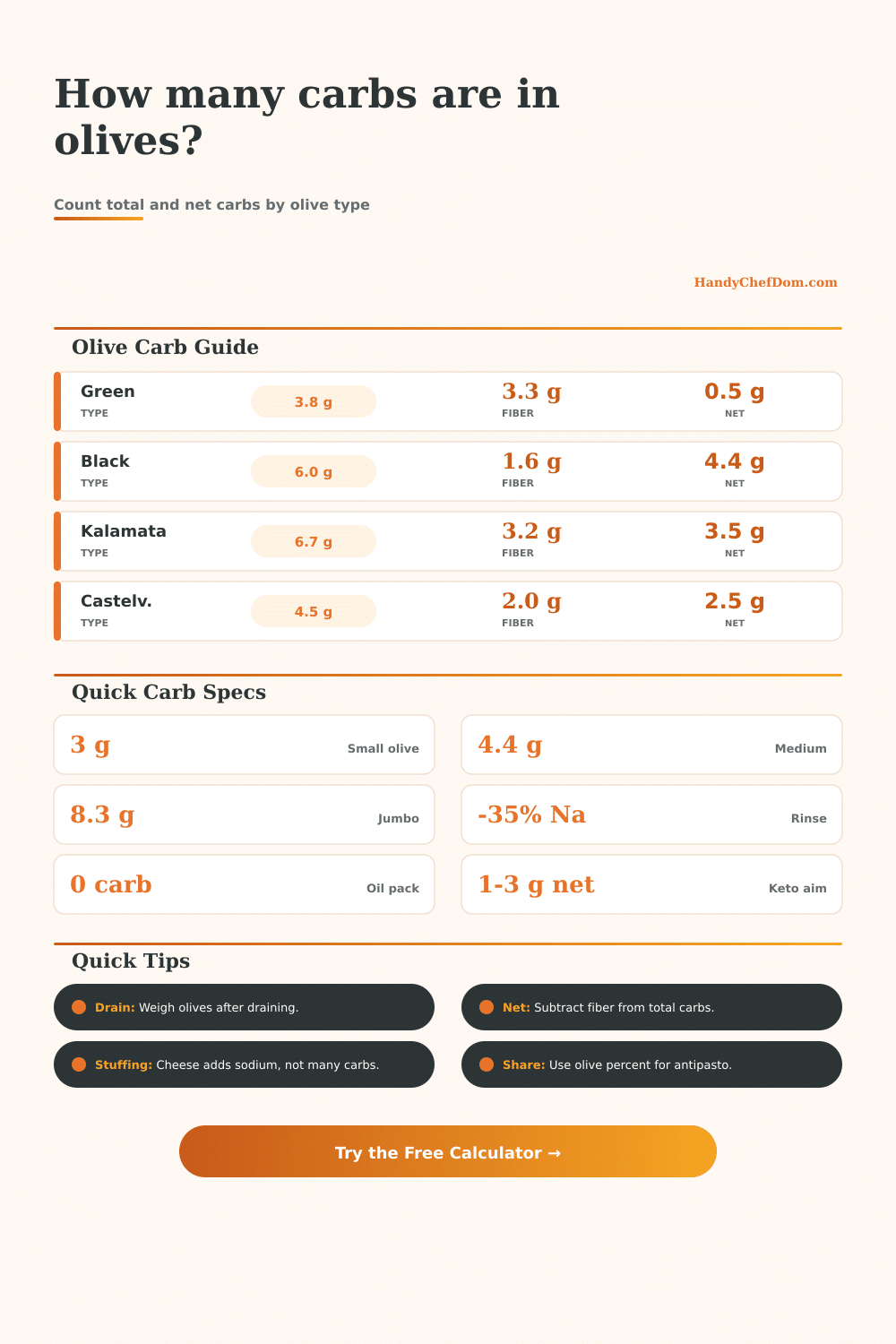
| Green | 3.8 g | 3.3 g | 0.5 g | 1556 mg |
| Black | 6.0 g | 1.6 g | 4.4 g | 735 mg |
| Kalamata | 6.7 g | 3.2 g | 3.5 g | 1600 mg |
| Castelvetrano | 4.5 g | 2.0 g | 2.5 g | 1200 mg |
| Nicoise | 4.0 g | 3.0 g | 1.0 g | 1500 mg |
| Mixed deli | 5.2 g | 2.7 g | 2.5 g | 1350 mg |
| Stuffing | Carb Each | Fiber Each | Sodium Each | Carb Note |
|---|---|---|---|---|
| None | 0.00 g | 0.00 g | 0 mg | Base only |
| Pimento | 0.15 g | 0.05 g | 4 mg | Tiny bump |
| Garlic | 0.22 g | 0.02 g | 2 mg | Small bump |
| Almond | 0.10 g | 0.10 g | 1 mg | Fiber helps |
| Jalapeno | 0.08 g | 0.03 g | 5 mg | Low bump |
| Blue cheese | 0.05 g | 0.00 g | 18 mg | Sodium adds |
| Anchovy | 0.00 g | 0.00 g | 20 mg | Salty fill |
| Feta | 0.05 g | 0.00 g | 12 mg | Salty fill |
| Portion | Count | Weight | Best Use | Net Guide |
|---|---|---|---|---|
| Martini | 2 | 9 g | Garnish | Very low |
| Snack | 8 | 35 g | Small bowl | Low |
| Salad | 12 | 53 g | Greek bowl | Varies |
| Tapas | 24 | 106 g | Shared dish | Split it |
| Pizza | 20 | 88 g | Topping | Per slice |
| Tray cup | 30 | 132 g | Relish tray | Serve small |
| Pack Style | Carb Impact | Sodium Impact | Fiber Impact | Use Case |
|---|---|---|---|---|
| Brine drained | Base carbs | Base sodium | Base fiber | Jar olives |
| Rinsed brine | Base carbs | Lower sodium | Base fiber | Meal prep |
| Oil packed | No carb add | Lower sodium | Base fiber | Tapas bowls |
| Sweet brine | Adds carbs | Base sodium | Base fiber | Pepper jars |
| Antipasto | Share based | Share based | Share based | Mixed trays |
| Stuffed | Fill based | Fill based | Fill based | Party snack |
Sure, olives are salty, and primarily just salt and brine anyway, so there’s little harm in consuming them by the handful. Follow a macro-centric approach because everything change; different cures, stuffings and colors produce varying amount of carbs. If you’re counting every last one, green olives (with their high fiber) will be lower-net-carb, while some black ones might be closer to top end. Enter your serving size and olives-of-choice into the calculator, which will do the work for you to determine whether or not they should of be part of your day’s allowance.
To understand net carbs, you must go beyond grams of sugar and starch listed on an ingredient label. Net carbs is calculated by subtracting the fiber content from total carb content. The part that impacts blood sugar. Keto dieters wants as few net carbs as possible while still enjoying food. So when you find green olives with higher fiber content different than black olives, the net carb content will be noticeably lower. That may not seem like much but it means you get to enjoy more of them.
How to Count Carbs in Olives
For sodium, it’s more about kind of pack, and for carbs it’s more about whether it has any at all. Rinsing brined olives can drastically reduce sodium without affecting the carb content (because there are no carbs in water). Carbs, on the other hand, don’t differ much between oil- and brine-packs, though an olive packed in oil will have slightly fewer carbs than one packed in brine. Separating them allows you to track both. You can wash your own brined olives to reduce salt but still get credit for their naturaly higher sugar content. The tool takes those adjustments into account, showing you what effect it really has nutritionally.
The secret number is the other variable, which is stuffing. That little fraction of a gram from a pimento doesn’t make much difference for anyone but it’s worth considering when cheese or garlic are used to stuff that olive. Nuts such as almonds brings a bit of carbohydrate and fiber to the party; cheese brings fat and sodium with minimal carbs. These little extras can pile up fast if you’re noshing on stuffed olives between meals. These types of stuffing is accounted for in the calculator and will give you a better idea of your carb intake than just a general guess at how many grams of carbohydrate exist in an olive.
The most common mistake people make here is estimating portion size. In other words, you are asking how many. How many olives in a martini versus how many in a Greek salad? The size of the olives also varies widely; using a jumbo stuffed olive weigh much more and therefore has a greater carb load compared to a dozen small cocktail olives (even though there’s the same number). Measuring by weight provides accuracy, particularly when you’re preparing meals for on-the-go that require precise measurements. That’s why both count and weight is available as options.
It gets more complicated with antipasto trays: Olives don’t make up all that’s on the tray. When dining off a mixed platter, calculate roughly what portion of your meal is made up of olives vs. The tray also includes meat, cheese, and other veggies, but the percentage will vary depending on which platter you choose. Use this percentage as an olive-only carb count. That way, you’re not overlooking the carb contribution of those snacks, and you won’t double-count any carbs.
The reference tables also put into perspective which olives is best suited for each diet. For example, because there is a wide variety of green olives with varying amounts of salt and other factors, Castelvetrano olives are moderate in sodium compared to others, yet high in net carbs relative to their plain green counterparts. Kalamatas add a bang of flavour at the expense of sugar. These baseline figures informs the decisions you’ll make when reaching for an olive from the jar, so you don’t have to be surprised along the way. You can plan ahead instead.
Handled properly, olives can fit into nearly every dietary style. From watching your sugar to sticking strictly to keto, it matters whether you’re counting total carbs or net carbs. You don’t need to deprive yourself of those favorite foods; you simply have to know what you’re consuming. Knowing that transforms that casual nibble into an informed decision. It keeps you on track with your goals but doesn’t take away from enjoying yourself.