🧄 Garlic Cloves Per Head Calculator
Estimate how many garlic heads to prep or buy from recipe clove counts, head type, size, trimming waste, and realistic min-max clove ranges.
Enter the cloves your recipe needs, then adjust for garlic family, head size, cloves already on hand, peeled trim, and a planning buffer. The calculator uses average plus low-high clove ranges so your shopping list is not built on one perfect head.
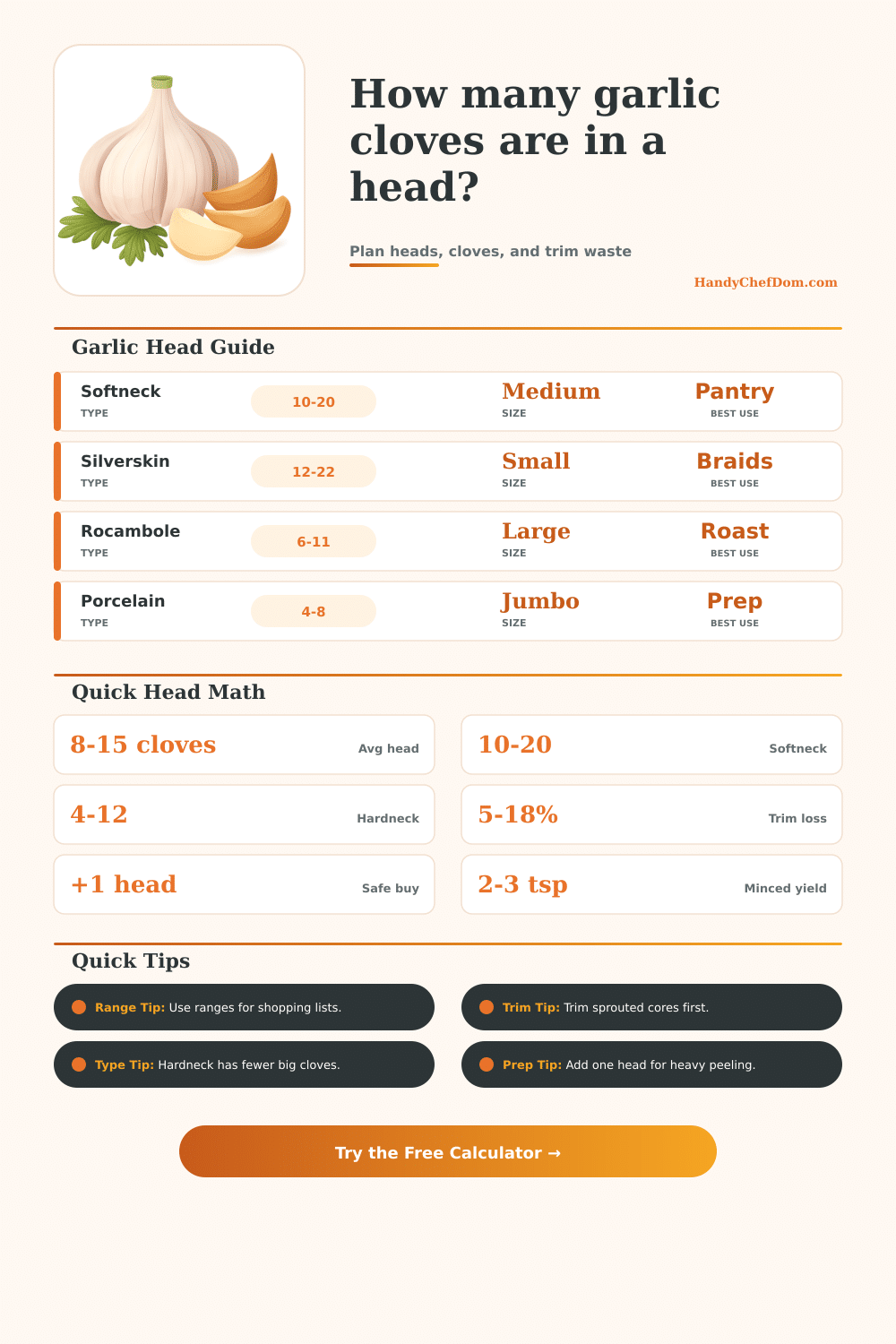
| Head Type | Typical Cloves | Clove Pattern | Planning Note |
|---|---|---|---|
| Softneck artichoke | 10-18 | Many medium cloves | Good for recipe lists |
| Softneck silverskin | 12-22 | More small cloves | Needs more peeling time |
| Hardneck rocambole | 6-11 | Large even cloves | Easy to count and peel |
| Hardneck porcelain | 4-8 | Few jumbo cloves | One clove may be strong |
| Purple stripe | 7-13 | Medium-large cloves | Good all-purpose range |
| Mixed market head | 6-18 | Varies by source | Use average plus buffer |
| Head Size | Clove Count Effect | Weight Effect | When to Use |
|---|---|---|---|
| Small tight head | About 25% lower | Less edible garlic | Small recipes and garnish |
| Medium everyday head | Baseline estimate | Standard prep yield | Most recipe planning |
| Large full head | About 25% higher | More usable cloves | Meal prep and roasting |
| Jumbo head | About 50% higher | Much larger cloves | Bulk prep and confit |
| Condition | Usable Factor | Trim Expectation | Kitchen Cue |
|---|---|---|---|
| Fresh tight skins | 96-100% | Low trim | Firm cloves, dry skins |
| Mixed pantry heads | 88-94% | Moderate trim | Check outer cloves first |
| Sprouted cores | 80-88% | Higher trim | Remove green centers |
| Dry outer cloves | 82-90% | Edge trim | Discard hollow cloves |
| Bruised cloves | 74-84% | Sort heavily | Cut away soft spots |
| Pre-peeled bowl | 98-100% | Minimal trim | Count before mincing |
| Clove Size | Minced Yield | Edible Weight | Recipe Planning |
|---|---|---|---|
| Small clove | About 1/2 tsp | 2-3 g | Use extra for bold flavor |
| Medium clove | About 3/4 tsp | 3-5 g | Default recipe estimate |
| Large clove | About 1 tsp | 5-7 g | Good for sauces |
| Jumbo clove | About 1 1/2 tsp | 7-10 g | Count carefully for balance |
Garlic can be unpredictable (as are all produce items), and sometimes you has less of something than the amount called for in a recipe. Say you need six cloves of garlic. But you can only see four clove in the head? Why is that?
Garlic behave differently depending on genetics, soil conditions, and how long it’s been stored. One cup of salt isn’t always one cup; one cup of rice isn’t one cup. Knowing that can help make meal-planning less hopeful and more factualy.
Why Garlic Amounts Change
When you enter what your recipe calls for into the calculator above, it do the math for you. No guesswork conversion, no optimistic shopping list, just reality. What’s behind all that? The primary influence: Are you holding a hardneck or a softneck bulb?
Most supermarket garlic is a softneck variety (think silverskin or artichoke). A single head will yield 20-ish cloves, which is all tightly wedged into place and require ages to separate. By contrast, a hardneck (such as a porcelain or rocambole) typically yield just six to 10 big, loose, strip-easily cloves. Quantity versus convenience; take your pick.
For quick cooking, such as in a sauté, it’s faster with a hardneck (though you’ll need to purchase slightly more heads). When I’m planning a huge pot of marinara and don’t feel like spending hours peeling, though, softneck is my friend, even if I has to buy some more.
The same goes for size. That little head of garlic may appear full when you’re looking at it in the market, but it’ll have many fewer actual usable cloves inside than a big old fat one. Because head sizes vary so much, the tool compensate to make your estimate as close as possible to what is actualy on your kitchen counter.
Under-estimating how much you need will result in recipes running too low. Fresh bulbs will still lose some yield to trimming, as you can’t eat the root plate or the papery bits holding them together. If they are older or starting to sprout, you will lose even more yield. Old and sprouting centers are bitter and must go, taking more edible weight away with them. Putting a safety margin into your estimate takes all of that normal decline into account, without having to eyeball each individual clove before you bring it home.
Minced garlic will take up much more space than most cooks expect. A small clove will mince up to 1/2 tsp, while a large one yield about a teaspoon. So before adding minced garlic to any dish where the number of teaspoons is called for instead of cloves, check that you know the approximate size of your typical clove, otherwise you may accidentalilly under- or over-season the dish.
As the chart on the page makes clear, yield depends on how you prepare it; slicing creates less surface area and makes the amount look smaller than chopping does. And since many recipes call for more than just garlic, understanding the prep style’s impact can help you find that sweet spot of not-too-much-but-not-too-little. With confits, for example, you may believe you’ve got enough garlic when measured as whole cloves… But it’s surprising how much smaller actual edible flesh becomes after peeling and trimming.
I don’t think anyone ever buys too many heads. While onions and even potatoes last a while, the same cannot be said about garlic. They has a short shelf life and will store best in a cool dry location. Would you rather have more cloves hanging around in your pantry? Better to have some left over than to be out mid-way through a braise.
The calculation factors in how many heads you might already have on hand and accounts for the distance between where you’re at (what you need) and where you want to get to. That way if you’re just wrapping up a bulb that has been lingering for awhile but want coverage for a larger batch, you won’t buy too much. You’ll know exactly how many heads of garlic to expect in your pantries, making it a predictable variable instead of chaos.
Thinking of garlic not as a constant but as a variable alters the math of preparing with it. It’s no longer an exercise in averages and instead you plan for ranges. This eliminates the friction of cooking. You won’t have to go to the store at the last minute because you’re out, and you won’t have to compromise because you want more (or less) than what you’ve got.
It’s all about making sure there are a few extra cloves on hand when the moment comes to chop so your dish turns out just like you meant it to, without any improvising due to lack of quantity. A handful of backup cloves isn’t much to pay for kitchen peace of mind. You should of bought more.