🍚 Rice Cups Per Pound Calculator
Estimate dry cups, cooked cups, servings, and pantry bag yield by rice variety, measuring cup size, and dry or cooked planning context.
Use the mode selector to plan from a dry rice bag, a cooked serving target, or cooked rice on hand. Cup results update for US cups, metric cups, rice cooker cups, or a custom measuring cup.
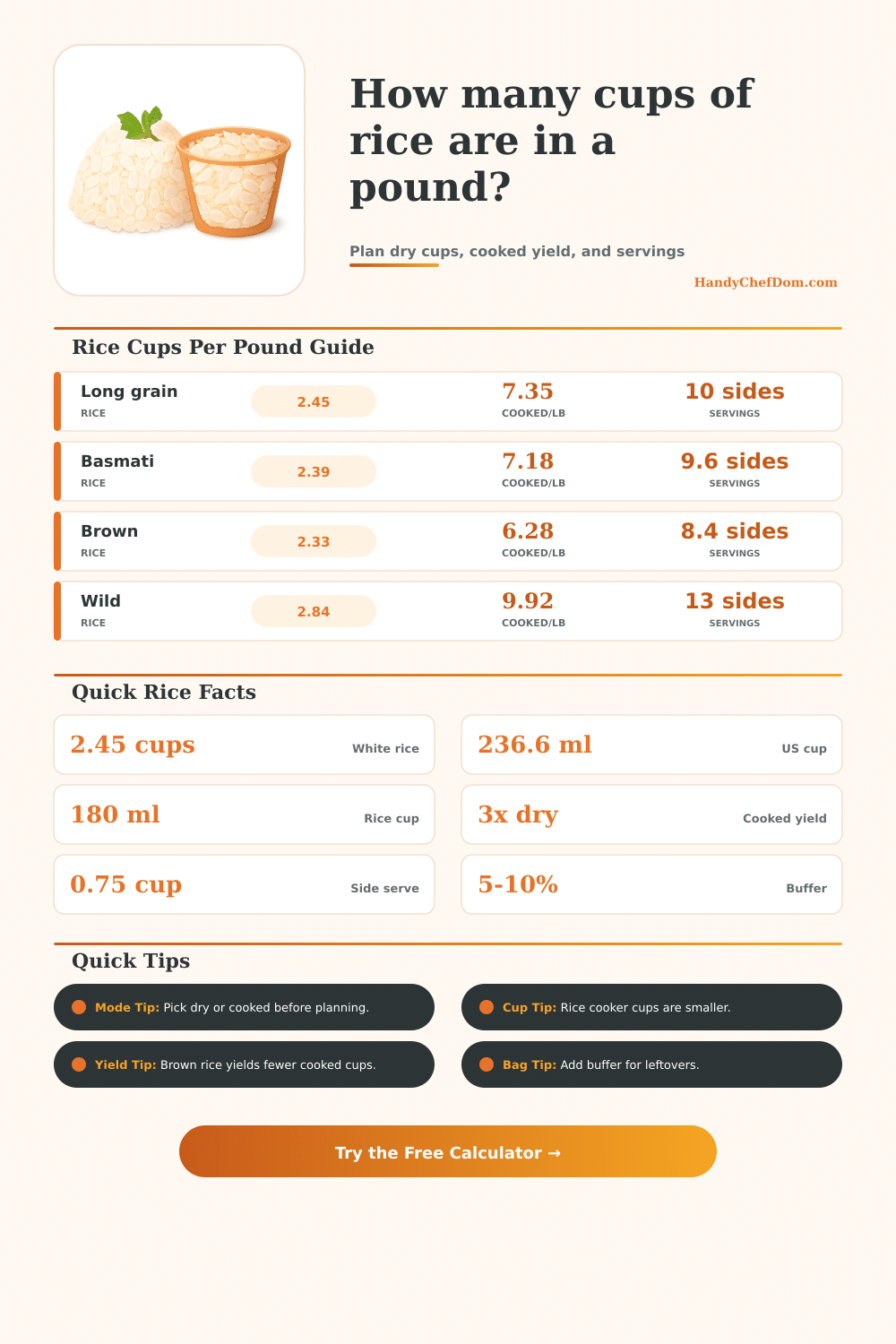
| Rice Variety | Dry g per US Cup | Dry US Cups per lb | Cooked Cups per lb |
|---|---|---|---|
| Long grain white | 185 g | 2.45 | 7.35 |
| Basmati | 190 g | 2.39 | 7.16 |
| Jasmine | 185 g | 2.45 | 7.11 |
| Long grain brown | 195 g | 2.33 | 6.28 |
| Arborio | 200 g | 2.27 | 6.35 |
| Sushi rice | 205 g | 2.21 | 5.53 |
| Wild rice | 160 g | 2.83 | 9.92 |
| Black rice | 190 g | 2.39 | 6.68 |
| Cup Measure | Volume | Long Grain g/Cup | Long Grain Cups/lb |
|---|---|---|---|
| US cup | 236.6 ml | 185 g | 2.45 |
| Metric cup | 250 ml | 195 g | 2.33 |
| Rice cooker cup | 180 ml | 141 g | 3.22 |
| Half cup scoop | 118.3 ml | 92.5 g | 4.90 |
| Custom cup | User set | Scaled | Scaled |
| Dry Bag Size | Dry US Cups | Cooked Cups | Side Servings |
|---|---|---|---|
| 1 lb white rice | 2.45 cups | 7.35 cups | 9.8 servings |
| 2 lb white rice | 4.90 cups | 14.7 cups | 19.6 servings |
| 5 lb white rice | 12.25 cups | 36.8 cups | 49 servings |
| 10 lb white rice | 24.50 cups | 73.5 cups | 98 servings |
| 20 lb white rice | 49.05 cups | 147 cups | 196 servings |
| Serving Style | Cooked Cups Each | Dry US Cup Each | Best For |
|---|---|---|---|
| Light side | 0.50 cup | 0.17 cup | Small plates |
| Standard side | 0.75 cup | 0.25 cup | Dinner plates |
| Main bowl | 1.00 cup | 0.33 cup | Rice bowls |
| Hearty bowl | 1.25 cups | 0.42 cup | Meal prep |
For example: Rice costs less when purchased by 5-pound bag. But then you only cook a couple of cups at a time. This means that unless you figure out how much volume change from dry to cooked, you’re basically just playing a guessing game: Am I good? Will I need to top off my pot with leftover pasta?
It all depends: Did you get short-grain vs. Did you get long grain? How did you measure out that cup? Do you mentally convert to cooked volume or not? Rice varieties also has different densities. These densities is not all equal, which is the second variable. You cannot assume that a pound will always be exactly some amount of cups.
Why Rice Cooking Is Confusing
For example, long grain white rice are very light and fluffy; it takes up more space then brown rice which is heavier and denser per cup. Some kinds of rice such as wild rice will pack into even greater volumes due to their low density. Assuming all rices are the same can lead to your portion sizes getting out of whack. Choose your rice variety in calculator above, and it will do the math for you (saving you from having to do the conversion yourself when most recipes don’t account for this!).
But what about the other side of the equation? What about the cup? This is where it all goes wrong in the kitchen. Cooks think that a cup is a cup is a cup, and if you have baking set, well, chances are the cup isn’t the same size as your rice cooker’s. A typical US legal cup (the one we see on every package of flour) comes out to around 237 milliliters, whereas the rice cooker cup are far more modest at 180 milliliters. Use two cups from your wrong measuring device on a recipe, and you’ll get either a soupy pile of goop or something resembling dust. With the tool, you can switch between them on the fly so no matter which measuring tool you’re picking up, your grain-to-water ratio remain intact.
And then there’s the question of…what exactly do you plan on making? Are you feeding four hungry people who want a lot of food, or are you using a few handfuls in pantry that you hope turn into something delicious? With dinner party planning, it tends to make more sense to think in terms of yield after it’s all done cooking. Six servings of rice, got it? How many pounds of that one pound bag is going to stretch that far onto everyone’s plate?
In reality, you don’t care so much about the dry weight as you care about whether you can feed all those mouth. The calculator works backward. You can put in how many servings you want then figure out exactly how much raw product you need to take out of storage.
The tool also easily handles adding a buffer. Cooking isn’t always exact. Sometimes you drop some grain on the floor, maybe one batch of cooked grain didn’t soak up as much liquid evenly. Having an additional 5-10% of coverage mean you won’t have to stop midway through dinner because you’re out. It is a little thing, but it makes a difference if you’ve got company over and can’t just pop down to the shop.
If you don’t want to plug things into the calculator each time, there are reference tables at the bottom of page. These tables breaks down the numbers so you can scan them and see right away how many servings a pound of rice gets you, depending on type and size of serving. For example, a typical main dish would require a cup (or even more) of cooked rice, while a side dish is usually only 3/4 cooked cup. Knowing that will make cooking and buying amounts easier.
Arithmetic isn’t everything when it comes to rice planning. Planning for rice means planning with respect for the ingredient, how it becomes soft and a basic food from its hard-grain state. Knowledge of your numbers reduces mealtime stresses and wasted food. Next time you grab a bag, you’ll know precisely what it contains in way of dinners.