Coconut Milk Per Cup of Rice Calculator
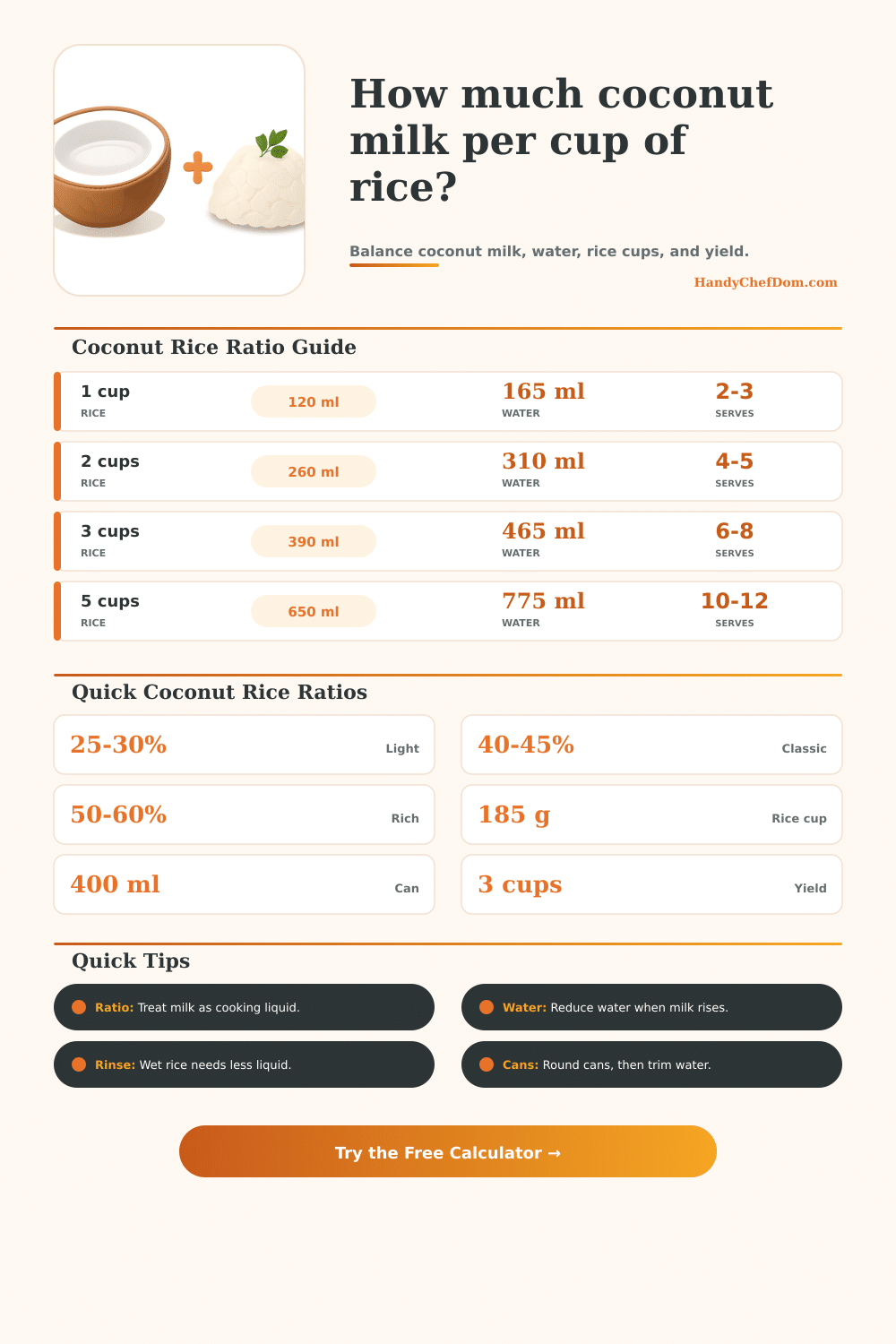
Scale coconut rice from one cup to a party tray with rice cups, grain absorption, coconut milk percentage, water ratio, can size, cooker method, servings, and richness.
1Coconut Rice Presets
2Rice Cups and Liquid Inputs
Coconut Milk and Water Results
Your coconut rice calculation will appear here.
3Ingredient Breakdown Cards
4Calculation Table
| Step | Amount | Ratio or percent | What it means |
|---|---|---|---|
| Dry rice basis | 370 g | 2.0 cups | Rice amount after serving mode and buffer |
| Base liquid target | 576 ml | 1.20 | Before rinse credit and method adjustment |
| Final total liquid | 544 ml | 2.3 cups | Coconut milk plus added water |
| Coconut milk | 239 ml | 44% | Milk portion after can rounding |
| Water | 305 ml | 1.3 cups | Water needed to complete the ratio |
| Rinse moisture credit | 32 ml | 0.1 cups | Moisture already clinging to rinsed rice |
| Can use | 0.6 can | 160 ml left | Based on selected can or carton size |
5Reference Tables
| Rice type | Approx g per cup | Base liquid per cup | Best coconut rice use |
|---|---|---|---|
| Jasmine or fragrant white | 185 g | 1.18 to 1.22 cups | Classic aromatic coconut rice |
| Long grain white | 190 g | 1.22 to 1.28 cups | Separate grains for bowls and sides |
| Basmati style | 180 g | 1.15 to 1.22 cups | Light coconut rice with long grains |
| Short grain white | 195 g | 1.08 to 1.16 cups | Softer, slightly clingy texture |
| Parboiled long grain | 185 g | 1.32 to 1.42 cups | Firm grains that need more liquid |
| Brown rice | 190 g | 1.55 to 1.75 cups | Higher absorption and longer cook |
| Sticky rice blend | 195 g | 1.00 to 1.10 cups | Clingier coconut rice portions |
| Aged dry white rice | 188 g | 1.28 to 1.38 cups | Dry grains that drink more liquid |
| Richness target | Coconut milk share | Milk per rice cup at 1.2 ratio | Texture effect |
|---|---|---|---|
| Light coconut | 25% to 30% | 72 to 86 ml | Clean grains with gentle aroma |
| Balanced | 34% to 38% | 98 to 109 ml | Noticeable coconut without heaviness |
| Classic coconut rice | 40% to 46% | 115 to 132 ml | Creamy aroma and fluffy texture |
| Rich and creamy | 50% to 56% | 144 to 161 ml | Rounder mouthfeel, softer finish |
| Extra rich | 58% to 65% | 167 to 187 ml | Very coconut-forward, best in small servings |
| Cooking method | Liquid factor | Why it changes | Calculator assumption |
|---|---|---|---|
| Rice cooker standard | 1.00 | Covered, steady steam loss | Baseline for home cookers |
| Rice cooker quick cycle | 1.03 | Faster heat can need more liquid | Small boost for firmer cycles |
| Stovetop covered pot | 1.08 | More evaporation before absorption settles | Extra water folded into total liquid |
| Stovetop wide pan | 1.14 | Wider surface loses steam faster | Higher liquid and lower rinse credit |
| Heavy pot or claypot | 1.11 | Retained heat can firm the bottom | Boosts liquid to protect texture |
| Pressure cooker rice mode | 0.90 | Very low evaporation | Reduces total liquid |
| Steamer bowl method | 0.94 | Steam surrounds the rice bowl | Needs less added liquid |
6Comparison Grid
Best for repeatable coconut rice. Keep total liquid steady, then split it between coconut milk and water.
Useful with 200 ml, 400 ml, or 560 ml cans. Round coconut milk first, then reduce water to protect the ratio.
Needs extra water because steam escapes before the grains finish absorbing. Coconut percent stays tied to total liquid.
High coconut percentages work best in smaller batches or bold meals because coconut fat softens the grain finish.
7Two Practical Coconut Rice Tips
Making good coconut rice requires exact measurements. In particular, substituting some coconut milk for an equal amount of water can be the difference between a dry versus a fluffy end result. Changing either the recipe or the amount of rice alters the cooking time and taste, meaning you require an accurate measurement to adjusts the liquid accordingly.
The calculator works like this: after you select your preferred grain type and richness, it crunches the numbers. Why? Different types of rice soaks up different amounts of liquid. Aged rice might soak up more liquid than fresh, while jasmine will use less liquid then brown. To accommodate this, the calculator starts with a base ratio (which incorporates these variables), then divides the resulting amount of liquid into coconut milk and water. It even takes into account whether you’ve rinsed your rice until it’s lightly damp; if so, it will reduce the water portion to prevent mushy results.
How to Measure Ingredients for Perfect Coconut Rice
There’s also the process by which your food is cooked: If you’re using a rice cooker with a lid to cover the rice, it retains more steam and requires just a bit less water overall than if you were boiling it on the stove top in a big flat pan. This way, the calculator takes the difference into account, leaving the coconut percentage unchanged regardless of how much rice you make or what method you use to do it. And when you’re meal prepping or feeding multiple people, that kind of consistency can be pretty important.
The second primary control is the richness level. At the low end, a light coconut rice (where each grain stays separated) serves as a fine side dish for grilled meats. As you increase the richness, the finished product soften into something more suitable to serve alongside curries. You can use the calculator to select a target percent, or manually input your own number; then it will display the resulting number of milliliters of coconut milk needed.
Coconut milk, however, contains fat, which makes a given percentage richer or lighter in taste depending on the fat content of the can itself. To account for this, the tool has a spot for that information, and adjusts the richness score accordingly.
And what about bigger numbers: Does it matter if you round your strategy? When dealing with larger numbers, can size and your rounding strategy can comes into play. Most home cooks prefer not to bother measuring out a partial can; they just open the whole thing. Unfortunately, opening a whole can throws off the liquid-to-solid ratio. To avoid that issue, the calculator rounds up, and then trims the water side automatically to make sure the final texture is protected. It will even tell you how much coconut milk is left in any unopened can so you can determine whether to save it for another recipe or toss the leftovers.
The figures also support a sensible tip: To use coconut milk, count it as part of the overall cooking liquid, not extra. For every amount you add, subtract that from the amount of water. Too much moisture will make for soft (and less defined) grain. Similarly, the calculator takes into account any rice that’s already wet when put in the pot. That moisture is applied to the total, hence the “rinse credit.”
The ratio tool becomes useful in the real world when you change just one variable and see what else changes with it. Want to make more? Need your recipe for brown rice instead of white? Or maybe it’s that special night and you’d like something heartier and richer. Adjust the servings, and the calculator adjusts the amount of water, coconut milk, and other ingredients to match, all while not making you re-measure anything. When you’re rushing around on a busy weekday evening, you still want it to come out exactly the same as always.
Eventually, the math stops mattering so much as the familiarity with how it makes you think, what do I know about making this again? How much water for one person of brown rice? It’s another quarter-cup more (of all liquid) per cup of dry grain, compared to white. Two cups of white rice from 400 milliliters of can is about right in my book; I’ll remember that, and use a different measuring device next time if I’m cooking for four instead of two. But those clues remind me to check the tool again whenever my cooking needs change, whether it’s the type of rice or the number of people I am feeding. It’s about getting consistently good coconut rice, every single time, even if there is two people or twelve.