🧇 Belgian Waffles Calorie Calculator
Estimate Belgian waffle calories from batter weight, waffle size, butter or oil, pearl sugar, syrup, whipped cream, berries, toppings, and serving count.
Use measured batter when you have it. If batter is left at zero, the calculator estimates batter from style, diameter, depth, and waffle count.
| Waffle style | Base kcal per g | Typical batter | Common calorie range |
|---|---|---|---|
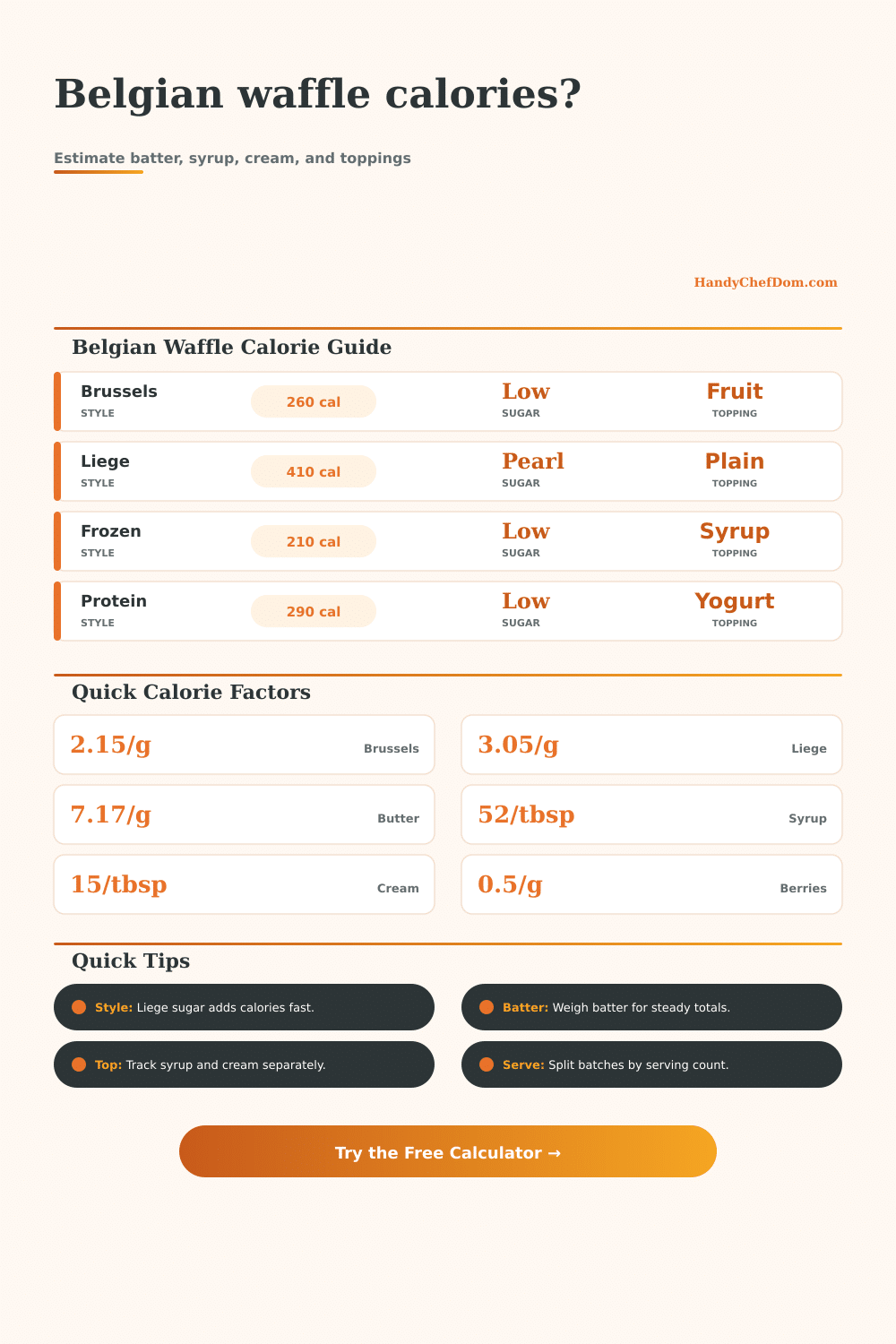
| Brussels Belgian | 2.15 | 120 g each | 250-320 each |
| Liege Belgian | 3.05 | 110 g each | 380-520 each |
| Buttermilk Belgian | 2.35 | 125 g each | 300-430 each |
| Protein Belgian | 2.05 | 135 g each | 280-410 each |
| Mini Belgian | 2.30 | 55 g each | 120-210 each |
| Frozen Belgian | 2.75 | 75 g each | 190-260 each |
| Diameter | Grid depth | Batter guide | Use in calculator |
|---|---|---|---|
| 4 inch | 0.6 inch | 45-65 g | Mini boards |
| 6 inch | 0.8 inch | 85-110 g | Light brunch |
| 7 inch | 1.0 inch | 110-140 g | Classic Belgian |
| 8 inch | 1.1 inch | 145-180 g | Deep stack |
| 9 inch | 1.2 inch | 180-230 g | Dessert plates |
| 10 inch | 1.4 inch | 240-310 g | Share waffle |
| Topping | Measure | Calories | Belgian waffle note |
|---|---|---|---|
| Maple syrup | 1 tbsp | 52 cal | Deep pockets hold more |
| Whipped cream | 1 tbsp | 15 cal | Light swirl |
| Fresh berries | 100 g | 50 cal | Good volume |
| Powdered sugar | 1 tbsp | 30 cal | Small dusting |
| Chocolate drizzle | 2 tbsp | 110 cal | Dessert topping |
| Ice cream | 1 scoop | 140 cal | High impact |
| Scenario | Waffles | Serving split | Planning note |
|---|---|---|---|
| Solo cafe plate | 1 | 1 serving | Count every topping |
| Brunch pair | 2 | 2 servings | Syrup often doubles |
| Family brunch | 6 | 4 servings | Use batch batter |
| Mini waffle board | 12 | 6 servings | Small add-ins add up |
| Dessert bar | 10 | 10 servings | Track cream and scoops |
| Freezer tray | 8 | 8 servings | Log toppings later |
Each time you attempt to cook up some Belgian waffles there’s a certain point at which food goes from safe to dangerous. That happens when you grab the syrup bottle. Until this point, you’re simply melting butter and pouring batter. Afterward, you’re not preparing breakfast, but building a sugar delivery system. In some cases, it takes only a couple of tablespoons to distinguish between a respectable brunch plate and something requiring a post-meal nap.
And that’s when that calculator becomes your truest friend. It removes the delusion that we’re dealing with an innocent carb and reveals what we’re actualy feeding our bodies. And most think that the point of the waffle is the waffle. Wrong.
How to Count Waffle Calories
The basic waffle batter are a given. It could be the dense Liege-dough variety studded with melting pearls of sugar or the airy Brussels style. This establishes the baseline, sure. But who cares? You know what a seven-inch waffle looks like, and you know its general calorie range. If you’re going by eyesight alone, you’ll guess pretty close.
So what does make all the difference? What makes the waffles different is what you do up top. The waffle grid, those deep grooves, are there for a reason: they’re made to hold stuff. They hold stuff in their pockets.
This includes stuff like pure maple syrup, which adds about fifty calories per tablespoon to whatever you were eating before. Sounds reasonable, right? Except when you start pouring and suddenly find yourself adding four or five tablespoons into each crevice. Now the topping’s more than doubled the calories of what’s already cooked in the iron work.
That’s why measuring your batter is far more important than you’d expect. Eyeballing your ladle mean guesswork. One scoop might be eighty grams of batter. Next time, it’s two ounces. And after plugging in your measured weights, the tool does the math for you. No longer do you have to convert and fiddle with coefficients or even worry about guesses. Because you’re forced to get right about the base before adding the chaos of toppings. What are you starting from? What are you building upon? Know that and you’ll know how much of that is necessary and how much extra can be omitted.
With a Liege waffle, you already know it’s going to be sweet and dense. The pearl sugar burns within the dough, giving the waffle pockets of concentrated sweetness; no need for added syrup. There’s no reason to treat your Liege waffle as an empty canvas and drown it in syrup.
Also note how the fat alters the equation. Yes, butter makes everything taste better, but it adds massive amounts of energy density. Melted butter will make this dish higher in calories then a neutral oil swap (though it’ll change the taste profile). To really save the day with calories, we need volume.
Fresh berries add a pop of acidity that cuts right through the richness of the waffle. They also add some textural contrast. Adding a hundred grams of fresh raspberries or strawberries doesn’t do much to the overall count, but physically there’s a lot more on the plate. That’s where the fullness trick comes in: Even when the energy load is reduced, you feel as if you’re eating more because there is more there.
Whipped cream is another animal entirely. Though it looks airy, it’s mostly just fat and sugar. A light swirl is okay. A mountain is not.
The math quickly goes messy if you’re feeding a crowd. Twelve mini waffles laid out on a board don’t look like much. And each one doesn’t seem so bad. Then everyone helps themselves to three. Then they add a dollop of cream and a drizzle of chocolate, and the batch number skyrockets. The page’s reference table show how quickly little add-ins add up in a group. Sure, a teaspoon of chocolate drizzle may not sound like much, for one waffle. But times ten?
Don’t get me wrong; we’re still going to eat waffles. Waffles are good. But we need to manage the variables. Want more whipped cream? Cut down on the syrup. More ice cream? No butter in the batter. We’re going to get our breakfast fix AND be happy about it if we understand just how much we’ll give up for that initial bite.
So begin with batter weight. Measure out that syrup. And let’s keep in mind that the grid isn’t a recommendation, but rather a container.