🥣 Yogurt Egg Substitute Calculator
Replace eggs with plain, Greek, dairy-free, or skyr yogurt in muffins, cakes, pancakes, and quick breads while keeping batter moisture balanced.
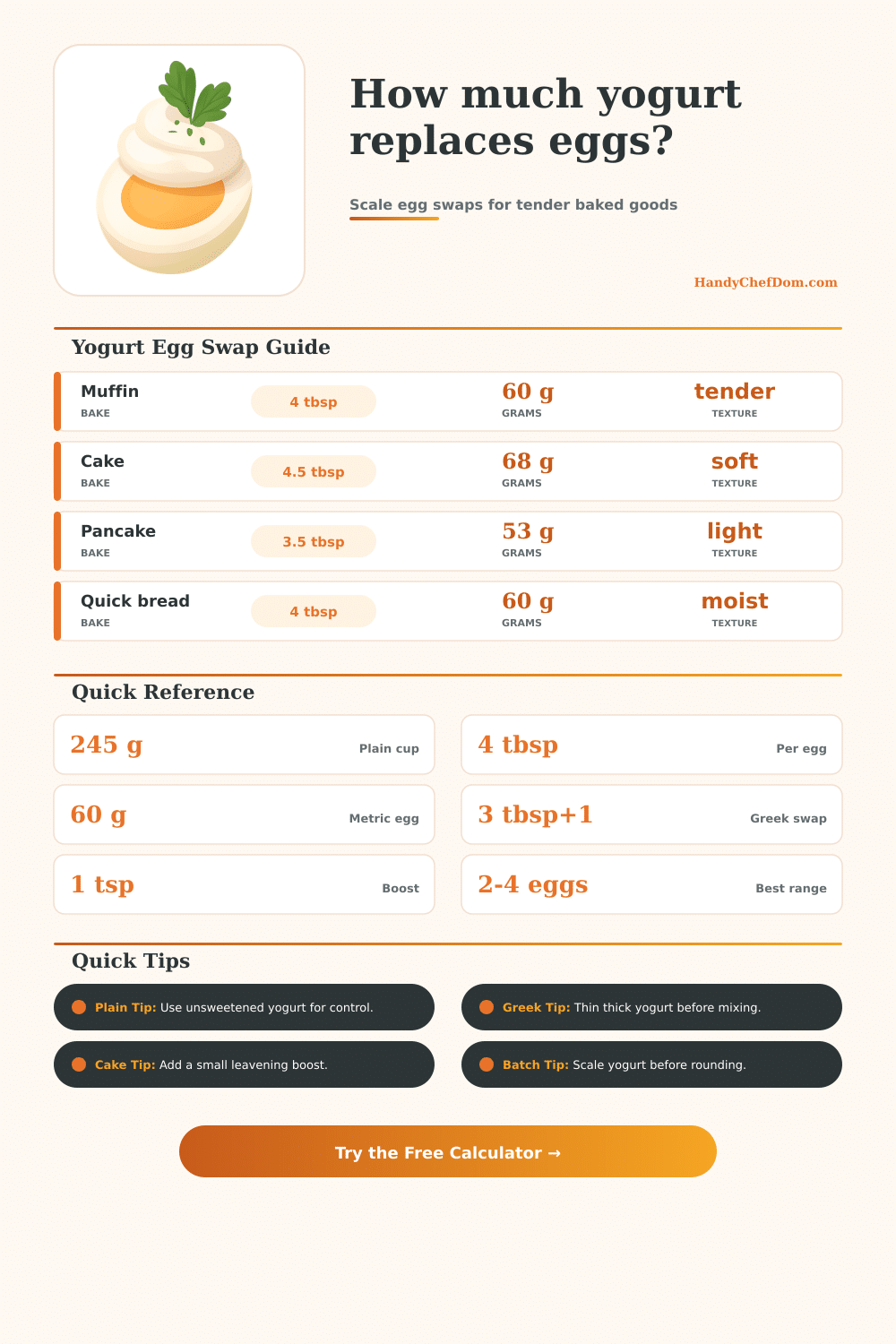
Use 1/4 cup plain yogurt as the standard egg swap, then use the calculator to adjust for Greek yogurt thickness, recipe style, egg size, and batch scaling.
| Baked Good | Yogurt Per Large Egg | Best Yogurt | Moisture Note |
|---|---|---|---|
| Muffins | 4 tbsp or 1/4 cup | Plain whole milk | Balanced moisture for domed, tender muffins. |
| Layer cake | 4.5 tbsp | Plain or low-fat | Slightly more yogurt helps softness when eggs are removed. |
| Pancakes | 3.5 tbsp | Plain or low-fat | Less yogurt keeps batter pourable and light. |
| Quick bread | 4 tbsp or 1/4 cup | Whole milk or Greek thinned | Good for banana bread, pumpkin bread, and loaf cakes. |
| Brownies | 3 tbsp | Greek or plain | A smaller swap keeps brownies dense instead of cakey. |
| Cornbread | 3.75 tbsp | Plain whole milk | Works with a small leavening boost for lift. |
| Yogurt Type | Weight Per Tbsp | Calculator Adjustment | Best Use |
|---|---|---|---|
| Plain whole milk | 15 g | Baseline | Muffins, cakes, and quick breads. |
| Plain low-fat | 15 g | Add 3 percent volume | Pancakes and lighter batters. |
| Greek yogurt | 17 g | Use less yogurt, add thinning liquid | Cakes, quick breads, and brownies. |
| Nonfat Greek | 17 g | Use less yogurt, add more liquid | High-protein batters needing moisture help. |
| Skyr style | 18 g | Use less yogurt, thin well | Sturdy loaves and snack cakes. |
| Dairy-free | 14 g | Add 5 percent volume | Vegan-style muffins and pancakes. |
| Vanilla yogurt | 15 g | Reduce added sweetener if needed | Sweet cakes and breakfast bakes. |
| Strained homemade | 18 g | Treat like Greek yogurt | Dense batters with extra liquid available. |
| Eggs Replaced | Plain Yogurt | Greek Yogurt Plus Liquid | Metric Plain Yogurt |
|---|---|---|---|
| 1 egg | 4 tbsp or 1/4 cup | 3.5 tbsp yogurt + 0.5 tbsp liquid | 60 g |
| 2 eggs | 8 tbsp or 1/2 cup | 7 tbsp yogurt + 1 tbsp liquid | 120 g |
| 3 eggs | 12 tbsp or 3/4 cup | 10.5 tbsp yogurt + 1.5 tbsp liquid | 180 g |
| 4 eggs | 16 tbsp or 1 cup | 14 tbsp yogurt + 2 tbsp liquid | 240 g |
| 6 eggs | 24 tbsp or 1 1/2 cups | 21 tbsp yogurt + 3 tbsp liquid | 360 g |
| 8 eggs | 32 tbsp or 2 cups | 28 tbsp yogurt + 4 tbsp liquid | 480 g |
| Moisture Situation | What To Do | Leavening Cue | Texture Result |
|---|---|---|---|
| Thick Greek yogurt | Add 1/2 to 1 tbsp milk per egg | 1/4 tsp baking powder per egg | Soft crumb without heavy batter. |
| Very wet fruit batter | Use the sturdy target or reduce 1 tbsp liquid | Standard boost | Prevents gummy quick bread slices. |
| Pancake batter | Use 3.5 tbsp yogurt per egg | High-rise boost if batter sits | Pourable batter with light lift. |
| Cake batter | Use 4.5 tbsp yogurt per egg | High-rise boost | Better tenderness after egg removal. |
| Dairy-free yogurt | Use a smooth, unsweetened style | Standard boost | Moist crumb with mild flavor. |
| Four or more eggs | Replace gradually when possible | Check lift needs | Best for dense cakes or quick breads. |
Banana bread. Your recipe requires 3 eggs, but all you’ve got is flour and yogurt in fridge. It’s one of the most popular kitchen improvisations to swap dairy for eggs. If you’re panicking that you can’t pull it off, don’t worry. You’re not alone.
But it’s also one of the least understood swaps. And here’s the rub: Most times, yes, it will work, but rarely because yogurt itself doesn’t do the trick. Yogurt add moisture and acidity. However, it provides no protein network to catch air as batter is mixed. That is where an egg adds structure, along with moisture and lift.
How to Replace Eggs with Yogurt in Baking
That means you’ll need to approach the recipe different, from how much of each ingredient you use right down to how you mix the batter, and what kind of result you expect when the oven door finally swings open. The quarter cup rule is what most home baker are familiar with: Just substitute four tablespoons of plain yogurt for each large egg in your recipe. Because standard whole milk yogurt has about the same amount of water as yolk end of an average egg, it’s a good starting point.
But baking is all about exceptions: Change the type of bread you’re making or change brand of yogurt, and that quarter cup rule falls apart. Regular yogurt goes through straining, which removes some of its water and leaves behind more solids then regular yogurt. When baked, using the same volume of Greek yogurt as plain would result in gummy, dense muffins; the batter is simply too thick to rise correctly.
Once you choose the type of yogurt, the calculator take care of the rest, including additional liquid required to thin out those thicker cultures. So no guessing if you’ll need milk or water; the tool accounts for different thickness and keeps your batter pourable.
Then think of what kind of texture you want: Is it going to be something like a delicate layer cake, which needs more yogurt per egg to stay tender, or a hearty quick bread? A stiffer muffin or cornbread will tolerate less moisture; follow those subtleties, and you won’t have a rubbery crust or a sunken middle. And it all makes sense when you see the reference tables on the page, which explain why pancakes needs less yogurt to stay light while brownies need even less to remain dense. It’s a balance of wet and dry ingredients (not too much flour or it becomes glue). But just enough to hydrate without making glop.
Then there’s acidity: Yogurt will be tangy enough to react with the baking soda more aggressively than neutral egg whites would. The chemical reaction produce those little carbon dioxide bubbles, which aid your cake rise, without its egg proteins. Do you add too much extra baking powder or soda to make up for lost eggs? You’re left with a metallic taste. Depending on whether you’re making a simple loaf vs. A high-rise cake, the tool advise on how much of a leavening boost you’ll need. It is a small detail, but it matters when you are trying to get exact rise an original recipe requires.
Most subs fall apart at scale-up: when double-baking something like pancakes, multiplying just the yogurt volume won’t compensate for how extra yogurt will affect total weight of the batter. With the calculator, you can enter in batch multipliers so that it doesn’t matter if you’re preparing two muffins or twenty, your moisture ratios stays the same. This means you should of not add too much liquid because you think the yogurt was thick for two muffins, only to find it acts differently in a large batch.
But at the end of the day, it’s not as much about being precise with the swap; it’s about having the power, or knowing when to flex your baking muscle (or lack thereof) to account for what you’re replacing. If you have an idea of how much moisture and tanginess different types of yogurt bring to a recipe, adjust your leaveners accordingly to account for change in acidity (and don’t forget to keep an eye on the total wet-to-dry ratio).
We aren’t trying to pass off dairy-heavy treats as something else entirely; we want a good loaf of banana bread, one that just so happens to feature yogurt instead of eggs. Use the baseline amounts as a guide, tweak according to consistency of your yogurt, and let the chemistry take care of the rest.