🥜 Pistachios Protein Calculator
Estimate protein, calories, fat, and fiber from shelled kernels, in-shell pistachios, cups, grams, ounces, pounds, or recipe portions.
Choose how you measured the pistachios. For in-shell amounts, the calculator converts shell-on weight to edible kernels before estimating nutrition.
| Measurement | Shelled weight | Protein | Calories | Best use |
|---|---|---|---|---|
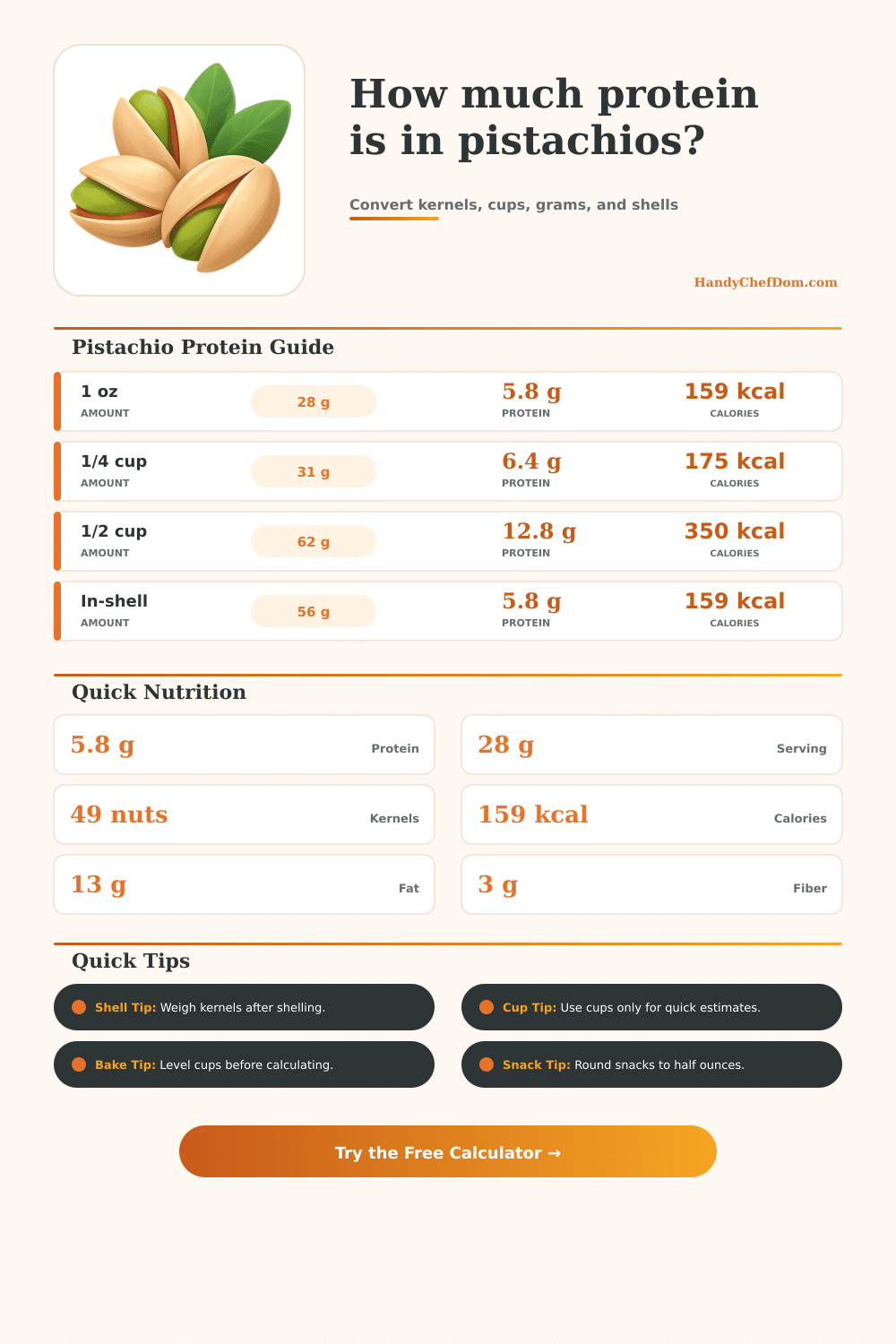
| 1 ounce kernels | 28 g | 5.8 g | 159 kcal | Single snack pack |
| 1/4 cup kernels | 31 g | 6.4 g | 175 kcal | Baking or topping |
| 1/2 cup kernels | 62 g | 12.8 g | 350 kcal | Recipe ingredient |
| 1 cup kernels | 123 g | 25.4 g | 696 kcal | Large baking batch |
| 49 kernels | 28 g | 5.8 g | 159 kcal | Counted snack |
| 2 ounces in-shell | 28 g edible | 5.8 g | 159 kcal | Shell-on bowl |
| Pistachio label | Protein/28 g | Calories/28 g | Fat/28 g | Fiber/28 g |
|---|---|---|---|---|
| Dry roasted kernels | 5.8 g | 159 kcal | 12.9 g | 3.0 g |
| Raw green kernels | 5.7 g | 158 kcal | 12.6 g | 2.9 g |
| Salted roasted kernels | 5.8 g | 160 kcal | 13.0 g | 3.0 g |
| Unsalted roasted kernels | 5.8 g | 159 kcal | 12.8 g | 3.0 g |
| Chopped baking pistachios | 5.8 g | 159 kcal | 12.9 g | 3.0 g |
| Slivered pistachios | 5.8 g | 159 kcal | 12.9 g | 3.0 g |
| In-shell roasted pistachios | 5.8 g edible | 159 kcal | 12.9 g | 3.0 g |
| Ground pistachio meal | 5.7 g | 160 kcal | 13.1 g | 2.9 g |
| Scenario | People | Shelled kernels | Protein total | Portion note |
|---|---|---|---|---|
| Light dessert topping | 4 | 56 g | 11.6 g | 14 g each |
| Snack packs | 6 | 168 g | 34.8 g | 1 oz each |
| Meal prep bowls | 8 | 224 g | 46.4 g | 28 g each |
| Cookie baking batch | 12 | 123 g | 25.4 g | 1 cup chopped |
| Party shell bowl | 16 | 448 g edible | 92.8 g | 2 oz in-shell each |
| Trail mix batch | 20 | 560 g | 116.0 g | 28 g each |
| Conversion | Kernel weight | Ounce equivalent | Cup equivalent | Kernel count |
|---|---|---|---|---|
| Small topping | 14 g | 0.5 oz | 0.11 cup | 25 kernels |
| Standard snack | 28 g | 1.0 oz | 0.23 cup | 49 kernels |
| Quarter cup | 31 g | 1.1 oz | 0.25 cup | 54 kernels |
| Half cup | 62 g | 2.2 oz | 0.50 cup | 109 kernels |
| One cup | 123 g | 4.3 oz | 1.00 cup | 215 kernels |
| One pound kernels | 454 g | 16.0 oz | 3.69 cups | 794 kernels |
Without a nutritionist having to explain it to you, you likely already know that pistachios is good for you. They’re full of protein, have a satisfying snap when you eat them and their bright green color are a sign that they’re fresh. However, due to the wildly different density between various preparations of the nuts, the amount of protein in a serving doesn’t necessarily change at the same rate then the size of the portion. A cup of loosely-packed slivered pistachios in a bowl has many fewer nut than a cup of whole roasted ones. Even though both cups of food look like they hold the same amount, changing the cut style alone can cause your protein intake to fluctuate by several grams.
With this handy little calculator, you’ll no longer need to guess if that handful is enough for a light snack or a filling meal replacement. All you need to do is choose what kind of measurements you’d like the calculator to use and it’ll do the math for you. Most people measure pistachios by volume when they are baking, but volume is a notoriously unreliable metric for protein tracking. But as we all know, volume is an unreliable way to track protein. Why? Because it’s impossible to tell if you’ve packed the cup aggressively or not… There could be a lot more air in there than not. Chopped pistachios won’t act like whole kernels and fill out the space, leaving lots of room in the process.
How to Count Protein in Pistachios
So this tool takes the guesswork out of that by allowing you to tweak weight-per-cup depending on what shape your ingredients are in. To be exact, you can also input grams. I guess that is always the best bet anyway if you’re using food to reach fitness goals. Just keep in mind: A heaping scoop will give you a wildly different amount of protein than a level scoop.
But then there’s shelling, another wrinkle not many think about until staring down a pile of empty shells trying to figure out what on earth ended up going into their system. Because the shells add a lot of weight and no nutrition, the calculator has an option for in-shell conversion as well. By weight, a typical bag of roasted pistachios is half shell. So you’ll have to eat twice the amount printed on the bag to get the number of kernels you expected. Tweaking the edible yield percentage clarifies the disconnect between theory (the average) and reality (your particular batch). Is it particularly airy? Is it particularly dense? A little tweak to that percentage will make sure the final protein estimate lines up with reality instead of a theoretical average.
The nuts in your diet There’s more to it than simple numbers: incorporating nuts into your diet requires context. For example: pistachios have an entire amino acid profile. Odd among plant-based foods. That’s good not only because of the overall mass of protein they provide, but also quality. Combined with their fiber and healthy fat content, you’re getting a slow-burning fuel source that won’t spike your blood sugar as much as eating something high in carbs would.
To help you see what all those calories translate to in real terms (e.g., “how many grams of actual nutrients did I get?”) there’s a handy table at the bottom of page that compares the same serving size of different preparations. You’ll quickly see the amount of space each occupies compared to the actual nutrition inside. And then there is baking, which is a slightly different variable. Heat has a way of changing density (and moisture) of ingredients. When you grind up pistachios and mix them into a dough, they act less like nuts and more like flour. That alters how much liquid they will absorb and their ability to hold things together. All of which impacts the resulting texture in your baked goods.
The calculator lets you choose whether you’re using whole or chopped/silvered pistachios because these will have different nutritional values based off this form. For example, you may discover that a recipe asking for a half-cup of ground pistachio meal pack about the same amount of protein as a quarter cup of whole kernels because it’s more densely packed. Small difference, big deal if you want to get your nutrition right without wrecking dinner.
When you weigh instead of guess your portions, it’s easier to know how much is enough. If you buy in bulk, a standard package might contain multiple servings. How many times have you snacked only to find out you’ve already had more than one? Use this formula to calculate the grams of protein per serving depending on how many bags/packs/number of people you’re feeding so you distribute correctly. You’ll avoid underestimating calories if you don’t know exactly how much you’re eating. This comes in handy whether you’re dishing up a big party bowl or packing away meal containers for the week.
All told: Pistachio is a versatile food that fits equally comfortable both sweetened up inside a pastry or mixed with greens in a savory salad. They’re one of those foods where thinking about weight makes you think differently about nutrition. Instead of guessing based on eyeballing a bowlful, you can count your protein precisely by considering not only their density but also cuts, shells and packaging. Knowing exactly how much each kernel contributes will help turn what might have been a mindless nibble into a conscious nutrition decision the next time you grab that bag of green nuts.
That knowledge turns a basic snack into a smart move.