Potato Sodium Calculator
Estimate sodium for baked, boiled, mashed, or fries-style potatoes using potato count, grams, unsalted, salted, seasoned, serving count, added salt, toppings, daily sodium limit, and batch scaling.
1Potato Sodium Presets
2Potato Count, Grams, Salt, Toppings, and Serving Inputs
Potatoes are naturally low in sodium, so this calculator separates natural potato sodium from added salt, seasoning blend sodium, topping sodium, and serving math. Use grams when the potatoes are already cut, mashed, or portioned.
Potato sodium result
Choose potato details, then calculate.
3Live Potato Sodium Snapshot
4Potato Type and Natural Sodium Grid
| Potato type | Typical edible weight | Natural sodium | Sodium per 100 g | Best calculator entry |
|---|---|---|---|---|
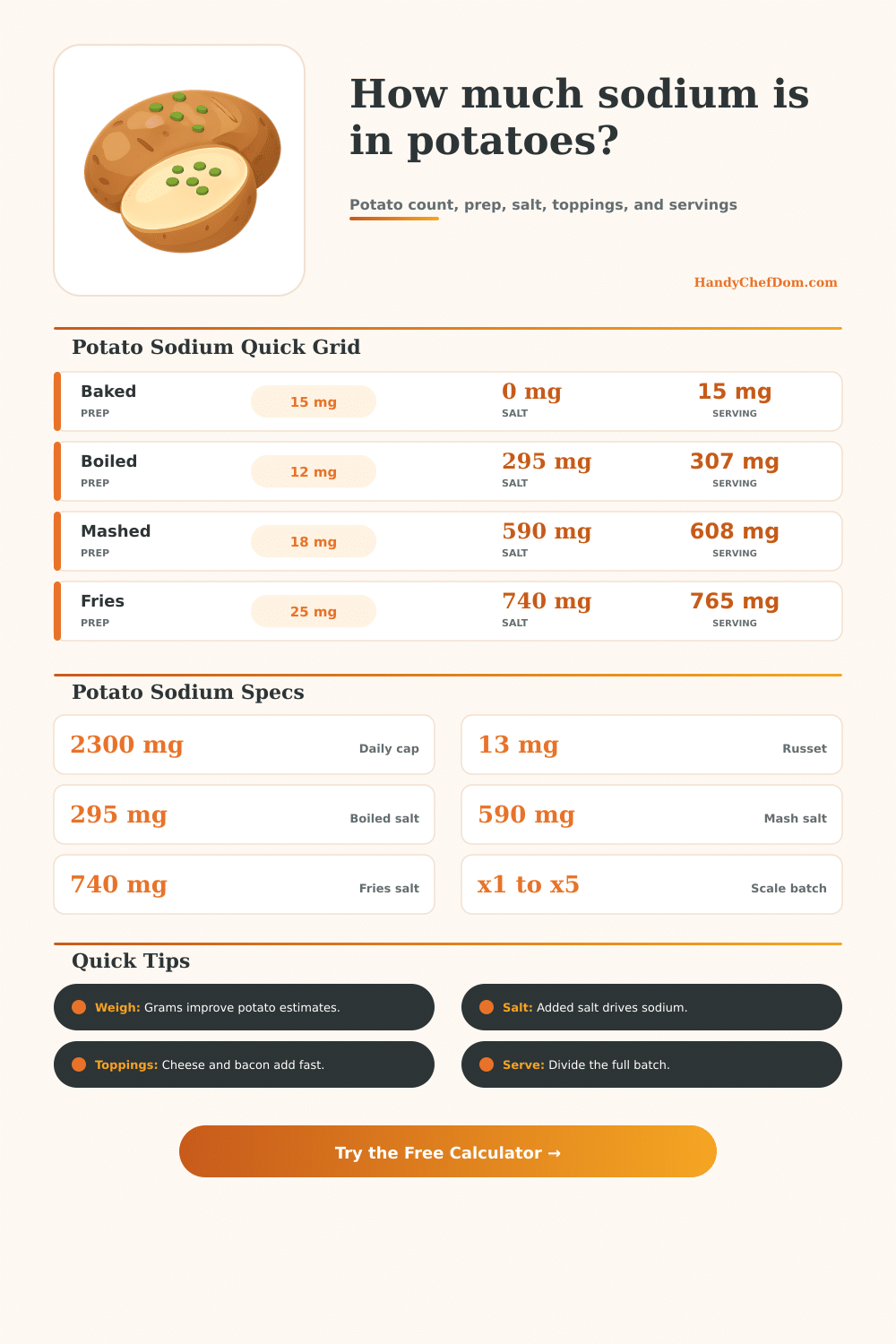
| Medium russet potato | 173 g each | About 13 mg | About 8 mg | Count mode for baked potatoes. |
| Large russet potato | 299 g each | About 22 mg | About 7 mg | Count mode for big steakhouse potatoes. |
| Medium Yukon gold | 148 g each | About 10 mg | About 7 mg | Count or gram mode for mash. |
| Medium red potato | 170 g each | About 12 mg | About 7 mg | Count mode for boiled sides. |
| Baby potato | 35 g each | About 3 mg | About 8 mg | Count mode for trays and salads. |
| Medium sweet potato | 130 g each | About 41 mg | About 32 mg | Count mode for baked sweets. |
| Frozen fries portion | 85 g portion | About 250 mg | About 294 mg | Gram mode or portion count. |
| Prepared instant mash | 140 g portion | About 320 mg | About 229 mg | Known sodium or gram mode. |
5Potato Prep, Salt, and Sodium Grid
| Prep style | Unsalted reading | Lightly salted | Salted profile | Seasoned profile |
|---|---|---|---|---|
| Baked or roasted | Natural potato sodium only | About 1/8 tsp salt per 4 servings | About 1/4 tsp salt per 4 servings | About 300 mg seasoning per batch |
| Boiled potatoes | Natural potato sodium only | About 1/4 tsp retained per pot | About 1/2 tsp retained per pot | About 500 mg herb-salt blend |
| Mashed potatoes | Natural potato sodium plus dairy if entered | About 1/4 tsp salt per batch | About 1 tsp salt per batch | About 700 mg seasoning per batch |
| Fries or wedges | Natural potato sodium if homemade unsalted | About 1/4 tsp salt per tray | About 1/2 tsp salt per tray | About 900 mg seasoned coating |
6Topping Sodium Reference Table
| Topping pattern | Portion used by calculator | Sodium per portion | How it changes the result |
|---|---|---|---|
| No salty topping | One empty topping slot | 0 mg | Shows potato and salt sodium only. |
| Butter only | One tablespoon salted butter | 90 mg | Small but visible on plain baked potatoes. |
| Sour cream | Two tablespoons | 20 mg | Usually lower than cheese or bacon. |
| Cheddar cheese | One ounce shredded | 180 mg | Often doubles a plain baked potato result. |
| Bacon and cheddar | One bacon-cheese topping set | 520 mg | Can dominate loaded potato sodium. |
| Gravy or sauce | Quarter cup | 360 mg | Adds quickly to mash or fries. |
| Chili topping | Half cup | 480 mg | Turns a potato into a meal-level sodium entry. |
| Custom topping | Label value entered | User value | Best for packaged sauces and leftovers. |
7Serving, Daily Limit, and Batch Scaling Table
| Scenario | Batch sodium | Servings | Per serving | Percent of 2300 mg |
|---|---|---|---|---|
| Four plain baked russets | About 52 mg | 4 servings | About 13 mg | About 1% |
| Four salted baked potatoes | About 642 mg | 4 servings | About 161 mg | About 7% |
| Boiled side with 1/2 tsp salt retained | About 1228 mg | 6 servings | About 205 mg | About 9% |
| Mashed potatoes with 1 tsp salt | About 2430 mg | 8 servings | About 304 mg | About 13% |
| Seasoned fries tray | About 1850 mg | 4 servings | About 463 mg | About 20% |
| Loaded baked potato plate | About 1096 mg | 2 servings | About 548 mg | About 24% |
8Calculator Mode Comparison
Best for baked potatoes, baby potato trays, and simple planning when each potato is still whole.
Best for boiled chunks, mashed potatoes, fries, leftovers, and any batch already cut or cooked.
Best when you want to fit a per-serving sodium goal by backing into available added salt.
Best for frozen fries, instant mash, packaged sides, or recipes with a listed sodium total.
9Two Practical Potato Sodium Tips
If you think that a simple baked russet potato doesn’t have any sodium, well…you’d be wrong, though impressively so. Naturaly, there’s some sodium in this potato… Thirteen milligrams in a medium potato. Not much for something you consume every day.
And where’s the risk? The risk is in the potato, or rather, in what is added after it is prepared. Salt is something that we think of as an end-of-the-recipe seasoning ingredient. In fact, it’s more of a way to preserve and add texture that goes into your food well ahead of the moment when you taste it.
Why Potatoes Have More Sodium Than You Think
Natural sodium intake are separated from added loads. Typically, consumers tend to finger-point at the spud rather than the cheese, butter, or fry coating. By forcing us to consider every source separately, the calculator change how we see the dish.
If you roast potatoes with oil and sprinkle them with salt, that’s one thing. If you boil potatoes in salty water, some of the sodium remains in the water and enters the potato, while most is left behind in the cooking water if you drain it well. Roasting concentrates flavors, but when you boil potatoes, some sodium penetrates while much stays in the water. Because our calculator take this into account, you can consider the extent to which you drain the water from your boiled-potato pot. It seems like a minor point, yet it explains why otherwise identical dishes would have slightly different sodium levels based off how they are prepared.
Where things get crazy is with toppings. Even one ounce of shredded cheddar cheese almost doubles the sodium of the potato underneath it. Before you sprinkle on any salt, bacon plus cheddar can drive one serving more than 1/5th (20%) of your maximum sodium consumption for the day. As the reference table demonstrates, what’s optional can be major when it comes to your overall sodium load. For those following a sodium regimen for health purposes, the topping row is as crucial as counting potato.
There’s another issue with batch scaling that most home chefs don’t consider: You probably never measure when doubling a recipe; instead, you simply double the salt out of habit, or whatever else. Then you split the increased portion back down into servings and are suddenly shocked by how much more sodium is in one serving now. To make matters worse, if you forget to halve everything else but keep splitting those portions evenly, suddenly you’ve got a tray big enough for a party but every bite pack double the punch. However, the tool does the math for you and makes sure your portion sizes scales to match the ingredients, so that even when you’re making double mashed potatoes, you’ll end up with the same amount per serving that you’d get from the original half-portion.
For example, using a different variety of potato doesn’t save you much. Sure, a russet might have a bit less natural sodium than a sweet potato, but that’s nothing compared to whatever else you’ll be adding to it later on. The other knob to turn here is the salt profile selection. With options like “seasoned,” “lightly salted” and “unsalted,” you can dial up whichever blend best matches whatever kind of cooking you’re trying to do; no need to try everything at home yourself. It becomes planning ahead instead of reacting, and you get an idea of just how far above (or below) your threshold you are at any given time.
Sodium isn’t something to deprive yourself of so much as be aware of. After all, the spud is innocent… It’s our vehicle for adding processed fats and salts that makes this humble side dish a nutritional obstacle. When we break things down piece by piece, we take back our power of deciding what we put in our mouths. We begin to recognize salt as a variable, not a given in food preparation, that we have the power to modify. And that’s worth far more than a list of recipe tips you should of seen earlier.