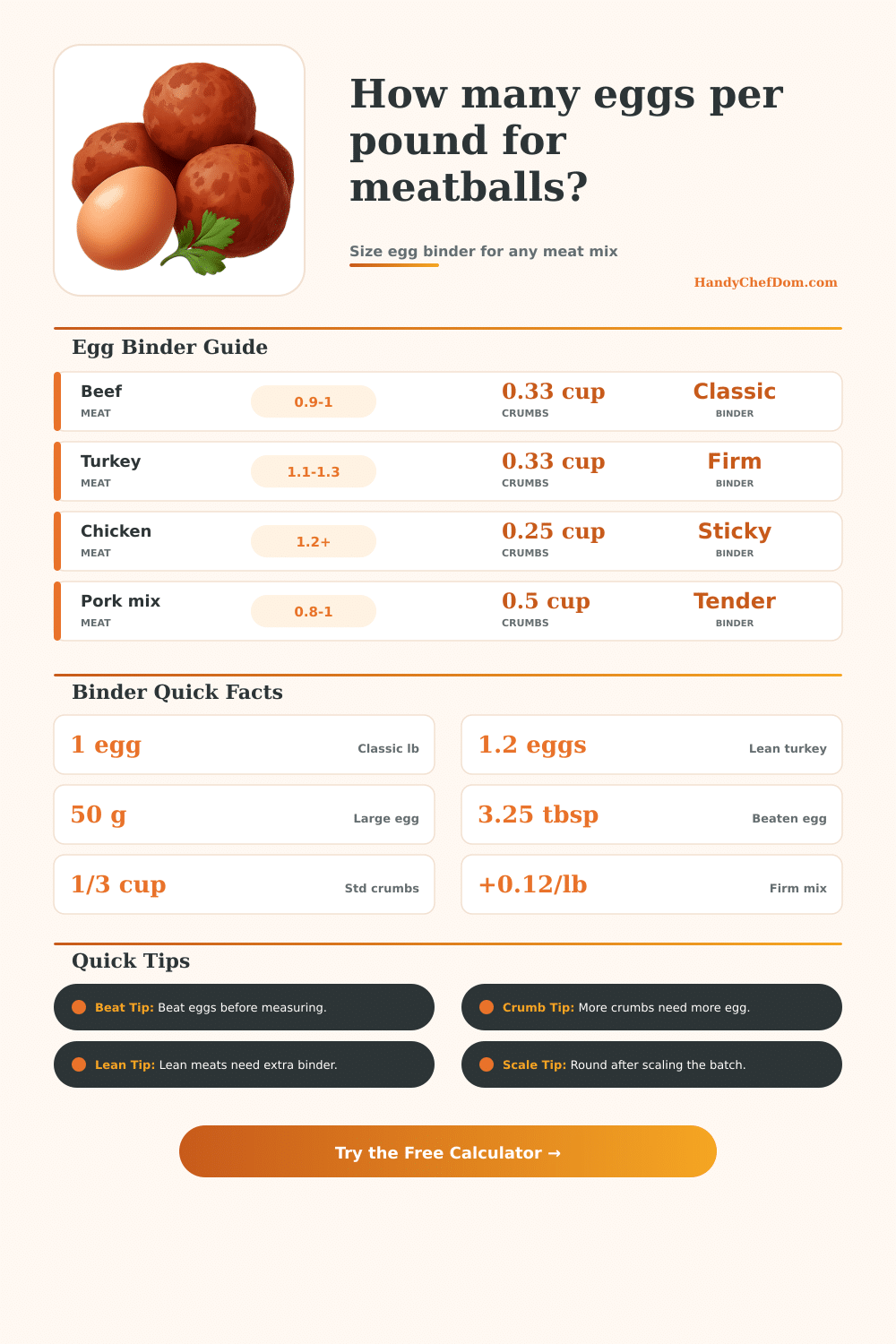
🥚 Eggs Per Pound for Meatballs Calculator
Estimate the egg binder amount for ground meat batches by meat type, crumb load, moisture level, meatball style, and batch scale.
Use the display unit to interpret the meat weight field. Breadcrumbs stay as cups per pound because meatball binder formulas are usually scaled from that kitchen measure.
| Meat type | Base large eggs per lb | Binder note | Best adjustment |
|---|---|---|---|
| 80/20 ground beef | 0.95 | Classic binder strength | Standard crumbs |
| Lean ground beef | 1.08 | Needs a little more hold | Add moisture first |
| Ground pork | 0.88 | Fat helps the mixture bind | Use lighter egg |
| Ground turkey | 1.18 | Lean and loose texture | Use firm binder |
| Ground chicken | 1.22 | Soft texture needs structure | Use dry crumbs |
| Ground lamb | 0.96 | Rich meat holds well | Balance crumbs |
| Beef and pork blend | 0.90 | Blend binds easily | Do not over-egg |
| Beef, pork, veal blend | 0.94 | Classic soft binder | Round gently |
| Breadcrumb setting | Cups per lb | Egg adjustment | Binder result |
|---|---|---|---|
| No added crumbs | 0.00 | -0.20/lb | Less egg needed |
| Light crumbs | 0.15 | -0.15/lb | Loose but tender |
| Lean mix crumbs | 0.25 | -0.08/lb | Light binder |
| Standard crumbs | 0.33 | 0.00/lb | Classic binder |
| Soft panade | 0.50 | +0.12/lb | Plush binder |
| Heavy crumbs | 0.67 | +0.24/lb | Firm binder |
| Extra crumbs | 0.75 | +0.33/lb | Very firm binder |
| Batch size | Classic beef eggs | Turkey eggs | Beaten large egg |
|---|---|---|---|
| 1 lb | 1 egg | 1.25 eggs | 3.25 tbsp |
| 2 lb | 2 eggs | 2.5 eggs | 6.5 tbsp |
| 3 lb | 3 eggs | 3.75 eggs | 9.75 tbsp |
| 5 lb | 5 eggs | 6 eggs | 16 tbsp |
| 8 lb | 8 eggs | 9.5 eggs | 26 tbsp |
| 10 lb | 9.5 eggs | 12 eggs | 32.5 tbsp |
| Egg size | Approx weight | Large egg equivalent | Beaten volume |
|---|---|---|---|
| Small | 38 g | 0.76 large | 2.5 tbsp |
| Medium | 44 g | 0.88 large | 2.9 tbsp |
| Large | 50 g | 1.00 large | 3.25 tbsp |
| Extra-large | 56 g | 1.12 large | 3.6 tbsp |
| Jumbo | 63 g | 1.26 large | 4.1 tbsp |
With eggs, though, most home chef use them as an afterthought, as something of a fill-in-the-blank suggestion instead of building block. Use this many here; do this with that number over there. Crack it in, and don’t give any further thought to what’s holding all that meat together, which is fat. If you are cooking a dish like lean turkey or blending multiple meats for a party tray, the dish becomes mushy on the plate. And not because of the egg; most often, it’s simply because of the ratio between the breadcrumbs/binder, and whatever moisture your particular batch happen to have.
Get that right, and mush becomes substantial. Plugging in what kind of meat you’re using and how firm you want it into the calculator above does math for you. No more guesswork about which of your slightly different lean chickens requires another 1/2 egg to hold it together. But knowing why you make these changes will keep you from wrecking a perfectly good mix even without being in front of the computer screen.
How Eggs Help Meat Stick Together
A meatball is basically an emulsion: a combination of fat, protein, starch and air. What the egg does is provide something to coagulate, which then holds everything together as it cooks. And the bread crumbs soak up any excess liquid so that the mixture doesn’t turn out too loose or greasy. Add more bread crumbs but not more egg? You’ve dried out the binder network. The structure has failed and you end up with a crumbly rather than tender result.
Most folks does this wrong. Standard eighty-twenty beef behaves very differently from leaner cuts such as ground chicken or turkey. Because beef is naturaly fatty, those muscle fibers coat themselves with fat, which creates a slick surface that helps the muscle bind. That lubrication isn’t there when we’re working with leaner poultry, which depends more on the protein structure of the egg to stick things together. The tool takes that into account, upping the baseline egg need for both chicken and turkey.
It also factors in what type of meatball you want to make. A mini-meatball has a greater surface area to volume ratio and is therefore more likely to fall apart in sauce; it needs a firmer binder. You can go easier on the loosey-goosey factor with large meatballs, since their interior will set before their exteriors breaks down.
Breadcrumbs are the wildcard ingredient. Panko is light and airy. Dry fine crumbs suck up liquid greedily. Fresh soft crumbs (like from a slice of bread) expand rapidly and provide very little structure. You can tweak your breadcrumb choice in the calculator. For example if you’re using heavy dry crumbs, the system will increase the number of eggs so that you’ve got sufficient liquid protein to soak up all those starchy crumbs. Too few egg and the breadcrumbs just turn into dry spots inside the meatball. It sounds small, but it matters for mouthfeel.
Another important factor that many home chef overlook is how moist the mix is. A wetter mixture requires fewer eggs and vice versa (add too much water, and the egg’s protein will clump excessively, making for a tough, springy mouth-feel that bites back). Too little liquid means the meat particles are going to rub up against each other with friction; some kind of lubricant, namely, binder, is necessary. Depending on the wetness of your mix, the tool will adjust to match. Just be honest about the appearance of what’s in your bowl pre-mixing: That’ll make all the difference.
But what happens when you scale up? That’s where intuition fails most. Just because your original recipe is a standard batch, it doesn’t mean doubling it means perfectly doubling the eggs. This changes with the surface area, or if you are moving from a standard batch to freezer prep. Because freezing and thawing can breakdown the delicate protein network, freezer batches may also need a bit more firmness in their binder. The calculator accounts for all this, giving a little buffer on the final number to make sure there is proper structure after temperature changes. Then it rounds out the number into actual kitchen measures (tablespoons of beaten egg vs. Quarter eggs, etc.), so there’s no estimating fractions that don’t even exist in your pantry.
Finally, there are ratios. Remember that ratios, and not dogma, are at the heart of cooking. The number table above is a place to begin… A place where you get a starting point of what will work from a chemical perspective. From there, use your fingers to determine what the mixture should feel like. It should be both pliable (soft) and yet hold its shape when gently pressed between your fingers. Too much binder = doughy consistency; too little = crumbly, which means you need to increase egg or decrease crumb. You should of used the math to make an educated guess and trust your fingers to tell you when something needs tweaking.
When it seems like things might be dry, crack open another yolk. You can’t un-set the yolk after it’s been added. But you can adjust up from there. Stop guessing. Start cooking confidently by using calculated ratio and adjusting from there.