🍎 Apple Calorie Calculator
Estimate calories, edible weight, carbs, fiber, and sugar from whole apples, peeled apples, sliced cups, or baking portions.
Choose the way you measured the apples. Whole apple mode subtracts core waste, cup mode uses sliced or diced apple weight, and baking mode shows cooked yield.
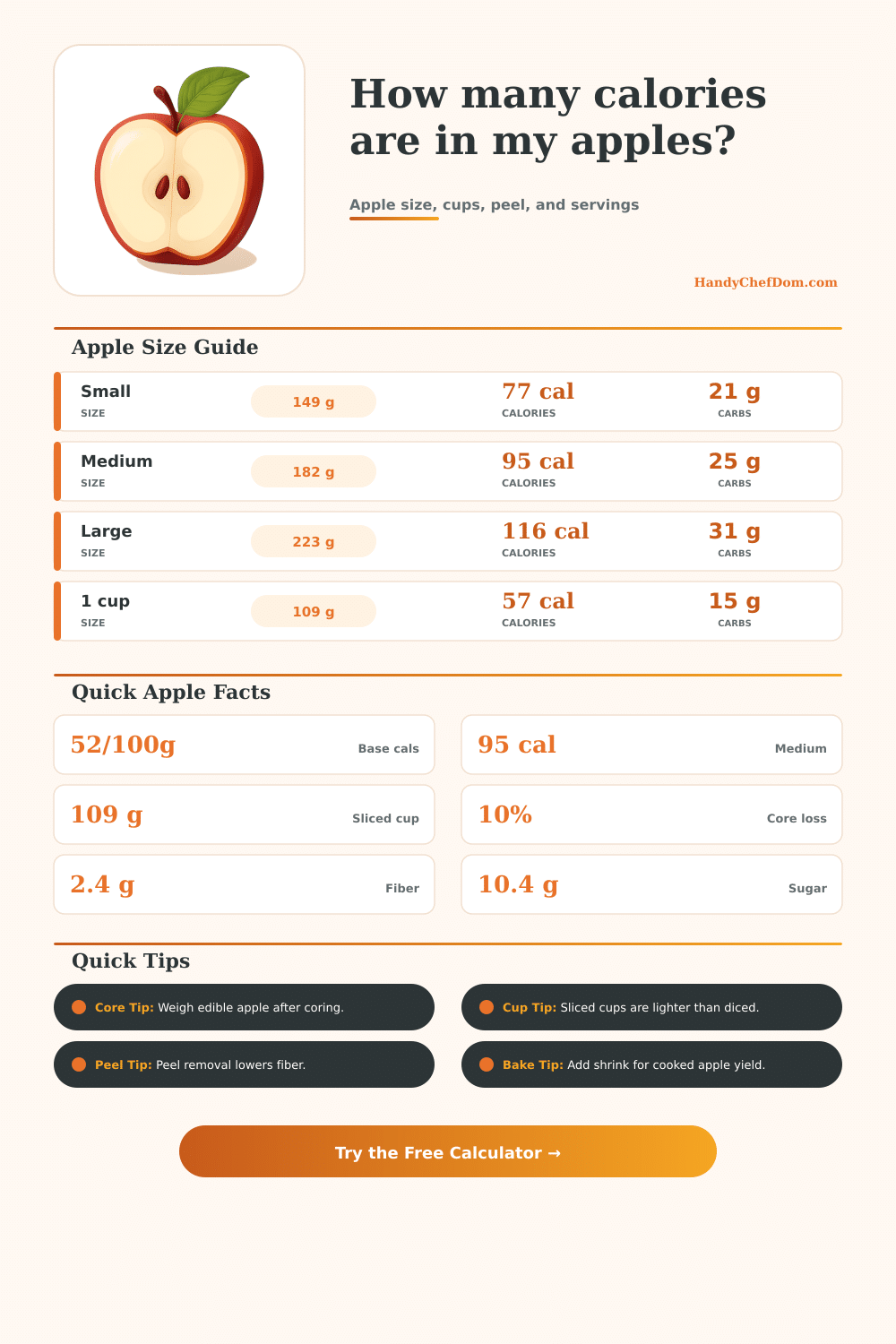
| Apple Size | Gross Weight | Edible After 10% Core | Calories With Peel |
|---|---|---|---|
| Snack apple | 120 g / 4.2 oz | 108 g | 56 cal |
| Small apple | 149 g / 5.3 oz | 134 g | 70 cal |
| Medium apple | 182 g / 6.4 oz | 164 g | 85 cal after core |
| Large apple | 223 g / 7.9 oz | 201 g | 104 cal after core |
| Extra large apple | 270 g / 9.5 oz | 243 g | 126 cal after core |
| Apple Variety | Calories | Carbs | Fiber | Sugar |
|---|---|---|---|---|
| USDA average raw apple | 52 | 13.8 g | 2.4 g | 10.4 g |
| Gala | 57 | 13.7 g | 2.3 g | 10.4 g |
| Fuji | 63 | 15.2 g | 2.1 g | 11.7 g |
| Honeycrisp | 52 | 14.0 g | 2.2 g | 10.3 g |
| Granny Smith | 58 | 13.6 g | 2.8 g | 9.6 g |
| Pink Lady | 55 | 14.4 g | 2.5 g | 10.9 g |
| Red Delicious | 59 | 14.1 g | 2.3 g | 10.5 g |
| Golden Delicious | 57 | 13.9 g | 2.4 g | 10.7 g |
| McIntosh | 52 | 13.8 g | 2.4 g | 10.1 g |
| Apple Measure | Approx Weight | Calories | Best For |
|---|---|---|---|
| 1 cup sliced raw apple | 109 g / 3.8 oz | 57 cal | Snacks, salads |
| 1 cup diced raw apple | 125 g / 4.4 oz | 65 cal | Oats, lunchbox |
| 1 cup chopped raw apple | 125 g / 4.4 oz | 65 cal | Fruit bowls |
| 1 cup grated raw apple | 110 g / 3.9 oz | 57 cal | Muffins, pancakes |
| 1 cup cooked apple pieces | 245 g / 8.6 oz | 127 cal | Warm toppings |
| 1 cup unsweetened applesauce | 244 g / 8.6 oz | 111 cal | Sauce portions |
| Portion Style | Edible Apple | Calories | Use |
|---|---|---|---|
| Toddler portion | 60 g / 2.1 oz | 31 cal | Small snack |
| Lunchbox side | 75 g / 2.6 oz | 39 cal | Half apple |
| Snack portion | 100 g / 3.5 oz | 52 cal | Everyday snack |
| Baking cup filling | 125 g / 4.4 oz | 65 cal | Raw cup prep |
| Pie slice apple share | 140 g / 4.9 oz | 73 cal | Filling share |
| Medium edible apple | 164 g / 5.8 oz | 85 cal | One cored apple |
| Applesauce cup | 122 g / 4.3 oz | 56 cal | Sauce side |
An apple is an apple (or so most think), but as we all know, most bags don’t share the full nutrition details of what gets placed in your belly. Are you grabbing a medium-sized one for a snack? The number of calories will vary greatly depending on whether you remove the skin, how large this particular piece of fruit is, and if you’re consuming it raw or as part of a baked pie.
Once you input your own measurements into the calculator above, it does the math for you (no need to guess at moisture loss and core weight here) and turns your vague estimate into exact information for your day. Here’s what matters: The numbers at the grocery counter count the entire fruit, the stem, the core, all of it! You don’t eat any of that. So if you get out your scale and just weigh the damn apple then log those calories, you’re logging inedible mass.
Why Apples Are Hard to Count
That’s why the calculator asks how you want to measure: By weight of the apple itself (or whatever you’re eating), or by its size? Because a medium-sized apple generally tips the scales at around 182 grams, but only around 10% of that is actualy edible. Take away that core, and you’ve suddenly dropped your real consumption way down. It doesn’t sound like much, but it adds up quicker then you’d think over time; especially when you’re taking regular bites of snack food every day for a few weeks.
This means that when it comes to fruit, variety matters; different types vary in their sugar content (not something most consumers are aware of). Even two apples of equal apparent size, say a Granny Smith and a Fuji, is not going to have the same number of carbs and sugar inside them. To get your count right, the calculator accounts specifically for these varieties. When calculating out the amount of Honeycrisp you’re munching on, the data used isn’t some generic average, it accounts for its special sugar profile and relative crispness. That’s useful if, for example, you’re tracking a rigid fiber target or need to maintain a steady blood sugar level.
A large percentage of that fiber is located in the skin, which is why peeled fruit has a different nutrient breakdown. You want those numbers to be accurate. The majority of the tracking mistakes occur during preparation method. The number of calories in an apple doesn’t differ when it’s sliced versus whole. But the volume of those slices won’t fit in the same cup as a whole one would. More specifically, a cup of cubes will be heavier than a cup of slices due to their tighter packing. When measuring for something like a fruit salad or some oatmeal, this wrong guess about density ruins the carb count.
To account for texture, the tool allows users to specify whether they’re grating, chopping, dicing, or slicing. Each option comes with its own weight-to-volume ratio, which impacts the end result. Small, sure. But important if accuracy is the name of the game.
There’s an added complication here: heat causes moisture loss, which means as the apples bake, they’ll release some water and shrink in size, concentrating whatever sugar and calories are left behind per gram. Raw sliced apple is about fifty-seven calories per cup. After baking, it would of taken up less space and have more calories per gram. For this reason we’ve built an adjustment to account for shrinkage. We use it to estimate the amount of moisture given off and display the actual size of your portion when it emerges from the oven. This is particularly handy with baked desserts containing cooked fillings, such as crumbles and pies. These items reduce considerably once in the oven.
Until you see it in ounces or grams, portion size always seems arbitrary. A toddler needs a smaller serving than an adult; a side of something for lunch in a box isn’t the same as a piece of that same thing for dessert at a full dinner. This tool divides up how many standard shares there are of whatever you’re looking at, and allows you to adjust the rest of your eating habits based off the information. Preparing for a party tray? Trying to only eat so many fruits each day? Having concrete numbers helps eliminate guesswork. Instead of wondering if half an apple is too much, you will know exactly what it adds to your plate.
At the end of the day, logging what you eat isn’t as much about getting perfect as it is about becoming aware. And this is where the calculator shines. It removes the guesswork about how cooking alters food. It also stops you from wondering if one food has more calories than another, or if those differences even matter. This strips the nutrition of each bite down to its bare bones.
Once you know the weight, the math handles the calories. Do whatever you want with that food once you know its weight. Eat an apple guilt-free; don’t worry if it’ll throw off your meal plans. That’s what the peace of mind is for, and it’s worth a handful of extra configuration buttons.