🍯 Honey Calorie Calculator
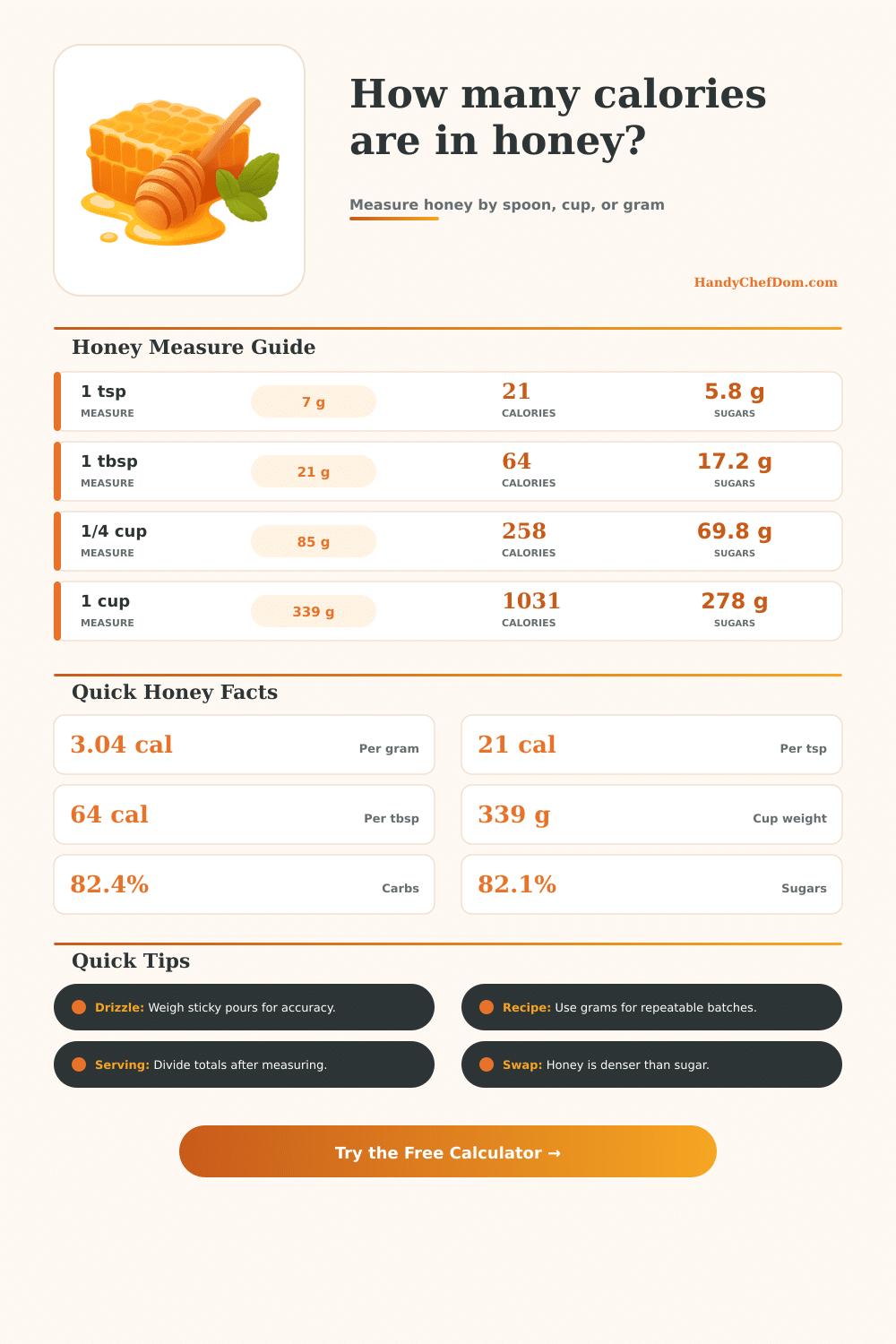
Calculate honey calories, carbs, and sugars by teaspoon, tablespoon, cup, or gram for drizzles, drinks, and recipe sweetener amounts.
Enter the honey amount you plan to use, choose spoon, cup, or gram measurement, then divide nutrition by servings for drizzle or recipe portions.
| Honey measure | Weight | Calories | Carbs | Sugars |
|---|---|---|---|---|
| 1/2 teaspoon | 3.5 g | 11 | 2.9 g | 2.9 g |
| 1 teaspoon | 7.1 g | 21 | 5.8 g | 5.8 g |
| 2 teaspoons | 14.1 g | 43 | 11.6 g | 11.6 g |
| 1 tablespoon | 21.3 g | 64 | 17.5 g | 17.4 g |
| 2 tablespoons | 42.5 g | 129 | 35.0 g | 34.9 g |
| 1/4 cup | 84.8 g | 258 | 69.9 g | 69.6 g |
| 1/2 cup | 169.5 g | 515 | 139.7 g | 139.1 g |
| 1 cup | 339 g | 1031 | 279.3 g | 278.3 g |
| Use style | Typical amount | Servings | Calories each | Best input |
|---|---|---|---|---|
| Tea sweetener | 1 tsp | 1 | 21 | Teaspoon |
| Toast drizzle | 2 tsp | 1 | 43 | Teaspoon |
| Yogurt bowl | 1 tbsp | 1 | 64 | Tablespoon |
| Oatmeal swirl | 1 tbsp | 1 | 64 | Tablespoon |
| Marinade glaze | 1/4 cup | 4 | 64 | Cups |
| Baking batch | 1/2 cup | 12 | 43 | Cups |
| Honey variety | Cal/g | Carb/g | Sugar/g | Use note |
|---|---|---|---|---|
| Clover honey | 3.04 | 0.824 | 0.821 | Everyday measuring |
| Wildflower honey | 3.06 | 0.828 | 0.824 | Floral drizzle |
| Orange blossom honey | 3.03 | 0.821 | 0.818 | Tea and fruit |
| Buckwheat honey | 3.08 | 0.831 | 0.827 | Bold recipes |
| Manuka honey | 3.05 | 0.825 | 0.822 | Spoon portions |
| Raw honey | 3.04 | 0.824 | 0.821 | General use |
| Acacia honey | 3.02 | 0.818 | 0.815 | Light drizzle |
| Creamed honey | 3.04 | 0.824 | 0.821 | Spreadable spoon |
| Sugar in recipe | Honey target | Approx spoons | Calories | Serving idea |
|---|---|---|---|---|
| 25 g sugar | 19 g honey | 2.7 tsp | 57 | Small glaze |
| 50 g sugar | 38 g honey | 1.8 tbsp | 114 | Mini batch |
| 100 g sugar | 75 g honey | 3.5 tbsp | 228 | Loaf or sauce |
| 150 g sugar | 113 g honey | 5.3 tbsp | 342 | Cake batch |
| 200 g sugar | 150 g honey | 7.1 tbsp | 456 | Large batter |
| 300 g sugar | 225 g honey | 10.6 tbsp | 684 | Batch bake |
But honey always feels like healthier option compared to white sugar. It’s naturaly! It comes from bees! But its high calorie density are hard to account for unless you have some plan in mind. One tablespoon doesn’t look like much when held in the palm of your hand, yet it pack about seventeen grams of sugar and roughly sixty-four calories. That’s more than half the recommended daily maximum added sugar (if you’re on the strict side of things).
The visual volume of sweeteners can be deceiving because liquid density varies, making visual estimates unreliable. For example, while granulated sugar weighs less per volume unit then honey, honey is also heavier than water, with one cup weighing more than 300 grams. Yet most of us don’t weigh our sweetener; we just pour by eye, further decreasing accuracy.
Why You Should Measure Your Honey
After you pick a form (teaspoons? tablespoons? cups? After you pick a form like grams, the calculator on the page do all the math for you. Because it adjusts for density automatically, there’s no need to remember any conversion factor. But here’s what you need to know: depending upon how you entered the information, the answer will differ.
For instance, if I put in one cup of honey, then you’re going to get the actual weight of that cup… Which happen to be a lot. However, if you are making a salad dressing for four person, maybe you want to know how many calories land in each individual serving. You don’t really care about the calories in a whole cup of honey. You care about the calories in a single serving. That’s where the “serving adjustment” comes into play. You tell it how much you’ve made in total, then specify how many servings that equals. Now you’ll have an accurate picture of what a serving size of anything you’re eating actualy is.
Calories don’t vary much by type of honey. There are about 3 calories per gram in clover, wildflower, or buckwheat honey. Yes, they taste different so use them where their flavor adds value. No, consuming any of these doesn’t metabolize differently in your body, though Manuka honey might hit your wallet harder since it’s more expensive. It has health benefits, but it’s not lighter on calories. You’re paying for special bioactive compounds and quality; not something lower in calories.
This is good to know so that you don’t assume unusual honeys will lower your sugar intake. They won’t. Your caloric intake come from how much you eat, not what kind you eat.
Adding another twist is replacing sugar with honey when baking. Unlike granulated sugar, which does not contain moisture, honey is wet. If you simply replace sugar with honey, your cakes will sink in the middle or be otherwise overly wet. To counteract different densities of the two sugars, the recipe table above lists suggested ratios to use, showing roughly how much to decrease or increase as needed. In most cases, honey require a smaller quantity by weight, since it’s sweeter on the tongue.
This changes the other ingredient quantities, so you’ll want to scale back on any liquids elsewhere in the recipe to maintain an appropriate texture. This is where a lot of recipes gets thrown out when people try trial-and-error. Knowing the desired quantity ahead of time means there’s no need for adding more flour (or whatever) mid-mix.
It’s not about restriction; it’s about awareness. You don’t have to avoid eating honey if you love it, but being aware of how much you’re adding, a drizzle here, a drizzle there… Helps you add it with intention. I always measure my sweetener once it’s on the food. When I eyeball it, I add more. Why? Because I can’t estimate well when it’s a gooey liquid. A spoonful… Whether measured or weighed, gives me a clue. It becomes an intentional decision instead of a guess.
And that mindset shift is what makes all the difference: from random eating to mindful eating.