🥔 Potato Calorie Calculator
Estimate calories, carbs, fiber, and potassium by potato type, size, cooked weight, skin option, and servings.
Use count and size when you do not have a scale, or enter raw, cooked, baked, or plain mashed weight directly for a tighter estimate.
| Potato Type | Calories per 100 g | Carbs per 100 g | Fiber per 100 g | Potassium per 100 g |
|---|---|---|---|---|
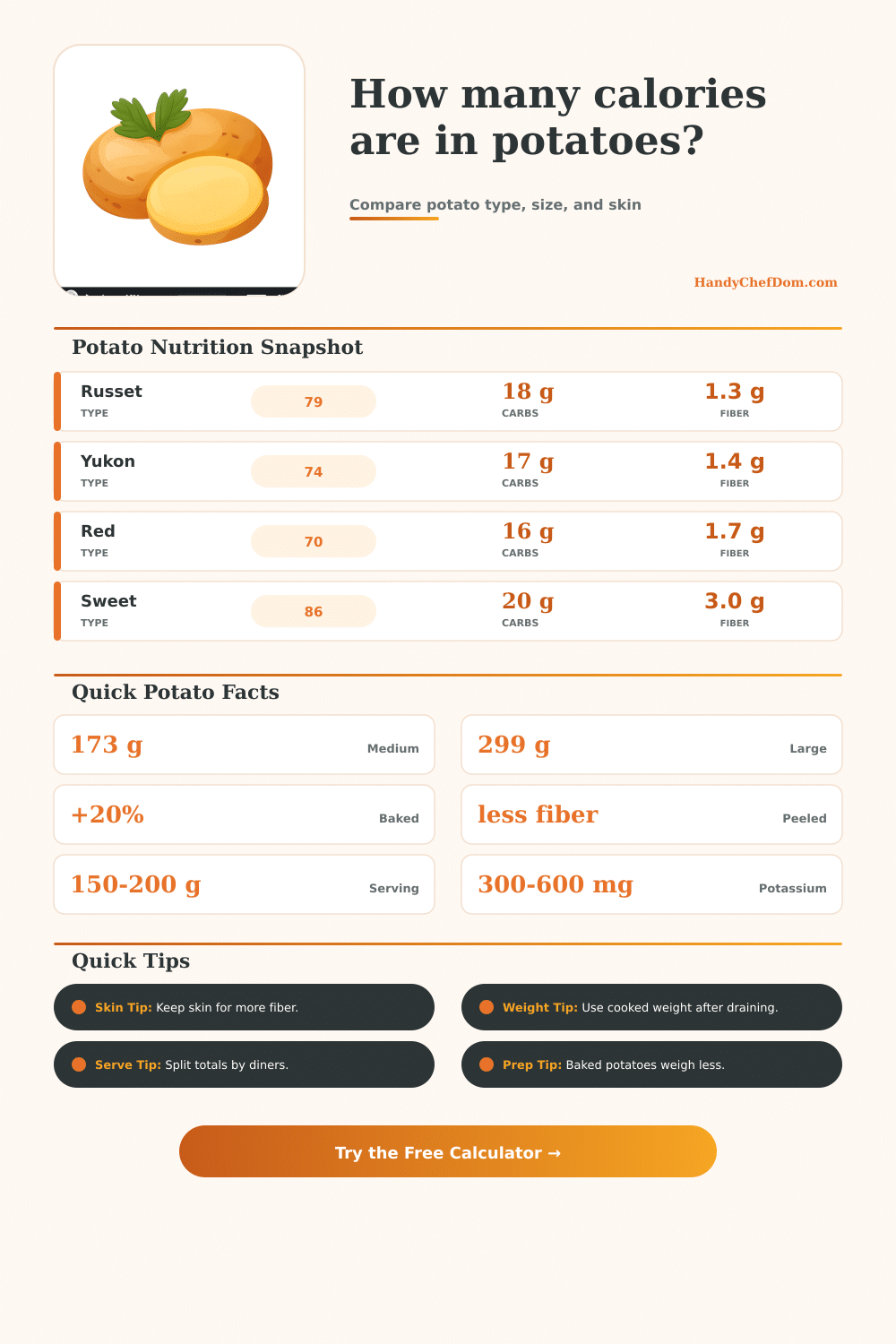
| Russet potato | 79 | 18.1 g | 1.3 g | 417 mg |
| Yukon gold potato | 74 | 17.1 g | 1.4 g | 407 mg |
| Red potato | 70 | 15.9 g | 1.7 g | 455 mg |
| White potato | 69 | 15.7 g | 2.4 g | 407 mg |
| Fingerling potato | 77 | 17.2 g | 2.2 g | 421 mg |
| Purple potato | 73 | 17.2 g | 1.8 g | 337 mg |
| New potato | 71 | 15.8 g | 1.7 g | 379 mg |
| Sweet potato | 86 | 20.1 g | 3.0 g | 337 mg |
| Potato Size | Typical Raw Weight | Ounce Estimate | Best Use | Counting Note |
|---|---|---|---|---|
| Baby or mini | 38 g | 1.3 oz | Tray sides | 5 to 6 per serving |
| Small | 110 g | 3.9 oz | Snack plate | 1 to 2 per serving |
| Medium | 173 g | 6.1 oz | Standard side | 1 per serving |
| Large | 299 g | 10.5 oz | Main potato | 1 large for hearty plates |
| Extra large baker | 369 g | 13.0 oz | Shared baker | Split for two lighter servings |
| Weight Condition | Calorie Density | Carb Density | Potassium Note | When To Pick It |
|---|---|---|---|---|
| Raw weighed | Base value | Base value | Full estimate | Before prep or batch logging |
| Boiled or steamed | About 13 percent higher | About 8 percent higher | Lower after draining | After cooking in water |
| Baked | About 20 percent higher | About 18 percent higher | More concentrated | After oven or air fryer baking |
| Plain mashed | About 16 percent higher | About 10 percent higher | Depends on draining | Plain mash without add-ins |
| Serving Goal | Weight per Person | Medium Potato Equivalent | Typical Calories | Planning Note |
|---|---|---|---|---|
| Small snack | 100 g | About 0.6 potato | 70 to 95 | Good for light plates |
| Side dish | 150 to 200 g | About 1 potato | 105 to 190 | Best everyday estimate |
| Main bowl | 250 to 350 g | 1.5 to 2 potatoes | 175 to 335 | Use for loaded potato bases |
| Buffet or event | 120 to 160 g | About 0.75 potato | 85 to 150 | Allows room for other sides |
There is a particular kind of confusion that arrives every time you hold a potato in one hand and a nutrition label in the other. A potato looks so straightforward! But then there are hidden facts: how much does it weigh? How much water is in there? How was it prepared? All of these factors make your best guess become a big mistake.
Maybe you think a boiled potato equals a baked potato because each started out with equal amounts of raw mass. Nope. Usually wrong. Tracking all these thing by hand makes this process feel like guessing in the dark. You want a tool which can adjusts for changing densities and moisture loss. After you pick your potato variety and input a crude number (or weight) it’ll do all the calculations for you, as seen in the calculator above. No need to flip through thick government databases and forget whether those red skins was peeled or not.
Why Potato Nutrition Is Hard to Guess
Depending on how you prepare your potato, it’s going to have different amounts of nutrients per gram. For example, if you bake a potato, the water inside turn to vapor in the hot oven air. You’re left with something in a smaller space with more concentrated fiber and starch. So one hundred grams of baked potato contains a lot more energy then one hundred grams of raw potato. It has less water holding it back. When you select how you want your potato prepared, the tool makes adjustments based off those changes so your final numbers are truly representative of what you eat (rather than what came home in the grocery bag).
Setting the skin is more important than many folks know. Yes, I see lots of cooks peeling their potatoes to achieve a cleaner look and perhaps a slightly smoother texture. But they’re also removing an outsized quantity of micronutrients and fiber stored immediately under potato’s thin exterior. Leaving the skin on doesn’t significantly increase calories, but it will greatly improve the nutrient density. For those tracking fiber for digestive reasons, keeping the skin on is among the simplest upgrades available. No additional steps. No recipe alteration required. A little thing, but it counts if you’re trying to hit your daily micronutrient targets via whole foods instead of supplements.
Similarly, while we lump together all those standard white potatoes as “potatoes,” the sweet potatoes behaves differently on the nutrition chart. Because they have more starch and sugars packed into denser flesh even before any cooking starts, they’re usually a bit higher in carbs (and hence calories) per hundred grams. That doesn’t mean they’re worse for you; it means they’re different. If you’re carefully managing your carbohydrate load for whatever reason, such as controlling blood sugar, you may want to adjust your serving size to match (e.g., consume less sweet potato than russet). Or maybe, if satiety matters most to you, you’ll enjoy that extra-fiber content instead. Either way, the tool makes this clear distinction between types so you can compare one against another side-by-side. There’s no guessing or relying on memory.
That’s because at-home chefs mess up primarily when it comes to estimating sizes. It’s easy to assume all potatoes are about the same (like those perfect little round balls). But there’s a huge range between a large baking russet and a small salad potato. And obviously, a big potato has more weight (and thus, calories). A medium-sized potato weighs approximately one hundred and seventy grams. When you increase to the large size range, it rockets up to almost two-hundred grams. For example, imagine you are planning meals for yourself and three roommates. If each person has one serving of whatever you make, an incorrect size preset might throw off your week-long plan. Stop your guesswork by looking at realistic weight ranges. Again, that visual intuition is unreliable when it comes to root veggies.
The other factor is the amount of water left in what’s cooked. Water will evaporate from boiling potatoes, so they pick up some water along the way but then release it while draining. That gives boiled potatoes a medium caloric density that falls somewhere in-between raw and baked. When it comes to mashed potatoes, there’s such wide variation based on whether you drain the starchy liquid or not. If you are watching calories for weight control or post-workout muscle repair, getting this detail right matters. It prevents you from slowly creeping below your true intake. And it creeps over weeks of sloppy logging. Small daily decisions add up to big long-term differences.
So all this boils down to not obsessing over every gram. Instead, fill in those blind spots so it no longer feels like you’re playing a game of “what’s in this,” where you don’t know what’s going on until you’ve eaten something. If you know the carbs and calories of the potatoes in tonight’s dinner, you won’t stress out as much over any hidden variables. You’ll make topping and portion decisions confidently. And you’ll stop seeing the veggie itself as some mysterious thing that might throw your entire day off kilter, you’ll see it as a sure bet for your next meal plan. You’ll get to enjoy the damn thing instead of wondering if that side dish just ruined your whole day. The dinner table will quiet down, and so will the numbers.